Our system will evaluate the answer based on this AI-generated description.
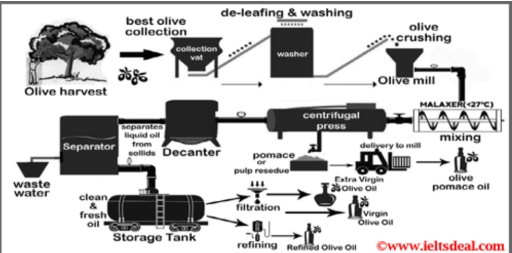
The image illustrates the detailed process of olive oil production starting with "Olive harvest," leading to "best olive collection" through mechanical means, into "collection vat" followed by "de-leafing & washing" using a "washer," then "olive crushing" occurs at the "Olive mill," processed in a malaxer at "27°C," leading to "mixing," and then separation happens via "Decanter" into "liquid oil from solids," with solids becoming "pomace or pulp residue"; liquid moves to "centrifugal press," directed towards "delivery to mill" to produce different olive oil grades: "Extra Virgin Olive Oil," "Virgin Olive Oil," and "Olive Pomace Oil"; routes excess into "separator" producing "waste water" and directs oils through "filtration" before storage in "Storage Tank" labeled as "clean & fresh oil," finalized by "refining" into "Refined Olive Oil."
Given the complexity of the image, the above description may not be entirely accurate.
Skyrocket your IELTS band score by 1-2 points in under a month with our premium plan!
Note: Both the topic and the answer were created by one of our users.
The diagram shows the process of making olive oil from different grades. The process starts with harvesting from the field and is then delivered to the factory for processing.
When arriving at the factory, the first step is selecting the best fruits and separating the leaves as well as washing them. After that, the olives are crushed and then enter the mixing stage at a temperature of 27°C and then go to the centrifugal process.
In this process, pomace or pulp residue is produced and then delivered to the pomace oil sellers. The oil that can still be processed goes to the decanter stage which then separates solids from oil and remaining water.
The last process is filtration which produces extra virgin olive oil and another process is refining which produces refined olive oil.
Word Count: 134
