Our system will evaluate the answer based on this AI-generated description.
The image displays two side-by-side diagrams titled "Solar Electricity Generation", illustrating system operation under "Sunny Conditions" and "Cloudy Conditions". In the left panel, "Sunny Conditions", a sun icon directs "Sunlight" to "Solar Panels", which supply "Direct Current Electricity" that splits into two paths: one to "Battery Storage" labeled "Battery Charging", and one to an "Inverter (Direct Current to Alternating Current Conversion)". The inverter outputs "Alternating Current Electricity", which divides to supply "Homes" and the "Power Grid". In the right panel, "Cloudy Conditions", clouds direct "Reduced Sunlight" to "Solar Panels", sending "Reduced Direct Current Electricity" to the "Inverter (Direct Current to Alternating Current Conversion)". Concurrently, "Battery Storage" supplies energy via "Battery Discharging" to the inverter. The inverter delivers "Alternating Current Electricity" to "Homes", while a dashed arrow shows potential input from the "Power Grid" to "Homes" marked "(If Required)".
Given the complexity of the image, the above description may not be entirely accurate.
Skyrocket your IELTS band score by 1-2 points in under a month with our premium plan!
Note: Both the topic and the answer were created by one of our users.
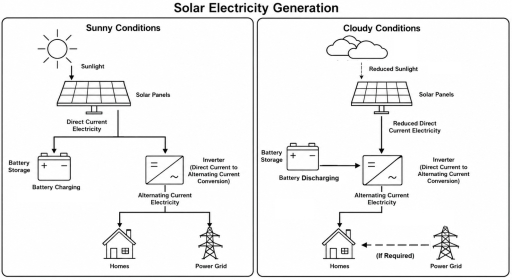
The diagrams illustrate how electricity is produced, using solar panels, during distinct atmospheric conditions. Overall, the diagram presents five possible stages of electricity transfer, with sunny conditions producing the most compared to cloudy.
On one hand, the diagram under sunny conditions starts with solar panels absorbing energy from sunlight. This energy, known as Direct Current electricity, is split and passed along to a battery storage to charge, and an Inverter. The inverter is a mechanism which converts Direct Current into Alternating Current, which allows the electricity to switch directions. This Alternating Current electricity is then sent to homes and power grids.
On the other hand, under cloudy conditions, the sun is no longer present. This decreases the amound of sunlight solar panels can absorb, which further leads to a decrease in direct current passed to the inverter. However, as the battery storage was previously supplied with sufficiant electricity, it is able to charge the inverter on its own. This is a similar case shown with the power grid, which had also been powered beforehand during sunny conditions. In the end, the inverter has the capability to send electricity to homes, and if needed, can also be supplied by the power grid.
Word Count: 201
