Our system will evaluate the answer based on this AI-generated description.
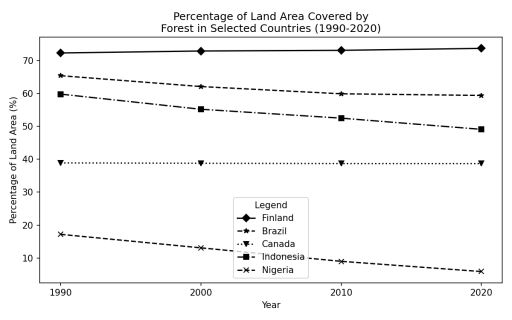
The image features a line graph titled "Percentage of Land Area Covered by Forest in Selected Countries (1990-2020)". The vertical axis is labeled "Percentage of Land Area (%)" with scale values ranging from 10 to 70 in increments of 10. The horizontal axis is labeled "Year" with points at 1990, 2000, 2010, and 2020. A box labeled "Legend" specifies five categories: Finland (solid line, diamond markers) showing ~72% (1990), ~73% (2000), ~73% (2010), and ~73.5% (2020); Brazil (dashed line, star markers) showing ~65.4% (1990), ~62% (2000), ~60% (2010), and ~59.5% (2020); Indonesia (dash-dotted line, square markers) showing ~59.7% (1990), ~55.2% (2000), ~52.4% (2010), and ~49.1% (2020); Canada (dotted line, upside-down triangle markers) showing ~38.8% across all four years (1990, 2000, 2010, 2020); and Nigeria (dashed line, x markers) showing ~17.2% (1990), ~13.1% (2000), ~9.1% (2010), and ~6.0% (2020).
Given the complexity of the image, the above description may not be entirely accurate.
Skyrocket your IELTS band score by 1-2 points in under a month with our premium plan!
Note: Both the topic and the answer were created by one of our users.
The diagram depicts the proportion of all land surfaces with forest in five various nations over 30 years.
As can be seen, Finland and Canada showed almost a constant rate of land area covered by forest, while Brazil and Indonesia showed a gradual decrease.
The percentage of forest in Nigeria reached its lowest point among all the countries.
Now, turning to details, the highest proportion that is more than 70% of the land in Finland was covered by forest in 1990 and showed a slight increase by 2020, which is the same as Canada, showing no sign of fluctuation at all. The rest of the countries showed a fall in percentage from where it started in 1990, among which Nigeria showed the rapid decrease, reaching less than 5% in 2020, which was almost 20% in the year 1990.
The decrease in the rate between Brazil and Indonesia was parallel to each other from the beginning till 2010, when both of the nations’ land area decreased by almost 10%. However, after 2020, Brazil maintained its steadiness throughout, while Indonesia showed a rapid decrease compared to Brazil, reaching less than 50%.
Word Count: 189
