Our system will evaluate the answer based on this AI-generated description.
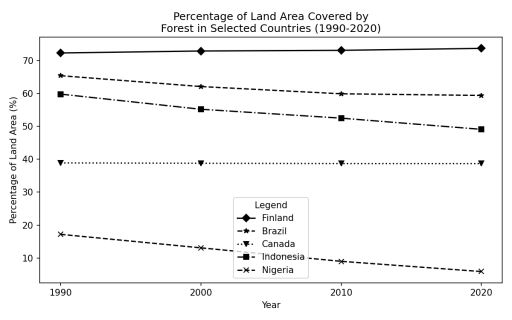
The image features a line graph titled "Percentage of Land Area Covered by Forest in Selected Countries (1990-2020)". The vertical axis is labeled "Percentage of Land Area (%)" with scale values ranging from 10 to 70 in increments of 10. The horizontal axis is labeled "Year" with points at 1990, 2000, 2010, and 2020. A box labeled "Legend" specifies five categories: Finland (solid line, diamond markers) showing ~72% (1990), ~73% (2000), ~73% (2010), and ~73.5% (2020); Brazil (dashed line, star markers) showing ~65.4% (1990), ~62% (2000), ~60% (2010), and ~59.5% (2020); Indonesia (dash-dotted line, square markers) showing ~59.7% (1990), ~55.2% (2000), ~52.4% (2010), and ~49.1% (2020); Canada (dotted line, upside-down triangle markers) showing ~38.8% across all four years (1990, 2000, 2010, 2020); and Nigeria (dashed line, x markers) showing ~17.2% (1990), ~13.1% (2000), ~9.1% (2010), and ~6.0% (2020).
Given the complexity of the image, the above description may not be entirely accurate.
Skyrocket your IELTS band score by 1-2 points in under a month with our premium plan!
Note: Both the topic and the answer were created by one of our users.
The diagram illustrates the percentage of forest-covered area in five chosen countries between 1990 and 2020.
Overall, Finland has the highest fraction of land covered by forests, staying at a plateau throughout the years. Nigeria, in contrast records the least percentage of forest-covered land with an obvious fall throughout the years.
In Brazil, the forestal area starts at roughly 65% in 1990 and mildly has a steady decrease over the years, falling to approximately 62% in 2020. Although, in Indonesia, the forestal area declines as well, it happens more drastically. Starting at 60% in 1990, the drop throughout the years remained constant, resulting with 50% of land coverage during 2020. Nigeria, has the most substantial decrease out of all countries, beginning at roughly 18% in 1990 and having a considerable fall over 30 years, culminating at approximately 4% of the area covered.
In contrast, Finland and Canada had a plateau pattern, with mild change in forestal-area coverage. Finland began at roughly 73% of area covered in forests and slightly climbed up to 75% in 2020. In contrast, Canada’s forestal coverage stayed unchanged throughout the years with 40% of total land area.
Word Count: 191
