🔥 Today Only: Save 30% on Premium — Offer Ends Soon! - Upgrade Now!
Multiple Graphs

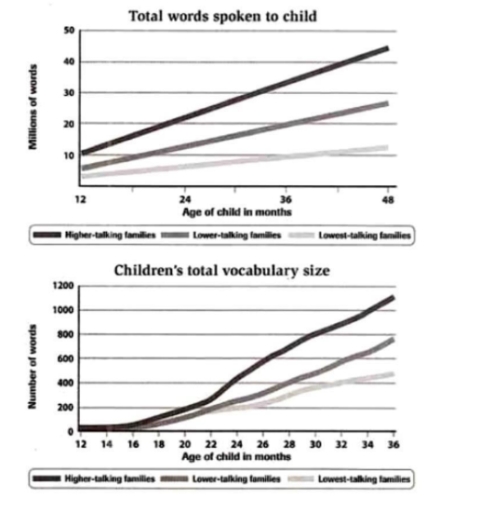
Band 4+: The graphs below give information on the number of words spoken to children in various categories of family and the size of the vocabulary of those children.

Image for topic: The graphs below give information on the number of words spoken to children in various categories of family and the size of the vocabulary of those children.
Our system will evaluate the answer based on this AI-generated description.
The image contains two line graphs; the top graph indicates "Total words spoken to child," and the bottom graph indicates "Children's total vocabulary size." In the top graph, there are three lines representing "Higher-talking families," "Lower-talking families," and "Lowest-talking families," respectively. Each line trends upward from age 12 months to 48 months for a child, indicating an increase in the number of words spoken to the child in each family category over time, with the higher-talking families consistently having more words spoken as compared to the other two groups at each measured point. No specific numerical values are provided on the y-axis, but the number of words ranges from 0 to 50 (assuming the unit is thousands). In the bottom graph, the lines trend upward from age 12 months to 36 months, representing an increase in the child's vocabulary size over time, with higher-talking families again having a consistently larger vocabulary size compared to the other two groups. The y-axis ranges from 0 to 1200 words, with values indicated at intervals of 200; all lines start at age 12 with a vocabulary size of approximately 0 words and end at age 36 with the highest-talking family line over 1100 words, the lower-talking family line near 800 words, and the lowest-talking family line close to 600 words.
Given the complexity of the image, the above description may not be entirely accurate.
Note: Both the topic and the answer were created by one of our users.

The chart shows that higher speaking families have the most significant increase of 45 million words at the age of 48 months. That is the highest digit compared to the number of words spoken by higher talking families at the age of 36 months, which is 35 million words. The higher talking families spoke 10 million words at the age of 12 months which was the least of these groups.

Compared to the lowest speaking families, the slightest words spoken to children were 3 million words at the age of 12 months. This family category experienced the lowest rises every month with a total of 9 million words over the 48 months. Whereas, lower talking families said more words (6 million words) at the age of 12 months with the highest increase of 7 million words at the age of 36 months.

On the other hand, the largest growth in a child’s vocabulary is 200 million words at the age of 24 months according to the higher speaking families. Based on the data, all three categories have been continuously increasing. At the age of 16, higher-speaking families experienced only a slight increase, amounting to 20 million words.

Unlike families with the lowest communication, who experienced a extremely smaller increase of 100 million words by 36 months. However, the greatest increase occurred at 28 months, reaching 100 million words. This section experienced a lesser growth compared to families with high communication.

Overall, these graphs have similarities and differences, especially in the family categories where families with high communication tend to experience a serious growth in words and vocabulary compared to lower communicating families.

Word Count: 272

Answers On The Same Topic:

The graphs below give information on the number of words spoken to children in various categories of family and the size of the vocabulary of those children.

The line garpah illustrates the information about the toatl number of spoken word to children in various fields of family and the children’s total vocabulary size. Overall, in 12 month old child the words spoken by the people are less. Whereas, lateron the number of the words spoken by the others has dramatically increased after […]

See All

Other Topics:

The charts below give information on the ages of the populations of Yemen and Italy in 2000 and projections for 2050. Summarise the information by selecting and reporting the main features, and make comparisons where relevant. Write at least 150 words.

The supplied pie chart delineates how old the people in Yemen and Italy were in 2000, and also how old they probably will be in 2050. Honestly, these two countries look almost like opposites, which makes it kind of interesting to compare. It can be clearly seen that in Yemen back in 2000, half of […]

The charts below give information on the ages of the populations of Yemen and Italy in 2000 and projections for 2050. Summarise the information by selecting and reporting the main features, and make comparisons where relevant. Write at least 150 words.

The four pie charts show how old the people in Yemen and Italy were in 2000, and also how old they probably will be in 2050. Honestly, these two countries look almost like opposites, which makes it kind of interesting to compare. In Yemen back in 2000, half of everybody was a kid under 15 […]

The graph shows the number of marriages and divorces in the USA between 1970 and 2000.

The bar chart provides information about the marriage and divorce rates in the USA from 1970 to 2000 and the marital status of adult Americans is demonstrated in another bar chart, for 1970 and 2000. To commence with, in 1970, 2.5 million marriages happened, whereas only 1 million divorces took place. In subsequent years, marriage […]

The pie charts below show the percentage of five kinds of books sold by a bookseller between 1972 and 2012. Summarise the information by selecting and reporting the main features, and make comparisons where relevant.

The graph illustrates the ratio of five distinct type2 of books marketed by a bookseller from 1972 to 2012. Overall, it is clear that Adult fiction was the most popular books in the end of3 period. Conversely, Others was most preferred type of books in the early period. In 1972, Others type books recorded was […]

The charts below show the number of international students enrolled in four subjects at universities in one country in 2010 and 2020, and the percentage of those students who successfully completed their degrees.

The bar chart illustrates the number of international students enrolled in four subjects at third-level education in one country in 2010 and 2020, and the line graph shows the percentage of those students who successfully completed their degrees. Overall, there is an increase in the number of students in all three subjects, with Arts being […]

The first chart shows the average housing prices in two cities in one country in 2010 and 2015, with projections for 2025. The second chart shows the percentage of people aged 30-35 who owned a home in 2010 and 2015.

The bar chart illustrates the average prices on housing in two cities under same country between 2015 and 2010, with projections for 2025, while the pie charts depicts the proportion of the housing status for 30-35 age group between 2010 and 2015. In general, the housing prices in both cities represented an upward trend, while […]

See All
We have detected unusual activity on your device.
Please verify your identity to continue.
Note: This verification step won't sign you in. If you have a premium account, please log in to access the service as usual.
Google/Gmail Verification
Or verify using Email/Code
We've sent a verification code to:
youremail@gmail.com (Not your email?)
Enter it below to complete the verification process.
Ensure your email address is correct, your inbox is not full, and you check your spam folder. If no email arrives, consider using an alternative email.
You will need a Premium plan to perform your action!
Note: If you already have a premium account, please log in to access our services as usual.

Plans & Pricing

Our mission is to make quality education accessible for everyone.
However, to keep our hardworking team running and this service alive, we genuinely need your support!
By opting for a premium plan, not only do you sustain us in achieving the mission, but you also unlock advanced features to enrich your learning experience.

Free

For learners who aren't pressed for time

What's included on Free
100+ Cambridge IELTS Tests
Instant IELTS Writing Task 1 & 2 Evaluation (2 times/month)
Instant IELTS Speaking Part 1, 2, & 3 Evaluation (2 times/month)
Instant IELTS Writing Task 1 & 2 Essay Generator (2 times/month)
500+ Dictation & Shadowing Exercises
100+ Pronunciation Exercises
Flashcards
Other Advanced Tools

Premium

For those serious about advancing their English proficiency, and for IELTS candidates aspiring to boost their band score by 1-2 points (especially in writing & speaking) in just 30 days or less

What's included on Premium
Save Your IELTS Test Progress & Analyze Mistakes By Question Type
Save Your Own Flashcard Sets & Use Them On Any Device
Unlock All Courses, IELTS Tests, Section & Part Practice
Unlimited AI Conversations
Unlimited AI Writing Enhancement Exercises
Unlimited IELTS Writing Task 1 & 2 Evaluation
Unlimited IELTS Speaking Part 1, 2, & 3 Evaluation
Checked Answers Will Not Be Published
Unlimited IELTS Writing Task 1 & 2 Essay Generator
Unlimited IELTS Speaking Part 1, 2, & 3 Sample Generator
Unlimited Usage Of Advanced Tools & AI Features
Priority Support within 24h (12-month plan only)

Due to the nature of our service and the provided free trials, payments are non-refundable.