Our system will evaluate the answer based on this AI-generated description.
The image includes two line graphs labeled as "Male Prison Population 1911–2001" and "Female Prison Population 1911–2001" in a European country. The male graph shows prison population starting at approximately 4,000 in 1911, dropping to around 3,000 in 1921, slightly increasing to about 3,500 in 1931, decreasing again to around 3,000 in 1941, maintaining until 1951, jumping to approximately 5,000 in 1961, then to about 10,000 in 1971, spiking to around 30,000 in 1981, and reaching nearly 50,000 in 2001. The female graph shows prison population starting at roughly 200 in 1911, decreasing to about 100 in 1921, staying stable until 1931, increasing to around 200 in 1941, slightly decreasing in 1951, surging to about 600 in 1961, then to around 1,000 in 1971, dropping to approximately 800 in 1981, and finally increasing to nearly 3,500 in 2001.
Given the complexity of the image, the above description may not be entirely accurate.
Skyrocket your IELTS band score by 1-2 points in under a month with our premium plan!
Note: Both the topic and the answer were created by one of our users.
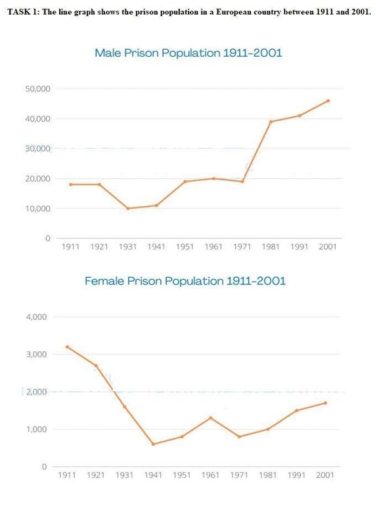
The line graph provides information regarding trends in the prison population of a European country over the period from 1911 to 2001.
Overall, while the figure for male inmates witnessed a dramatic rise, the reverse was true for female prisoners. Of particular note is that male convicts consistently dominated across the entire period.
In detail, the number of male convicts started at around 18,000, a figure that then remained unchanged during the decade, before dropping significantly to 10,000 in 1931. However, men in prison experienced a considerable rise to just below 20,000 in 1961, after which it declined slightly to approximately 19,000 over the following decade. The figure for male inmates reached its peak at around 46,000 at the end of the period.
Turning to the next category, the number of women in prison stood at about 3,000 in 1911, but this was followed by a sharp dip to around 700 in 1941, before growing markedly to above 1,000 in 1961. The figure for female inmates fell to 700 again in 1971, after which it underwent a significant increase to approximately 1,600 by the end of the period.
Word Count: 188
