Our system will evaluate the answer based on this AI-generated description.
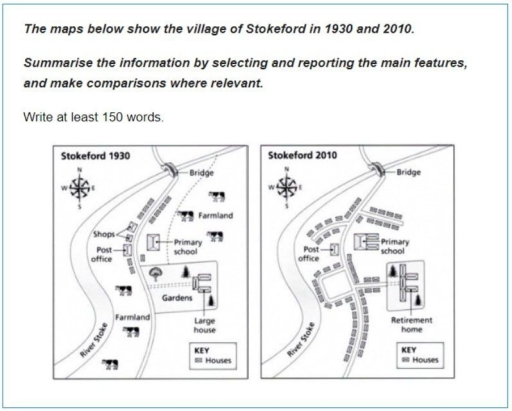
The image displays two maps of the village of Stokeford, one from 1930 and another from 2010, each with a key indicating Houses and Shops. The 1930 map features a river on the left, leading to a bridge in the upper right, with a road crossing the bridge and curving down through the village, passing by shops, a post office, primary school, and farmland before ending in a 'T' intersection. A large house lies below the 'T' intersection, surrounded by gardens. The 2010 map shows the river and bridge in the same location, but the road now bypasses the primary school and post office, which are situated next to each other and a new retirement home replaces the large house and gardens. The shops no longer exist, and additional houses line the road leading to the post office and primary school. The farmland has been subdivided into lots for houses.
Given the complexity of the image, the above description may not be entirely accurate.
Skyrocket your IELTS band score by 1-2 points in under a month with our premium plan!
Note: Both the topic and the answer were created by one of our users.
The two maps illustrate how the village of Stokeford changed between 1930 and 2010.
Overall, while the post office and primary school remained in the same location, Stokeford experienced major development, particularly with the replacement of farmland by residential housing.
In 1930, the village was largely rural, with farmland located on both sides of the main road. There were a few houses, a post office, several shops, a primary school, a large house, and adjacent gardens. By 2010, the farmland had been completely replaced by modern housing developments, especially on the right side of the village.
Although the post office remained unchanged, the nearby shops were removed and replaced with new homes and an additional road. The primary school was still located in the same area but had been expanded with extra buildings. The large house and gardens in the southeast were converted into a retirement home, with further buildings constructed around it.
In conclusion, the village became significantly more residential and urbanised, with farmland giving way to housing developments.
Word Count: 170
