Our system will evaluate the answer based on this AI-generated description.
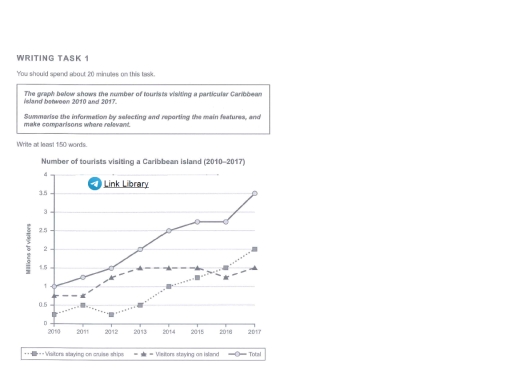
The image presents data detailing the number of tourists visiting a Caribbean island annually from 2010 to 2017, segmented between visitors staying on cruise ships and those staying on the island, with totals. In 2010: cruise ship visitors at 0.3 million, island visitors at 0.7 million, totaling 1 million; in 2011: cruise ship visitors at 0.5 million, island visitors at 0.7 million, totaling 1.2 million; in 2012: cruise ship visitors at 0.5 million, island visitors at 0.8 million, totaling 1.3 million; in 2013: cruise ship visitors at 0.6 million, island visitors at 1 million, totaling 1.6 million; in 2014: cruise ship visitors at 0.7 million, island visitors at 1.2 million, totaling 1.9 million; in 2015: cruise ship visitors at 1.3 million, island visitors at 1.3 million, totaling 2.5 million; in 2016: cruise ship visitors at 1.5 million, island visitors at 1.4 million, totaling 2.9 million; and in 2017: cruise ship visitors at 2 million, island visitors at 1.5 million, totaling 3.5 million.
Given the complexity of the image, the above description may not be entirely accurate.
Skyrocket your IELTS band score by 1-2 points in under a month with our premium plan!
Note: Both the topic and the answer were created by one of our users.
The chart illustrates how much the number of tourists visiting the Caribbean island has changed over a 7-year period, from 2010 to 2017. Units are measured in millions of visitors.
Overall, it is clear that while the number of tourists staying on cruise ships showed an upward trend, tourists staying on the island and the total experienced a stronger increase by more than tripling over the period. The growth was mainly driven by a sharp increase in cruise ship visitors
In 2010, the total of visitors on the Caribbean island started at 1 million visitors. Over the first 6 years, it experienced a steady increase before rising sharply up to 3.5 million visitors in the final year. It is noteworthy that between 2015 and 2016, the figure remained relatively stable at around 2.7 million.
By contrast, although the number of visitors staying on cruise started at a lower level than the visitors staying on the island, it experienced a steady rise up to 2 million visitors, overtaking the number of visitors staying on the island between 2015 and 2016. The most significant growth occurred between 2013 and 2015. It should be noted that the number of visitors staying on the island dropped to a low of 1.25 million in 2016, stabilising by 2017 to 1.5 million.
Word Count: 216
