Our system will evaluate the answer based on this AI-generated description.
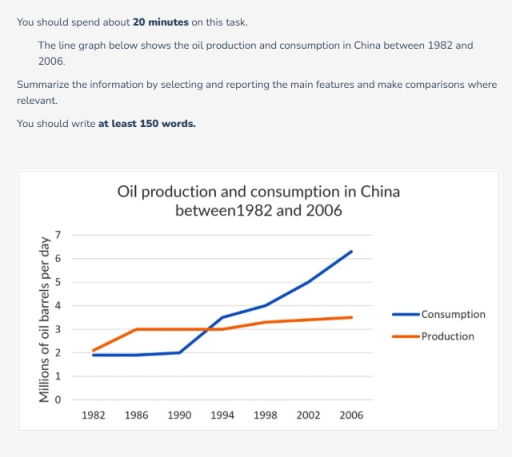
The image presents data on oil production and consumption in China from 1982 to 2006, illustrating production levels at 2 million barrels/day in 1982, consistently increasing to around 3 million barrels/day in 1986, fluctuating slightly until 1994 but stabilizing near 3 million barrels/day thereafter; consumption starts slightly below production in 1982, with less than 2 million barrels/day, then equating production in early periods, from 1986 to 1990, remaining relatively constant at around 3 million barrels/day until 1994, after which it significantly jumps to nearly 4 million barrels/day by 1998; production then increases steadily to approximately 4 million barrels/day by 2002 and sharply to almost 5 million barrels/day by 2006, while consumption portrays a rapid, notable rise post-1998, reaching close to 5-6 million barrels/day by 2006.
Given the complexity of the image, the above description may not be entirely accurate.
Skyrocket your IELTS band score by 1-2 points in under a month with our premium plan!
Note: Both the topic and the answer were created by one of our users.
The above line graph of oil production and consumption in China from 1982 to 2006 shows that the dynamics of oil production and consumption in China remained virtually unchanged from 1982 to 1990.
From 1990 to 1993, consumption increased from 2 to 3.5 million barrels per day. Slight growth was seen from 1994 to 1998, with only 0.5 million barrels per day over two years. However, from 1998 to 2006, we see a sharp jump in oil consumption, from 4.0 million barrels to 6.5 million barrels per day.
It should also be noted that in 1994, production and consumption were equal, and since 1994, production has remained virtually unchanged, while consumption has more than doubled. As of 2006, the gap between consumption and production was 2.5 million barrels per day. This is a significant difference, and to compensate for it, it is necessary to either purchase additional oil or use other, alternative energy sources.
Word Count: 154
