Our system will evaluate the answer based on this AI-generated description.
The image depicts a bar chart showing the number of houses built per year in the cities of Derby and Nottingham from the year 2000 to 2009; Derby houses are represented in blue and Nottingham in yellow. In 2000, 100 houses were built in Derby and 150 in Nottingham. In 2001, Derby had 150 and Nottingham 200. In 2002, numbers in Derby rose to 200, while Nottingham increased slightly to 250. In 2003, the numbers decreased for both cities, with Derby at 90 and Nottingham at 150. For 2004, Derby built 200 houses, and Nottingham constructed 300. The year 2005 had a steep decline for both, with Derby at 90 and Nottingham at 100. In 2006, Derby's constructions slightly grew to 140, and Nottingham's to 80. By 2007, Derby numbers remain unchanged, but Nottingham's decreased to 50. The numbers rose in 2008 dramatically, with Derby constructing 350 houses while Nottingham built 320. The chart concludes with 2009 data showing Derby at 90 houses and Nottingham at 350.
Given the complexity of the image, the above description may not be entirely accurate.
Skyrocket your IELTS band score by 1-2 points in under a month with our premium plan!
Note: Both the topic and the answer were created by one of our users.
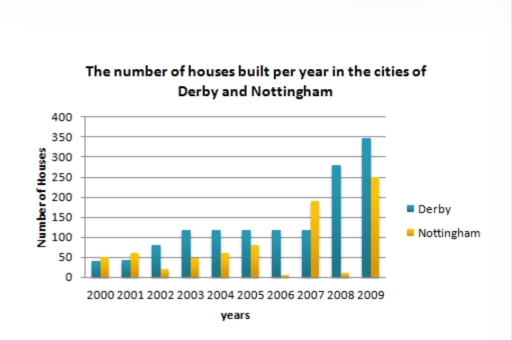
The bar chart illustrates the number of houses constructed in Derby and Nottingham each year from 2000 to 2009.
Overall, both cities witnessed a significant surge in the houses built over the period. Notably, Nottingham initially showed a higher number compared to Derby in the year 2000. However, by the end of the period, Derby had overtaken Nottingham.
In greater detail, Nottingham experienced a slight rise in the years leading up to 2002, however, it dropped to almost half in that year. Then, it increased steadily for three consecutive years. By 2006, the reversal between the two cities became clearer as the gap widened. Specifically, Nottingham experienced a dramatic dip of approximately more than 50. In the following year, it skyrocketed to almost 200, suggesting that the trend had regained its popularity. In addition, this city exhibited the same pattern, which continued over the following two years.
Conversely, Derby witnessed a steady increase during the same period leading up to 2002, alongside Nottingham. However, it gradually rose and remained steady at around 125 from 2003 to 2007. Moreover, by 2007, the trend of building houses in this city surged dramatically and grew continually until 2009, reaching a high point of about 350.
Word Count: 202
