

Part 1
You should spend about 20 minutes on this task. Write at least 150 words.
The diagram below shows how a biofuel called ethanol is produced.
Summarise the information by selecting and reporting the main features, and make comparisons where relevant.
Samples
Words: 0
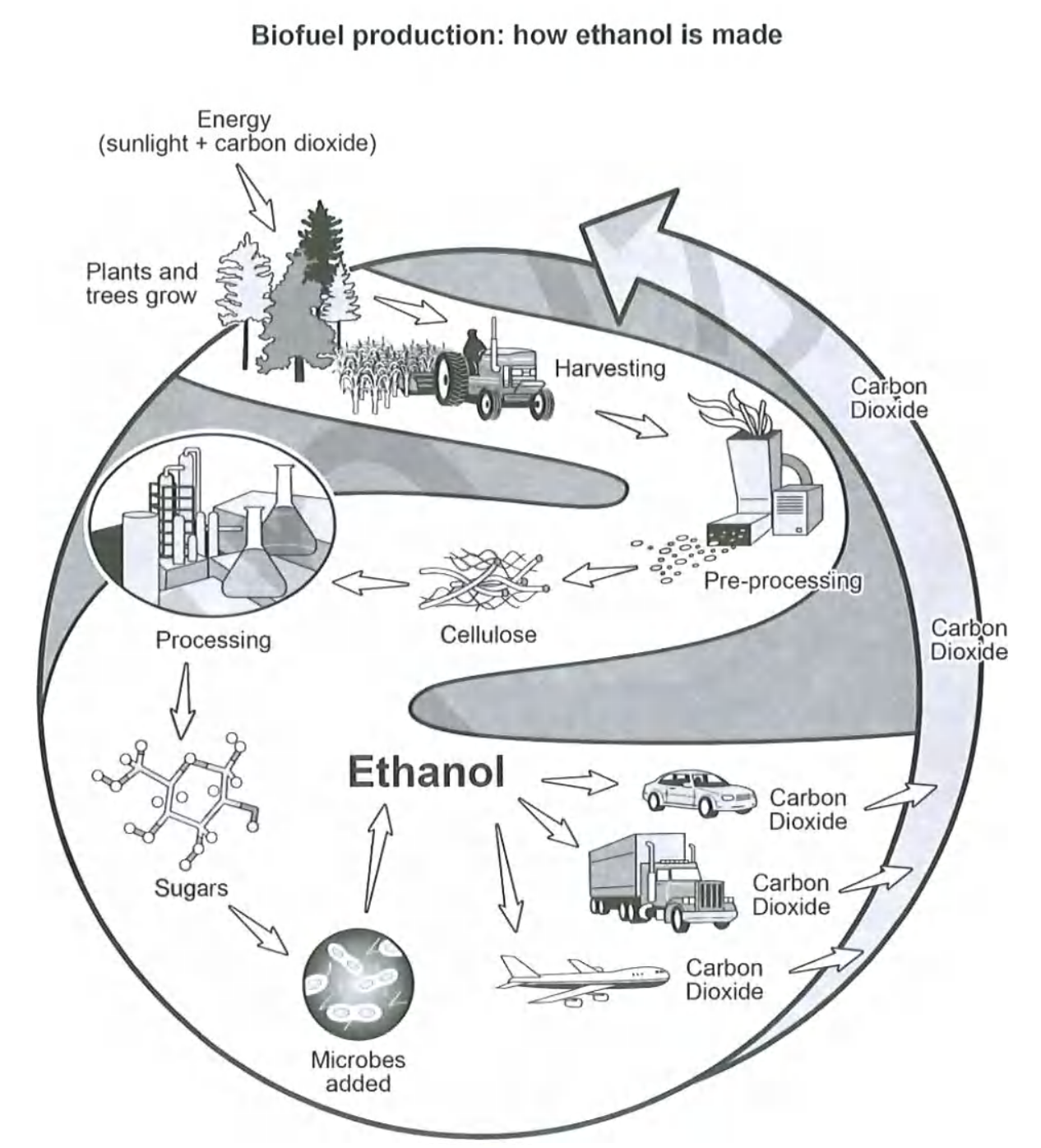
The diagram illustrates the whole cycle of manufacturing and uses of ethanol on a commercial scale.
Overall, the process starts in nature when plants convert sunlight and carbon dioxide into energy. Then, after all processing, it is used as a biofuel in cars, trucks, and airplanes. At the end, it again converts into its raw material, carbon dioxide.
At first, plants and trees are harvested and pre-processed through machines to convert them into their simplest form, which is called cellulose. Secondly, the cellulose is sent to a laboratory for further processing. Thus, sugars are formed, to which micro bacterias are added. After the fermentation process, ethanol, the required product, is synthesized.
Ethanol is used as a fuel for transport vehicles, both commercial and domestic. Furthermore, when ethanol is burnt inside the engine of automobiles, it releases carbon dioxide, which is a key element for ethanol production. Carbon dioxide is again used by vegetation along with sunlight to make energy. band 8
The illustration depicts the process of producing a biofuel named ethanol from plant materials.
Overall, the production of ethanol is a cyclical process that commences with the growth of plants and trees and ends with the use of ethanol as a fuel for transportation. Carbon dioxide released during the procedure then gets reabsorbed by the plants, ultimately completing the process.
The process begins when the plants and the trees grow through the use of sunlight and carbon-dioxide. Once the plants reach their maturity level, they are then harvested and transported for pre-processing, where the raw materials are prepared for further treatment. Upon the completion of this stage, cellulose is extracted from the plants.
In the next stage, the cellulose undergoes processing in industrial facilities and then it gets converted into sugars which later is added with microbes, eventually producing ethanol as the final product. Subsequently, the ethanol is used as a biofuel to power vehicles such as cars, trucks and aeroplanes, leading to the emission of carbon dioxide. Nevertheless, the emitted carbon dioxide then gets absorbed by the plants, making the process a continuous cycle.
4.5 completed
Band 6.5
The diagram illustrates the production of a biofuel called ethanol. Overall, the process of formulating this biofuel can be divided into three main stages: harvesting, pre-processing, and processing.
The first stage involves energy captured from sunlight and carbon dioxide by plants and trees, which serves as the power source for their growth. Once the plants have flourished and are ready for harvest, the process moves on to the pre-processing step. Here, the harvested plants are processed and fed into a cutting machine to break them down into smaller pieces, transforming them into cellulose.
In the processing stage, the cellulose is modified into sugars through chemical extraction. Once the sugars have been produced, microbes are added, resulting in the creation of ethanol. This ethanol can then be used as fuel for various types of transportation, including airplanes, trucks, and cars. However, it’s important to note that the combustion of this fuel releases carbon dioxide, which cycles back to the first stage, creating a sustainable loop.
Band 8.5
The flow chart illustrates the multi-stage process of producing a biofuel known as ethanol, showing how energy is converted into ethanol and how carbon dioxide is reused within the cycle.
Overall, the process consists of several stages that begin with the growth of plants and trees and end with the release of carbon dioxide, which is reused during plant growth.
Initially, plants and trees grow by absorbing energy from sunlight and carbon dioxide from the air. Once they are fully grown, they are harvested and sent for pre-processing, where the raw material is converted into a material called cellulose. After this stage, the cellulose undergoes further processing and is transformed into sugars. These sugars are then broken down and converted into ethanol.
In the final stage, ethanol is used as a fuel in vehicles such as cars, airplanes, and trucks. During its use, carbon dioxide is released into the atmosphere. This carbon dioxide is later absorbed by trees and other plants, allowing the cycle to continue.
nice one
The flow chart illustrates the multi-stage process of producing a biofuel, which is ethanol, highlighting how energy is transformed into ethanol, while showing how carbon dioxide is reused in the cycle.
Overall, the process comprises a series of distinct stages, beginning with the growth of plants and trees and culminating in the production of ethanol, which is subsequently used as a fuel, thereby completing the carbon cycle. All steps play a pivotal role in producing ethanol, which is an essential fuel for transportation.
First of all, energy, which is produced with the combination of sunlight and carbon dioxide, provides growth for plants and trees. Having been harvested, plants and trees are transformed into cellulose, undergoing pre-processing. After cellulose is produced, this material is transformed into sugars at the processing stage.
In the final phase, the finished product, ethanol, is formed once microbes are mixed with sugars. Subsequently, ethanol is utilized to release carbon dioxide into the air through transportation, such as planes, cars, and trucks.
The illustration provides information about how ethanol is manufactured, showing the main stages from the growing of plants to ethanol-making.
Overall, the production of ethanol is a multi-stage cyclic process, involving many stages from the raw plants to ethanol.
To begin with, sunlight provides energy to plants and trees, helping them to grow naturally. Then, farmers pick the trees in the harvesting season. After that, the plants go through a pre-processing stage, using a special machine to produce cellulose.
In the next stage, after cellulose is made, it is processed with the addition of some chemicals to make sugars. In the final stages, microbes are added to the mixture, and finally ethanol is ready to use as fuel, releasing carbon dioxide in cars, planes and buses, and the process commences again.
band 7.5
The diagram illustrates information about how ethanol is made.
Overall, the whole process consists of five main stages. It begins with the growing of plants and ends with the addition of microbes.
Initially, plants and trees need energy to grow, and this energy is provided to them in the form of sunlight and carbon dioxide. After these trees grow, they are then harvested by tractors and transported to a new machine for pre-processing. Next, with the help of this machine, cellulose is separated for laboratory usage.
In the next stage, the prepared cellulose is processed in the lab to make sugars from it. Then, microbes are added to this sugar to make fuel. As a result, this ethanol is then used in a lot of engines and machines, such as cars, planes, trucks, and so on. After the fuel is used by this machinery, they directly emit carbon dioxide into the environment. In this way, this process repeats.
The diagram illustrates the production process of a biofuel used for transport, known as ethanol. Overall, the production of ethanol follows a linear, man-made process consisting of nine main stages, beginning with the growth of trees and culminating in its use as fuel for transportation. In contrast, the carbon dioxide cycle is a natural, cyclical process that consists of two stages.
To start, trees absorb energy from sunlight and carbon dioxide to undergo photosynthesis. Once the plants have matured, humans harvest them using trucks for pre-processing. The trees are then cut into small pieces, referred to as cellulose, which undergo further modifications. Cellulose is the polymer that humans transform into its monomer, sugar, by adding chemicals. Ethanol is produced by mixing microbes with sugar; the microorganisms convert the sugar into ethanol, and this modified molecule is then used as fuel for cars, trucks, and planes.
The first stage of the carbon cycle begins when vehicles emit carbon dioxide into the atmosphere. Subsequently, plants absorb this carbon dioxide, utilizing it in photosynthesis. This process creates a continuous and sustainable cycle of biofuel production.