The Cambridge IELTS Academic series uses authentic past papers from the official exam creators, making it the most reliable way to practice. Because the material closely matches the real Academic exam in format, logic, and difficulty, it is the best category to start with if you want a true exam experience.
band 8.5
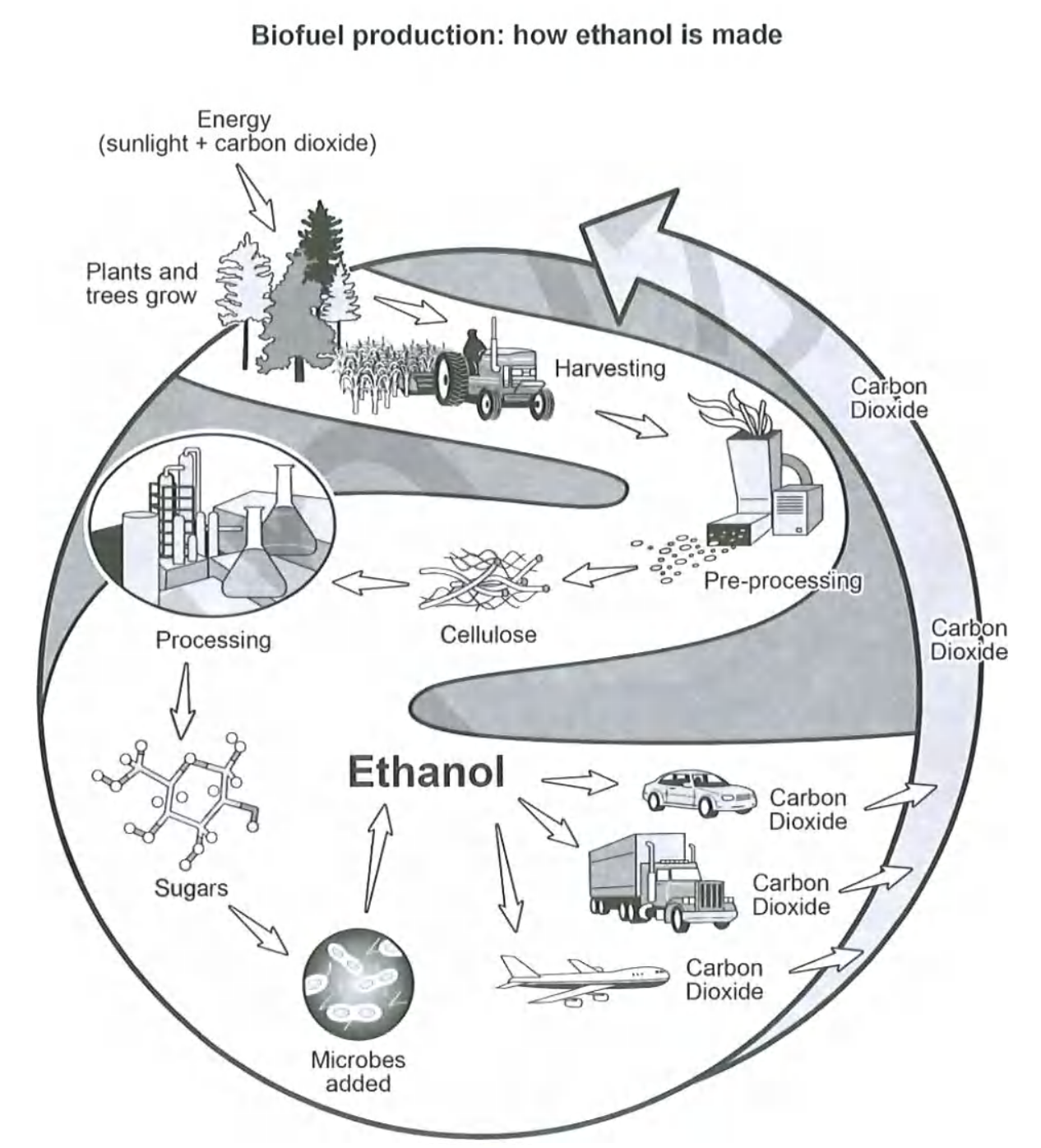
The diagram illustrates the creation of ethanol, also known as biofuel.
Overall, the process consists of ten stages, beginning with plants and trees receiving energy from sunlight and carbon dioxide, and ending with the distribution of carbon dioxide to the environment.
First of all, solar energy and carbon dioxide are absorbed by the vegetation, and as a result, it grows. This is followed by harvesting and continued by mechanical pre-processing, where the plants are cut into small pieces. Then, the cellulose is extracted. After that, the polysaccharide is processed in a laboratory to obtain sugars. Subsequently, microbes are added to the sugars to finally generate ethanol, which is used for diverse purposes.
Once ethanol is produced, it has three different end destinations: it is used as a fuel in cars, trucks, and planes, where it is burned to produce carbon dioxide and energy. This carbon dioxide is then returned to the natural carbon cycle.
The diagram illustrates how ethanol is produced from plants and how carbon dioxide is recycled in the process.
Overall, it can be seen that biofuel production is a difficult process that begins with plants and trees growing and ends with the use of ethanol as fuel.
At the first stage, plants and trees grow by using energy from sunlight and carbon dioxide. Then, the plants are harvested and sent for pre-processing. After that, the material is broken down into cellulose.
In the next stage, the cellulose is processed into sugars. Microbes are added to these sugars to produce ethanol. The final product, ethanol is used as a fuel for vehicles such as cars, trucks and planes.
When ethanol is burned, carbon dioxide is released into the atmosphere. This carbon dioxide is then reused by plants.
In conclusion, ethanol production is a circular process involving plant growth, chemical process, and fuel usage.
The provided flowchart delineates the intricate process of ethanol production, a prominent biofuel.
The ethanol production process is characterized by a cyclical flow, commencing with the growth of biomass and culminating in the transportation of the final product, while also highlighting the by-products generated throughout various stages.
The initial phase of ethanol production involves the assimilation of sunlight and carbon dioxide by plants, which facilitates their growth. This biomass is subsequently harvested and subjected to a pre-processing stage wherein cellular components are broken down, thus releasing additional carbon dioxide into the atmosphere. The cellulose derived from this biomass undergoes a chemical transformation to yield sugars, employing specific industrial techniques in laboratory settings.
The penultimate step in the production sequence involves the fermentation of sugars utilizing microbial agents, which converts these substrates into ethanol. Following this fermentation, the produced ethanol is transported for practical use as a biofuel, particularly in vehicles such as cars and trucks. It is noteworthy that while ethanol serves as a renewable energy source, its combustion still results in carbon dioxide emissions, contributing to atmospheric pollution. Consequently, this process embodies a continuous cycle, underscoring both the advantages and environmental repercussions associated with biofuel utilization.
9
The figure depicts the production process of a biofuel called ethanol.
overall, the production of biofuel ethanol is a multistage process which starts with the growing of trees and plants and ends with the production of ethanol. Meanwhile, this procedure requires eight different steps for accomplishment.
The process commences when the plants and trees absorb sunlight and carbon dioxide to provide itself the energy needed for growth. After maturing, they are harvested using a harvester machine and then they are pre-processed using a machine to shred them into very small and thin pieces to create cellulose fibres. The next step involves processing the cellulose fibres using two different types of chemicals and filtering and extraction device to turn them into sugar molecules. Finally, microbes are added to the sugar molecules to create the biofuel ethanol, which is used to run aeroplanes, large lorries and cars. These vehicles release carbon dioxide that plants absorb in order to create energy for growth. This helps the cycle to continue. got band 7
The given illustration depicts the process of producing a biofuel called ethanol. Overall, it consists of nine stages, beginning with the growth of plants and trees and ending with the use of ethanol in transportation, which results in the release of carbon dioxide into the environment.
First, plants and trees grow using energy from sunlight and carbon dioxide in the air. They are then harvested by tractors and sent to a pre-processing stage, where an intermediate product known as cellulose is produced. This material serves as the main raw material for ethanol production.
Next, the cellulose is transported to a laboratory, where it is processed into sugars. Microbes are subsequently added to these sugars to produce ethanol. Finally, the finished ethanol is used as a fuel for transportation, including cars, trucks, and planes. During its use, carbon dioxide is released into the atmosphere; this is then reused in a cyclical process, together with sunlight energy, to support the growth of plants and trees.
The diagram illustrates the whole cycle of manufacturing and uses of ethanol on a commercial scale.
Overall, the process starts in nature when plants convert sunlight and carbon dioxide into energy. Then, after all processing, it is used as a biofuel in cars, trucks, and airplanes. At the end, it again converts into its raw material, carbon dioxide.
At first, plants and trees are harvested and pre-processed through machines to convert them into their simplest form, which is called cellulose. Secondly, the cellulose is sent to a laboratory for further processing. Thus, sugars are formed, to which micro bacterias are added. After the fermentation process, ethanol, the required product, is synthesized.
Ethanol is used as a fuel for transport vehicles, both commercial and domestic. Furthermore, when ethanol is burnt inside the engine of automobiles, it releases carbon dioxide, which is a key element for ethanol production. Carbon dioxide is again used by vegetation along with sunlight to make energy. band 8
The illustration depicts the process of producing a biofuel named ethanol from plant materials.
Overall, the production of ethanol is a cyclical process that commences with the growth of plants and trees and ends with the use of ethanol as a fuel for transportation. Carbon dioxide released during the procedure then gets reabsorbed by the plants, ultimately completing the process.
The process begins when the plants and the trees grow through the use of sunlight and carbon-dioxide. Once the plants reach their maturity level, they are then harvested and transported for pre-processing, where the raw materials are prepared for further treatment. Upon the completion of this stage, cellulose is extracted from the plants.
In the next stage, the cellulose undergoes processing in industrial facilities and then it gets converted into sugars which later is added with microbes, eventually producing ethanol as the final product. Subsequently, the ethanol is used as a biofuel to power vehicles such as cars, trucks and aeroplanes, leading to the emission of carbon dioxide. Nevertheless, the emitted carbon dioxide then gets absorbed by the plants, making the process a continuous cycle.
The diagram illustrates the production of a biofuel called ethanol. Overall, the process of formulating this biofuel can be divided into three main stages: harvesting, pre-processing, and processing.
The first stage involves energy captured from sunlight and carbon dioxide by plants and trees, which serves as the power source for their growth. Once the plants have flourished and are ready for harvest, the process moves on to the pre-processing step. Here, the harvested plants are processed and fed into a cutting machine to break them down into smaller pieces, transforming them into cellulose.
In the processing stage, the cellulose is modified into sugars through chemical extraction. Once the sugars have been produced, microbes are added, resulting in the creation of ethanol. This ethanol can then be used as fuel for various types of transportation, including airplanes, trucks, and cars. However, it’s important to note that the combustion of this fuel releases carbon dioxide, which cycles back to the first stage, creating a sustainable loop.
You will need a Premium plan to perform your action!
Note: If you already have a premium account, please log in to access our services as usual.
Plans & Pricing
Our mission is to make quality education accessible for everyone. However, to keep our hardworking team running and this service alive, we genuinely need your support! By opting for a premium plan, not only do you sustain us in achieving the mission, but you also unlock advanced features to enrich your learning experience.
For those serious about advancing their English proficiency, and for IELTS candidates aspiring to boost their band score by 1-2 points (especially in writing & speaking) in just 30 days or less
What's included on Premium
Save Your IELTS Test Progress
Unlock All Courses & IELTS Tests
Unlimited AI Conversations
Unlimited AI Writing Enhancement Exercises
Unlimited IELTS Writing Task 1 & 2 Evaluation
Unlimited IELTS Speaking Part 1, 2, & 3 Evaluation
Due to the nature of our service and the provided free trials, payments are non-refundable.
Nếu bạn là người Việt Nam và không có hoặc không muốn trả bằng credit/debit cards, bạn có thể thanh toán bằng phương thức chuyển khoản:
Chọn gói:
419,000₫277,000 ₫ cho gói 1 tháng(chỉ 9,233₫/ngày)
1,239,000₫597,000 ₫ cho gói 3 tháng(chỉ 6,633₫/ngày)
2,469,000₫1,027,000 ₫ cho gói 6 tháng(chỉ 5,706₫/ngày)
4,929,000₫1,417,000 ₫ cho gói 12 tháng(chỉ 3,936₫/ngày)
Sau khi chuyển khoản, vui lòng đợi trình duyệt tự động điều hướng bạn trở lại Engnovate và bạn sẽ ngay lập tức nhận được mã kích hoạt tài khoản premium.


band 8.5
The diagram illustrates the creation of ethanol, also known as biofuel.
Overall, the process consists of ten stages, beginning with plants and trees receiving energy from sunlight and carbon dioxide, and ending with the distribution of carbon dioxide to the environment.
First of all, solar energy and carbon dioxide are absorbed by the vegetation, and as a result, it grows. This is followed by harvesting and continued by mechanical pre-processing, where the plants are cut into small pieces. Then, the cellulose is extracted. After that, the polysaccharide is processed in a laboratory to obtain sugars. Subsequently, microbes are added to the sugars to finally generate ethanol, which is used for diverse purposes.
Once ethanol is produced, it has three different end destinations: it is used as a fuel in cars, trucks, and planes, where it is burned to produce carbon dioxide and energy. This carbon dioxide is then returned to the natural carbon cycle.
Band 7.0
The diagram illustrates how ethanol is produced from plants and how carbon dioxide is recycled in the process.
Overall, it can be seen that biofuel production is a difficult process that begins with plants and trees growing and ends with the use of ethanol as fuel.
At the first stage, plants and trees grow by using energy from sunlight and carbon dioxide. Then, the plants are harvested and sent for pre-processing. After that, the material is broken down into cellulose.
In the next stage, the cellulose is processed into sugars. Microbes are added to these sugars to produce ethanol. The final product, ethanol is used as a fuel for vehicles such as cars, trucks and planes.
When ethanol is burned, carbon dioxide is released into the atmosphere. This carbon dioxide is then reused by plants.
In conclusion, ethanol production is a circular process involving plant growth, chemical process, and fuel usage.
The provided flowchart delineates the intricate process of ethanol production, a prominent biofuel.
The ethanol production process is characterized by a cyclical flow, commencing with the growth of biomass and culminating in the transportation of the final product, while also highlighting the by-products generated throughout various stages.
The initial phase of ethanol production involves the assimilation of sunlight and carbon dioxide by plants, which facilitates their growth. This biomass is subsequently harvested and subjected to a pre-processing stage wherein cellular components are broken down, thus releasing additional carbon dioxide into the atmosphere. The cellulose derived from this biomass undergoes a chemical transformation to yield sugars, employing specific industrial techniques in laboratory settings.
The penultimate step in the production sequence involves the fermentation of sugars utilizing microbial agents, which converts these substrates into ethanol. Following this fermentation, the produced ethanol is transported for practical use as a biofuel, particularly in vehicles such as cars and trucks. It is noteworthy that while ethanol serves as a renewable energy source, its combustion still results in carbon dioxide emissions, contributing to atmospheric pollution. Consequently, this process embodies a continuous cycle, underscoring both the advantages and environmental repercussions associated with biofuel utilization.
9
The figure depicts the production process of a biofuel called ethanol.
overall, the production of biofuel ethanol is a multistage process which starts with the growing of trees and plants and ends with the production of ethanol. Meanwhile, this procedure requires eight different steps for accomplishment.
The process commences when the plants and trees absorb sunlight and carbon dioxide to provide itself the energy needed for growth. After maturing, they are harvested using a harvester machine and then they are pre-processed using a machine to shred them into very small and thin pieces to create cellulose fibres. The next step involves processing the cellulose fibres using two different types of chemicals and filtering and extraction device to turn them into sugar molecules. Finally, microbes are added to the sugar molecules to create the biofuel ethanol, which is used to run aeroplanes, large lorries and cars. These vehicles release carbon dioxide that plants absorb in order to create energy for growth. This helps the cycle to continue. got band 7
The given illustration depicts the process of producing a biofuel called ethanol. Overall, it consists of nine stages, beginning with the growth of plants and trees and ending with the use of ethanol in transportation, which results in the release of carbon dioxide into the environment.
First, plants and trees grow using energy from sunlight and carbon dioxide in the air. They are then harvested by tractors and sent to a pre-processing stage, where an intermediate product known as cellulose is produced. This material serves as the main raw material for ethanol production.
Next, the cellulose is transported to a laboratory, where it is processed into sugars. Microbes are subsequently added to these sugars to produce ethanol. Finally, the finished ethanol is used as a fuel for transportation, including cars, trucks, and planes. During its use, carbon dioxide is released into the atmosphere; this is then reused in a cyclical process, together with sunlight energy, to support the growth of plants and trees.
The diagram illustrates the whole cycle of manufacturing and uses of ethanol on a commercial scale.
Overall, the process starts in nature when plants convert sunlight and carbon dioxide into energy. Then, after all processing, it is used as a biofuel in cars, trucks, and airplanes. At the end, it again converts into its raw material, carbon dioxide.
At first, plants and trees are harvested and pre-processed through machines to convert them into their simplest form, which is called cellulose. Secondly, the cellulose is sent to a laboratory for further processing. Thus, sugars are formed, to which micro bacterias are added. After the fermentation process, ethanol, the required product, is synthesized.
Ethanol is used as a fuel for transport vehicles, both commercial and domestic. Furthermore, when ethanol is burnt inside the engine of automobiles, it releases carbon dioxide, which is a key element for ethanol production. Carbon dioxide is again used by vegetation along with sunlight to make energy. band 8
The illustration depicts the process of producing a biofuel named ethanol from plant materials.
Overall, the production of ethanol is a cyclical process that commences with the growth of plants and trees and ends with the use of ethanol as a fuel for transportation. Carbon dioxide released during the procedure then gets reabsorbed by the plants, ultimately completing the process.
The process begins when the plants and the trees grow through the use of sunlight and carbon-dioxide. Once the plants reach their maturity level, they are then harvested and transported for pre-processing, where the raw materials are prepared for further treatment. Upon the completion of this stage, cellulose is extracted from the plants.
In the next stage, the cellulose undergoes processing in industrial facilities and then it gets converted into sugars which later is added with microbes, eventually producing ethanol as the final product. Subsequently, the ethanol is used as a biofuel to power vehicles such as cars, trucks and aeroplanes, leading to the emission of carbon dioxide. Nevertheless, the emitted carbon dioxide then gets absorbed by the plants, making the process a continuous cycle.
4.5 completed
Band 6.5
The diagram illustrates the production of a biofuel called ethanol. Overall, the process of formulating this biofuel can be divided into three main stages: harvesting, pre-processing, and processing.
The first stage involves energy captured from sunlight and carbon dioxide by plants and trees, which serves as the power source for their growth. Once the plants have flourished and are ready for harvest, the process moves on to the pre-processing step. Here, the harvested plants are processed and fed into a cutting machine to break them down into smaller pieces, transforming them into cellulose.
In the processing stage, the cellulose is modified into sugars through chemical extraction. Once the sugars have been produced, microbes are added, resulting in the creation of ethanol. This ethanol can then be used as fuel for various types of transportation, including airplanes, trucks, and cars. However, it’s important to note that the combustion of this fuel releases carbon dioxide, which cycles back to the first stage, creating a sustainable loop.
Band 8.5