Our system will evaluate the answer based on this AI-generated description.
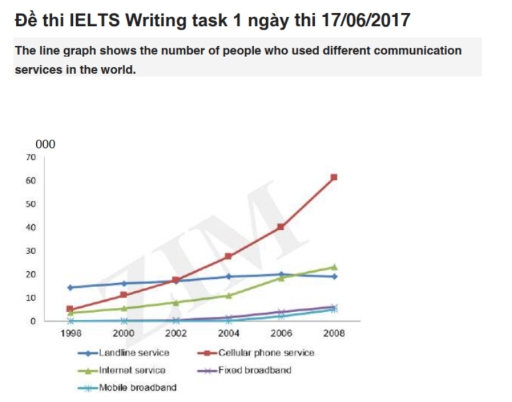
The image depicts a line graph illustrating the number of people using five communication services globally from 1998 to 2008. In 1998, landline service started at around 5 million, cellular phone service at 10 million, internet service and fixed broadband below 5 million, and mobile broadband at 0. By 2000, cellular service reached 15 million, internet service 5 million, landline around 8 million, fixed broadband slightly above 0, and mobile broadband remained absent. In 2002, cellular service rose to 30 million, landline at about 10 million, internet approaching 15 million, fixed broadband and mobile broadband each around 5 million. By 2004, cellular service sharply increased to 40 million, internet service reached approximately 30 million, landline at 12 million, fixed broadband about 10 million, and mobile broadband at 5 million. In 2006, cellular service expanded to 55 million, internet service to 40 million, landline at 15 million, fixed broadband at 18 million, and mobile broadband at 8 million. By 2008, cellular service peaked at 65 million, internet service at 50 million, landline at around 15 million, fixed broadband at 22 million, and mobile broadband at 20 million.
Given the complexity of the image, the above description may not be entirely accurate.
Skyrocket your IELTS band score by 1-2 points in under a month with our premium plan!
Note: Both the topic and the answer were created by one of our users.
The line graph compares the number of individuals who used various communication services across the world between 1998 and 2008.
Overall, many services nave increased over the period, except lendline service. In addition, cellular phone services had a considerably increase, whie moblie and fixed broadbands had a little rise throughout the period.
In 1998, landline provision had the highest position, at about 14,000, while other services were under 10,000. During the decade, landline provision remained unchanged with some little increase and decreases, reached about 18,000 users, in 2008.
Cellular phone and internet connectivities started with nearly the same count of users with a difference of 1,000. By 2002, both of them rose, internet connectivity steadily to 8,000, and cellular phone gradually to 15,000 had a meet with lanline service. In the following years, they continued grow with the same rate. In 2008, cellular phone provision remained the highest position, at under 60,000 users, and internet service the second position with 20,000 participants.
Finally, fixed and mobile broadband were the least used services, both of them did not have any consumers until 2002. Throughout the 6 years, they climbed and reached the similar number of consumers at the end of the period, at 4,000.
Word Count: 203
