
The European Eel - IELTS Reading Answers & Explanations
From Collins Practice Tests For IELTS 3 General Training Reading Test 1 · Part 3 · Questions 29–40
Reading Passage
Read the text below and answer questions 29-40.
The European Eel
One of the most mysterious and endangered fish in Europe is the European eel. Eels live long and complex lives and during their lifetime will travel thousands of miles, transforming themselves as they go. They can grow up to one metre long and have long, snake-like bodies with one pair of small fins at the sides. They are secretive creatures; most of their early life at sea is a mystery and when they come inland during their adult lives, they are nocturnal, living under stones and burrowing into mud during the day. They can live between seven and 85 years, with an average lifespan of 55 years, and much of this time is spent out of sight.
The European eel is a 'catadromous' fish: it is born at sea and spawns or reproduces there; then it migrates to inland waters to eat and grow. European eels can be found from Russia and Finland to as far south as the coasts of Morocco, Egypt and the countries around the Black Sea. They spend most of their adult lives in freshwater rivers, streams and estuaries before returning to the open ocean to lay eggs. We know quite a lot about the eels' adult lives but big questions remain about their migration. It was only very recently that scientists following eels with electronic tracking devices along part of their route discovered that the adults do not migrate directly to their breeding grounds. Instead, they follow ocean currents far south of their destination and then catch another current to go north later. They are a solitary species for most of their life and do not join other eels in schools or groups.
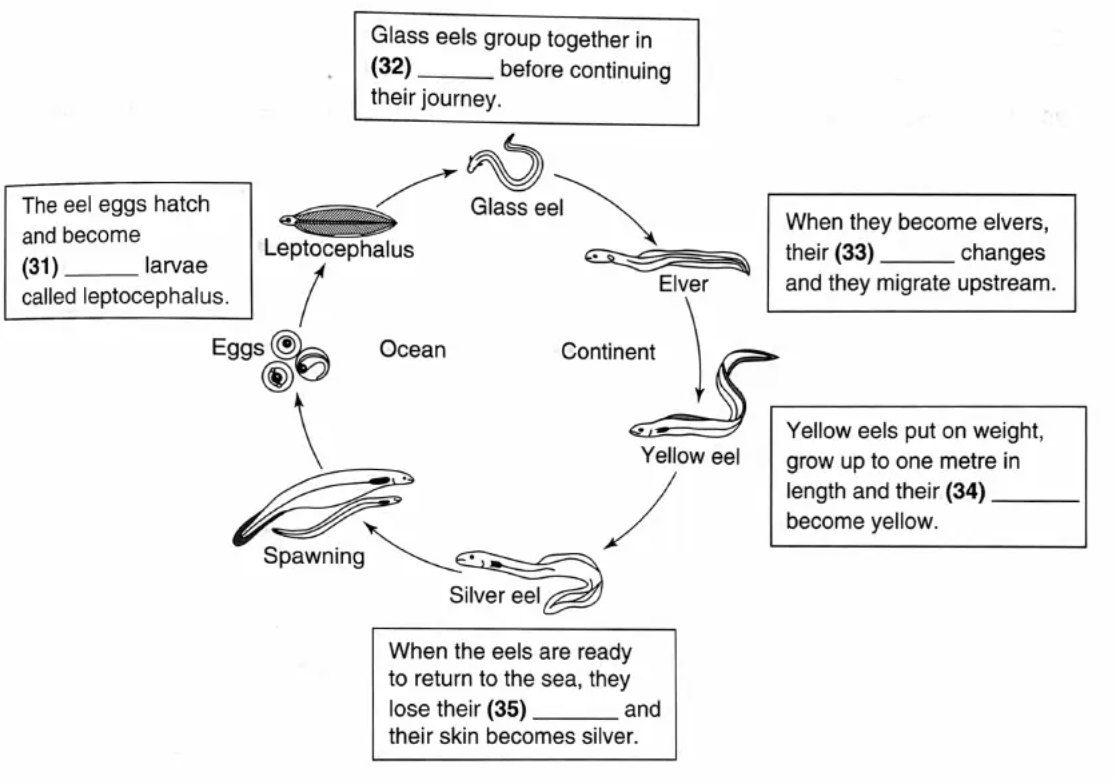
In the course of their life, eels pass through a number of very different stages, marked by changes in size, shape and colour. The European eels' life begins near Bermuda in the deep waters of the Sargasso Sea, in the middle of the North Atlantic, where the eggs hatch into transparent larvae called leptocephalus. The Sargasso is noted for its calm blue waters and the Sargassum seaweed that grows there, which the European eels use as cover, drifting with the Gulf Stream as it moves north-eastwards across the Atlantic. This 4,000-mile journey lasts over a year before the eels reach European and North African shores. They gather in the estuaries of rivers in the form of transparent miniature eels called glass eels to continue their migration inland. As glass eels leave the open ocean to enter the estuaries and ascend rivers, they gain colour and are known as elvers. Their migration occurs in late winter, early spring and through the summer months. For the next six to 20 years, the eels grow, putting on weight, becoming longer and developing yellow undersides. This is their yellow eel stage, when they travel continuously upstream toward lower temperatures and less salty waters, possibly also in reaction to crowded waters downstream. During their upriver journey, eels have been observed climbing obstacles such as dams to reach their breeding grounds and also leaving the water altogether and entering fields to eat slugs and worms. After migrating upstream, the male eels grow and feed for six to twelve years, the females for nine to 20 years, before returning to the sea to reproduce. Moving back to the sea, their stomachs dissolve, their skin turns silver and they are called silver eels. They seem to be stimulated to move downstream at night when there is a new moon or when the river is flooding.
Eels were once plentiful in Europe and were a source of food for many inhabitants. In the city of London, which is located on the river Thames, eel pie and jellied eels were a speciality in the poorer East End of the city. But now European eels are on the list of critically endangered species and their numbers have declined by around 90% since the 1970s. Researchers believe that this decrease happens at the glass eel stage, which is when the species is most at risk. In the past 40 years, the number of glass eels arriving in Europe has fallen by around 95%. Several reasons seem to be responsible for the decline. Artificial blocks to their natural migration routes, like weirs and dams, hydropower and water-pumping stations could be preventing the eels reaching their freshwater breeding grounds. Overfishing, pesticides and parasites are also believed to be part of the problem. Researchers in Portugal have found that rising temperatures and acidic waters are posing yet another threat. Dr Reinhold Hanel at the Thunen Institute in Germany also believes that climate change is harming eels by changing the ocean currents along their migration routes to and from the Sargasso Sea so that fewer glass eels are able to drift across to European shores. He stated that for fish that cross oceans and move between fresh and saltwater as eels do, climate change is yet another pressure. These vulnerable fish face so many dangers on their long journeys that the impact of man-made risks is proving too much for their survival.
Questions
Questions 29–30 Multiple Choice (One Answer)
Choose the correct letter, A, B, C or D.
Questions 31–35 Diagram Labeling
Complete the flow-chart below.
Choose ONE WORD ONLY from the text for each answer.
Questions 36–40 Short Answers
Answer the questions below.
Choose NO MORE THAN TWO WORDS from the text for each answer.
Answers & Explanations Summary
| # | Answer | Evidence | Explanation |
|---|---|---|---|
| Q29 | D | when they come inland during their adult lives, they are nocturnal, living under stones and burrowing into mud during the day | Excerpt/Passage Explanation: The passage explains that when adult eels move from the sea into rivers, they avoid the light and stay active during the night. Answer Explanation: The answer states that these eels are awake and moving around mostly at night. Reason For Correctness: The correct answer is D because the author uses the word 'nocturnal' to describe the eels when they live in rivers and streams as adults. In English, 'nocturnal' is a keyword that means an animal is active during the night and rests during the day. The writer supports this by saying they hide under stones or in mud when it is light outside. |
| Q30 | D | It was only very recently that scientists following eels with electronic tracking devices along part of their route discovered that the adults do not migrate directly to their breeding grounds. Instead, they follow ocean currents far south of their destination and then catch another current to go north later | Excerpt/Passage Explanation: The passage explains that modern technology showed a surprising fact about the eels' journey home. They do not swim in a straight line to the area where they have babies. Instead, they first swim much further south than necessary and then use a different water current to travel back north to their actual destination. Answer Explanation: The answer means that when eels swim back to their home in the Sargasso Sea, they do not take a straight path. They actually swim further south than their home before turning back north to reach it. Reason For Correctness: The correct answer is supported by the text's description of scientific tracking studies. It mentions that eels 'do not migrate directly' to the place where they lay eggs. Instead, 'they follow ocean currents far south' of that location before shifting direction. This means their journey is 'indirect' because it takes a longer, non-straight path that 'goes past' the target destination initially. Keywords to note are 'directly,' 'destination,' and 'ocean currents.' |
| Q31 | transparent | where the eggs hatch into transparent larvae called leptocephalus | Excerpt/Passage Explanation: The passage explains that when the eel eggs open, the baby eels (called larvae) are clear and see-through. Answer Explanation: The answer means that the baby eels are see-through or clear, like a window, because they do not have any color yet. Reason For Correctness: The correct answer is found by looking at the description of the eels during their first few stages of life. The passage explains that when the eggs hatch, the tiny fish (larvae) are 'transparent'. Later, when they reach the coast as 'glass eels', they are also described as 'transparent'. This word tells us what the eels look like at the beginning of their journey. |
| Q32 | estuaries | They gather in the estuaries of rivers in the form of transparent miniature eels called glass eels to continue their migration inland | Excerpt/Passage Explanation: The passage explains that small, clear eels (glass eels) come together in the water where the river meets the ocean (estuaries) so they can keep traveling into the country. Answer Explanation: The answer is the name for the areas where rivers meet the sea. Reason For Correctness: The correct answer is correct because the text describes the life cycle of the eel. After crossing the Atlantic Ocean for over a year, the eels reach the coast. At this point, they are called glass eels. The passage states that these glass eels collect or 'gather' in the estuaries of rivers before they start moving further into the land. This word specifically names the location where this part of their journey happens. |
| Q33 | colour | As glass eels leave the open ocean to enter the estuaries and ascend rivers, they gain colour and are known as elvers | Excerpt/Passage Explanation: The passage explains that as the young, clear eels move from the deep sea into the rivers, they begin to show a physical appearance and are given a different name. Answer Explanation: The answer is the appearance or tint that the fish gets as it moves from the sea into the rivers. Reason For Correctness: The correct answer is supported by the text which describes the change that happens when the young eels (glass eels) move into more shallow water near the land. When they enter the areas where the river meets the sea (estuaria) and go up the rivers, they stop being clear and start to have a visual appearance, which the text calls gaining 'colour'. After this change, they are called 'elvers'. |
| Q34 | undersides | For the next six to 20 years, the eels grow, putting on weight, becoming longer and developing yellow undersides | Excerpt/Passage Explanation: The passage explains that while the eels are growing and getting heavier over many years, the bottom part of their bodies turns yellow. Answer Explanation: The answer refers to the bottom part or the belly of the eel's body. Reason For Correctness: The correct answer is found in the description of the 'yellow eel stage.' During this period, which lasts 6 to 20 years, the eels undergo physical changes. These changes include getting larger, gaining weight, and growing yellow coloring on their bottom parts. The word 'developing' in the text indicates that this feature appears during this specific part of their life cycle. |
| Q35 | stomachs | Moving back to the sea, their stomachs dissolve, their skin turns silver and they are called silver eels | Excerpt/Passage Explanation: The passage explains that as the eels return to the ocean, their stomachs break down and disappear, and their skin changes color. Answer Explanation: The answer is 'stomachs', which refers to the part of the eel's body used for digestion. Reason For Correctness: The correct answer is 'stomachs' because the text describes the physical changes that happen when European eels prepare to go back to the ocean to lay eggs (reproduce). During this transformation, their internal 'stomachs' disappear or 'dissolve', and they are then called 'silver eels' because of their new skin color. |
| Q36 | London | In the city of London, which is located on the river Thames, eel pie and jellied eels were a speciality in the poorer East End of the city | Excerpt/Passage Explanation: The passage says that in London, dishes made from eels were very common and special foods for people living there. Answer Explanation: The answer is the city of London. Reason For Correctness: The correct answer is London. The passage explains that eels were used as food in Europe and identifies London as a city where specific eel dishes were very popular or a 'speciality'. |
| Q37 | glass eel | Researchers believe that this decrease happens at the glass eel stage, which is when the species is most at risk | Excerpt/Passage Explanation: The passage explains that experts think the drop in the eel population occurs during the 'glass eel' phase because that is the time when the animal is in the most danger. Answer Explanation: The answer identifies the 'glass eel' stage as the period in an eel's life when it faces the greatest threats to its survival. Reason For Correctness: The correct answer is 'glass eel' because the passage explicitly states that this specific life stage is 'when the species is most at risk'. In biology, being 'at risk' is a synonym for being in danger. The text even mentions that the number of eels returning to Europe at this stage has dropped by 95% over the last 40 years, highlighting the extreme danger they face during this time. |
| Q38 | acidic waters | Researchers in Portugal have found that rising temperatures and acidic waters are posing yet another threat | Excerpt/Passage Explanation: The passage explains that scientists working in Portugal identified both warmer water temperatures and water with high acid levels as new dangers to the eel population. Answer Explanation: The answer 'acidic waters' refers to water that contains high levels of acid, which can be harmful to fish and other aquatic life. Reason For Correctness: The correct answer is 'acidic waters' because the text specifically identifies it as a second danger found by scientists in Portugal, alongside 'rising temperatures'. The text uses the word 'threat' to describe these environmental conditions that harm the European eel. |
| Q39 | ocean currents | Dr Reinhold Hanel at the Thunen Institute in Germany also believes that climate change is harming eels by changing the ocean currents along their migration routes to and from the Sargasso Sea so that fewer glass eels are able to drift across to European shores | Excerpt/Passage Explanation: The passage explains that climate change (global warming) is causing the movement of water in the ocean to change, which makes it harder for young eels to travel to Europe. Answer Explanation: The answer 'ocean currents' refers to the way water moves through the sea in regular patterns. Reason For Correctness: The correct answer is 'ocean currents' because the text mentions that climate change (another term for global warming) is currently changing these water paths. This change is identified as one of the reasons why the number of eels is dropping, as it makes their long journey across the sea much harder. The word 'changing' in the question directly matches the word used in the passage to describe what is happening to the currents. |
| Q40 | man-made risks / man-made | These vulnerable fish face so many dangers on their long journeys that the impact of man-made risks is proving too much for their survival | Excerpt/Passage Explanation: The passage explains that these fish meet many natural dangers on their long trips, and the problems caused by humans (man-made risks) are making it impossible for them to survive. Answer Explanation: The answer means problems or dangers that are created by humans. Reason For Correctness: The correct answer is 'man-made risks' because the text explains that although eels face many natural dangers during their long travels, the extra problems caused by people are making it too hard for them to live. These 'risks' or dangers include things like building dams and causing climate change, which the passage mentions as pressures that are 'man-made'. |