
Bicentennial Park - IELTS Listening Answers & Explanations
From Cambridge IELTS 07 Academic Listening Test 4 · Part 2 · Questions 11–20
Audio
Questions
Questions 11–14 One Choice
Choose the correct letter, A, B or C.
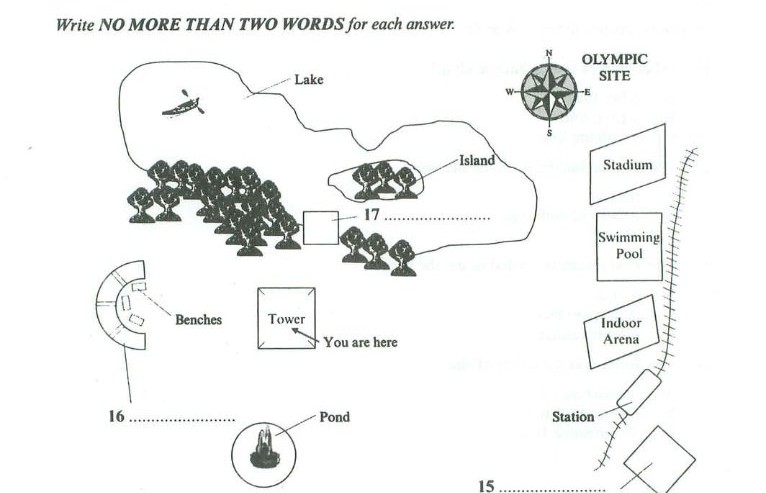
Questions 15–17 Map Labeling
Label the plan below.
Write NO MORE THAN TWO WORDS for each answer.
Questions 18–20 Table Completion
Complete the table below.
Write NO MORE THAN TWO WORDS for each answer.
| Area | Facility | Activity |
|---|---|---|
| The Mangroves | boardwalk | 18 |
| Frog Pond | outdoor classroom | 19 |
| The Waterbird Refuge | 20 | bird watching |
Answers & Explanations Summary
| # | Answer | Evidence | Explanation |
|---|---|---|---|
| Q11 | C | I hope that you're all wearing your most comfortable shoes and that you can keep up the pace | Excerpt/Transcript Explanation: The transcript shows the guide advising the visitors to wear shoes suitable for walking and to move fast enough to follow the tour group. Answer Explanation: The answer is a walking tour, which means the group is moving around the park on foot rather than using a vehicle like a bus or a train. Reason For Correctness: The correct answer is C because the tour guide, Sally, mentions that the visitors should be wearing 'comfortable shoes' and be able to 'keep up the pace'. These are instructions given to people who are about to do a lot of walking. Furthermore, she later asks them to follow her up the stairs, which confirms they are not on a vehicle. |
| Q12 | B | There used to be a lot of factories in this area until the 1960s. Creating the park required the demolition of lots of derelict buildings on the site, so most of the exciting park space all around you was originally warehouses and storehouses | Excerpt/Transcript Explanation: The transcript says that in the past, there were many factories and buildings for storage (warehouses and storehouses) in this area. Answer Explanation: The answer means that before the park was built, the buildings on that land were used for work and making products, like factories. Reason For Correctness: The correct answer is B because the tour guide says there were many factories here in the 1960s. She also mentions that there were 'warehouses' and 'storehouses' before the park was made. These are all types of industrial buildings used for manufacturing or storing goods. |
| Q13 | A | If the land was to be cleaned up, they wanted to use the site for recreation. Residents wanted open space for outdoor activities, rather than housing or even an indoor sports complex | Excerpt/Transcript Explanation: The transcript says that the people living nearby wanted to use the land for fun and movement (recreation) instead of houses or a sports building. Answer Explanation: The answer means the people living in the area wanted to use the land for relaxation and fun activities. Reason For Correctness: The correct answer is A because the transcript says that the people who lived there (the local community and residents) wanted the land for "recreation" and "outdoor activities." In English, "recreation" is a synonym for "leisure." The text also mentions that they did not want "housing" (apartment blocks) or an "indoor sports complex" (a sports centre). |
| Q14 | B | The tall blue-and-white building in front of us is called The Tower and is the centre point for the formal gardens | Excerpt/Transcript Explanation: The transcript says that the blue-and-white building named The Tower is the main middle spot for the formal gardens. Answer Explanation: The answer means that the tall building called The Tower is located right in the middle of the part of the park with ordered flower beds and paths, known as the formal gardens. Reason For Correctness: The correct answer is found when the tour guide describes the different parts of the Bicentennial Park. The guide explains that the park is divided into two main areas: a nature reserve and a formal park. The guide specifically mentions that the tall building ('The Tower') serves as the 'centre point' for the 'formal gardens'. This direct match shows that B is the right choice. Use of the phrase 'centre point' is a synonym for 'at the centre of' used in the question. |
| Q15 | car park | The Olympic site has its own station to encourage the use of public transport. There is also a car park, but it only holds a limited number of cars | Excerpt/Transcript Explanation: The transcript explains that the Olympic area has a train station so people use trains instead of driving. It also says there is a car park for people who drive, but it cannot hold many cars. Answer Explanation: The answer is a car park, which is a place where people can leave their vehicles when they visit the Olympic site. Reason For Correctness: The correct answer is car park because the tour guide is talking about the buildings and facilities near the Olympic site. She explains that there is a train station for public transport and also mentions a specific area where cars can be parked, although it only has a small amount of space. This matches the label needed on the map for that location. |
| Q16 | rose garden | And around to the west, you can relax and sit on a bench to smell the flowers in the rose garden | Excerpt/Transcript Explanation: The transcript explains that when looking towards the west, there is a rose garden where visitors can sit and enjoy the scent of the flowers. Answer Explanation: The answer is a specific area in the park where you can find many roses. Reason For Correctness: The correct answer is determined by the specific direction given by the tour guide. While standing at the top of the tower, she looks at different parts of the park. When she looks toward the west, she describes a place to sit on a bench and smell flowers. She names this specific location the rose garden. In English, a garden is a place where plants and flowers are grown, and 'rose' is the specific type of flower found there. |
| Q17 | café / cafe | and finally up to the north, if you look in front of you now, there's a lake with a small island in the centre, you can hire rowing boats at the boat shed, which you can't see from here, but if you look through the trees, you can see the café, which has lovely views across the water | Excerpt/Transcript Explanation: The transcript explains that when looking towards the north side of the park, there is a lake, and people can see the café by looking through the trees. Answer Explanation: The answer is a place where people can go to buy food and drinks. Reason For Correctness: The correct answer is 'café' because the guide mentions it while describing the view looking north from The Tower. She points out that although the boat shed is hidden, visitors can see the café if they look through the trees near the lake. |
| Q18 | cycling | The Mangroves have been made more accessible to visitors by the boardwalk built during the park's upgrade. You'd think that people would come here to look at the unusual plant life of the area, but in fact it's more often used for cycling and is very popular with the local clubs | Excerpt/Transcript Explanation: The transcript says that the boardwalk makes the Mangroves easier to visit, and instead of just looking at plants, people use it most frequently for riding bikes (cycling). Answer Explanation: The answer "cycling" means that riding a bicycle is the main thing people do on the boardwalk in the Mangroves section of the park. Reason For Correctness: The correct answer is given when the guide talks about the Mangroves and the boardwalk. Even though people might want to look at the plants, the guide explains that visitors actually use this specific area and its boardwalk most often for "cycling." This fits the table's requirement for an activity related to that facility. |
| Q19 | biology lesson | This is the far end of the park and over there you can see the Frog Pond, a natural feature here long before the park was designed. Just next to it we have our outdoor classroom, a favourite spot for school parties. The area is now most often used by primary schools for biology lessons | Excerpt/Transcript Explanation: The transcript explains that next to the Frog Pond, there is an outdoor classroom where primary school children come to have biology lessons. Answer Explanation: The answer means a school class where students study living things like plants and animals. Reason For Correctness: The correct answer is "biology lesson" because the guide identifies the "outdoor classroom" near the "Frog Pond" as a specific location for school groups. She mentions that this spot is now mostly used by young students from primary schools to have their biology lessons. Therefore, "biology lesson" is the correct activity for that area. |
| Q20 | viewing shelter | This area is in a sheltered part of the estuary, that's why the park's viewing shelter is a favourite spot for bird watchers who can use it to spy through binoculars | Excerpt/Transcript Explanation: The transcript states that the Waterbird Refuge has a 'viewing shelter' where bird watchers go to see different types of birds. Answer Explanation: The answer is the 'viewing shelter', which is a small building or area designed for people to sit and look at birds. Reason For Correctness: The correct answer is 'viewing shelter' because the guide mentions that the Waterbird Refuge area contains a 'viewing shelter'. This facility is specifically identified as the favorite spot for people who enjoy 'bird watching' (the activity listed in the table). |
Transcript
Welcome to all of you . . . can everybody see and hear me? . . . Good . . . I'm Sally, your guide for this tour of the Bicentennial Park . . . I hope that you're all wearing your most comfortable shoes and that you can keep up the pace. So let's get under way on our tour around this wonderful park.
I'll start today with some general background information. There used to be a lot of factories in this area until the 1960s. Creating the park required the demolition of lots of derelict buildings on the site, so most of the exciting park space all around you was originally warehouses and storehouses.
The idea of building a public park here was first discussed when a property developer proposed a high-rise housing development, but the local community wasn't happy. If the land was to be cleaned up, they wanted to use the site for recreation. Residents wanted open space for outdoor activities, rather than housing or even an indoor sports complex.
Now to the Bicentennial Park itself. It has two areas, a nature reserve and a formal park with man-made features and gardens. The tall blue-and-white building in front of us is called The Tower and is the centre point for the formal gardens. It stands twelve metres high, so follow me up the stairs to where we can take advantage of the fantastic views.
Well, here we are at the top of The Tower, and we're going to look at the view from each direction. Out to the east, the large buildings about a kilometre away are on the Olympic site. There's an indoor arena for gymnastics, a stadium for track and field and a swimming pool for races and synchronised swimming and also diving. If you look carefully down there, you can see the train lines. The Olympic site has its own station to encourage the use of public transport. There is also a car park, but it only holds a limited number of cars.
The formal park has some specially-created water features. If you look out here to the south, you can see a circular ornamental pond.
And around to the west, you can relax and sit on a bench to smell the flowers in the rose garden, and finally up to the north, if you look in front of you now, there's a lake with a small island in the centre, you can hire rowing boats at the boat shed, which you can't see from here, but if you look through the trees, you can see the café, which has lovely views across the water. OK, let's climb down now. We will go now and have a look at the nature reserve section of the park, which has opened up natural wetland to the public.
The Mangroves have been made more accessible to visitors by the boardwalk built during the park's upgrade. You'd think that people would come here to look at the unusual plant life of the area, but in fact it's more often used for cycling and is very popular with the local clubs.
This is the far end of the park and over there you can see the Frog Pond, a natural feature here long before the park was designed. Just next to it we have our outdoor classroom, a favourite spot for school parties. The area is now most often used by primary schools for biology lessons.
And finally let's pass by the Waterbird Refuge. This area is in a sheltered part of the estuary, that's why the park's viewing shelter is a favourite spot for bird watchers who can use it to spy through binoculars. You can watch a variety of water birds, but most visitors expect to see black swans when they come to the shelter. You might spot one yourself right now!
Well, here we are back at our starting point, the Visitor Centre.