
British Isles - IELTS Listening Answers & Explanations
From IELTS Simulation Tests Academic Listening Test 04 · Part 4 · Questions 31–40
Audio
Questions
Questions 31–32 Short Answers
Write NO MORE THAN TWO WORDS for each answer.
Questions 33–36 Diagram Labeling
Label the diagram below.
Write ONE WORD ONLY for each answer.
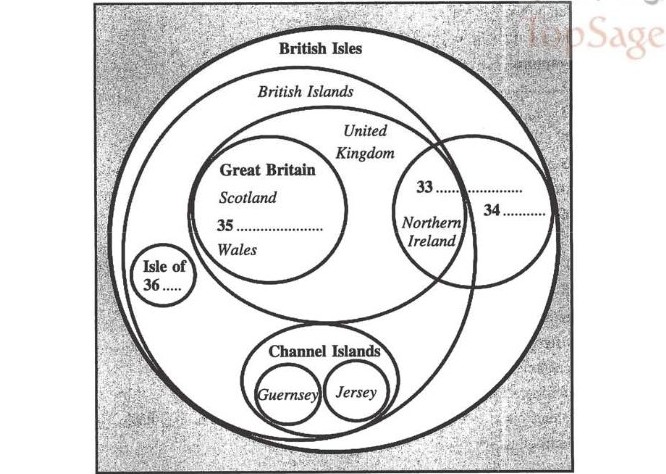
Questions 37–40 Sentence Completion
Complete the sentences below.
Write ONE WORD ONLY for each answer.
- There is 37 with language also when it comes to describing the British Isles.
- The northernmost point of Ireland belongs to the Republican 38 of Donegal.
- A Welshman will be upset if you call him 39.
- The former British Empire is now known as the Commonwealth of Nations to avoid recalling previous 40 relationships.
Answers & Explanations Summary
| # | Answer | Evidence | Explanation |
|---|---|---|---|
| Q31 | eastern Atlantic | Hello. I'm glad so many of you have turned out to hear what I have to say today about the British Isles, that area of the eastern Atlantic that we Americans find so confusing | Excerpt/Transcript Explanation: The transcript shows the speaker introducing the British Isles as an area situated in the eastern Atlantic. Answer Explanation: The answer refers to the eastern part of the Atlantic Ocean where the British Isles are located. Reason For Correctness: The correct answer is "eastern Atlantic" because at the beginning of the lecture, the speaker describes the British Isles as "that area of the eastern Atlantic". Since the sentence already provides the preposition "In the", the two words completing the location are "eastern Atlantic". |
| Q32 | political | I have a very useful image that might help you differentiate between the various labels that distinguish the political and geographic reality of the so-called British Isles. I want to show you a Venn diagram which is a mathematical illustration that shows all the possible relationships between sets | Excerpt/Transcript Explanation: The transcript states that the speaker is showing a Venn diagram to help listeners see the difference between political and geographic labels. Answer Explanation: The answer "political" refers to areas or labels related to government and countries, rather than physical land. Reason For Correctness: The correct answer is "political" because the speaker explains that the Venn diagram is used to show the difference between geographic terms and political terms for the British Isles. |
| Q33 | Ireland | In geographical terms, you will see that the British Isles is an archipelago made up of the two large islands of Great Britain and Ireland and including many smaller surrounding islands | Excerpt/Transcript Explanation: The transcript explains that geographically, the British Isles is a group of islands formed mainly by two big islands called Great Britain and Ireland. Answer Explanation: The answer refers to the island named "Ireland". Reason For Correctness: The correct answer is confirmed by the speaker when explaining the geographical parts of the British Isles. The speaker mentions that the British Isles consists of two large islands: "Great Britain" and "Ireland", along with many smaller surrounding islands. |
| Q34 | Ireland / Eire | Ireland is the name of the sovereign republic occupying the larger part of the island of Ireland. But to distinguish it from the name of the island itself, and most importantly from the other part which belongs to the UK, it is called the Republic of Ireland or its Irish-language name, Eire—that's E-I-R-E—even though Eire directly translates as 'Ireland' | Excerpt/Transcript Explanation: The transcript explains that the nation on this island is named Ireland, also known in the Irish language as Eire. Answer Explanation: The answer means either the name "Ireland" or its Irish-language name "Eire". Reason For Correctness: The correct answer is "Ireland" or "Eire" because the speaker explains that the sovereign republic occupying the main part of the island is officially called Ireland, the Republic of Ireland, or by its Irish name, Eire. |
| Q35 | England | England, Scotland, Wales and Northern Ireland are legal jurisdictions within the United Kingdom but Great Britain refers to the countries of England, Wales and Scotland as a unit | Excerpt/Transcript Explanation: The transcript states that England, Scotland, Wales, and Northern Ireland are the legal jurisdictions that form the United Kingdom, and that Great Britain consists of England, Wales, and Scotland together. Answer Explanation: The answer refers to the country of England, which is one of the legal jurisdictions inside the United Kingdom and part of Great Britain. Reason For Correctness: The correct answer is supported by the speaker's explanation of the parts that make up the United Kingdom and Great Britain. The speaker mentions England alongside Scotland, Wales, and Northern Ireland as constituent legal jurisdictions within the United Kingdom, and specifically as one of the three countries (England, Wales, and Scotland) forming Great Britain. |
| Q36 | Man | The British Islands contain the United Kingdom, the Channel Islands (made up of Guernsey and Jersey) and Isle of Man which all have the British Monarch as head of state | Excerpt/Transcript Explanation: The transcript states that the political group called the British Islands includes the United Kingdom, the Channel Islands, and the Isle of Man. Answer Explanation: The answer means the word "Man", which completes the place name "Isle of Man". Reason For Correctness: The correct answer is "Man" because the speaker lists the components of the British Islands, mentioning the United Kingdom, the Channel Islands, and the "Isle of Man". Therefore, "Man" is the single word that completes the label for this territory. |
| Q37 | confusion | So, you've learnt something about the geographical and political confusion surrounding the British Isles; let's have a look at some of the linguistic confusion | Excerpt/Transcript Explanation: The transcript states that after discussing the geographic and political confusion, the speaker will discuss the language-related (linguistic) confusion about the British Isles. Answer Explanation: The answer "confusion" means a state of being unclear, mixed up, or difficult to understand. Reason For Correctness: The correct answer is "confusion" because the speaker moves from explaining geographical and political mix-ups to discussing the problems with language ("linguistic confusion"). In the sentence, "linguistic" is paraphrased as "with language", which directly connects to the noun "confusion". |
| Q38 | County | Of course the 'northern' in "Northern Irish" is not completely accurate either as the most northerly peninsula on the island is in the County of Donegal which is part of the Republic | Excerpt/Transcript Explanation: The transcript states that the northernmost peninsula on the island belongs to the County of Donegal, a region that is part of the Republic of Ireland. Answer Explanation: The answer "County" refers to a territorial or administrative region in the Republic of Ireland named Donegal. Reason For Correctness: The correct answer is confirmed when the speaker talks about the furthest northern area of the island of Ireland. The speaker notes that the "most northerly peninsula" (the northernmost point) is situated in the "County of Donegal," which belongs to the Republic. Therefore, "County" correctly completes the sentence. |
| Q39 | English | I'd have to be the first to admit to calling my Welsh colleague, English, which really gets his heckles up | Excerpt/Transcript Explanation: The transcript says that calling a coworker from Wales "English" makes that person very angry. Answer Explanation: The answer means a person from England or the label "English". Reason For Correctness: The correct answer is supported by the speaker's story about referring to a colleague from Wales. The speaker mentions that calling a Welsh person "English" makes them angry or annoyed ("gets his heckles up"), because someone from Wales is Welsh, not English. |
| Q40 | colonial | However, it's no longer known as the British Commonwealth but is now called the Commonwealth of Nations instead presumably because current members do not want to remember the old colonial ties | Excerpt/Transcript Explanation: The transcript states that the organization changed its name to the Commonwealth of Nations because member countries prefer not to recall their past colonial connections with Britain. Answer Explanation: The answer "colonial" refers to something related to a colony or a period when one country ruled over other countries. Reason For Correctness: The correct answer is "colonial" because the speaker explains that the British Commonwealth changed its name to the Commonwealth of Nations. The speaker mentions this happened likely because current member nations do not wish to be reminded of their past connections as colonies. In the sentence, "relationships" matches the word "ties" in the lecture, and "to avoid recalling previous" corresponds to "do not want to remember the old". Therefore, the missing word describing these past relationships is "colonial". |
Transcript
Hello. I'm glad so many of you have turned out to hear what I have to say today about the British Isles, that area of the eastern Atlantic that we Americans find so confusing. I'm afraid just looking at a map or a page in the atlas doesn't necessarily explain the geographic terminology. In referring to the British Isles, a word of apology for those of you of Irish descent—that is, those whose ancestors come from Eire, the Republic of Ireland—no matter how geographically accurate the place names that I use today are, some of you will be understandably upset to be included in anything termed "British".
I have a very useful image that might help you differentiate between the various labels that distinguish the political and geographic reality of the so-called British Isles. I want to show you a Venn diagram which is a mathematical illustration that shows all the possible relationships between sets. Look at this Venn diagram and you will see that the geographical terminology is in bold while the political terms are in italics. See here the British Isles in bold and the British Islands in italics.
The aim of this lecture is to explain the meanings of and relationships among those terms. In geographical terms, you will see that the British Isles is an archipelago made up of the two large islands of Great Britain and Ireland and including many smaller surrounding islands. Of course you can't tell from the Venn diagram the true comparative size of these islands—you'll need to look at the map for that—but, take my word for it, Great Britain is the largest island of the archipelago followed by Ireland which, in reality geographically, lies to the west and there are over a thousand smaller islands.
Now in political terms, the 'United Kingdom of Great Britain and Northern Ireland' is the constitutional monarchy which includes the island of Great Britain, some small nearby islands (although not the Isle of Man or the Channel Islands) and the north-eastern part of the island of Ireland. Thank goodness it is generally shortened to United Kingdom, the UK, Great Britain or Britain or even the abbreviation GB—although none of these are strictly correct of course.
You'd better listen carefully to the next part because, I warn you, it is very confusing...Ireland is the name of the sovereign republic occupying the larger part of the island of Ireland. But to distinguish it from the name of the island itself, and most importantly from the other part which belongs to the UK, it is called the Republic of Ireland or its Irish-language name, Eire—that's E-I-R-E—even though Eire directly translates as 'Ireland'. The smaller portion of the island is called Northern Ireland. The partition of Ireland took place in 1922 after a great history of struggle that we won't go into here.
England, Scotland, Wales and Northern Ireland are legal jurisdictions within the United Kingdom but Great Britain refers to the countries of England, Wales and Scotland as a unit.
The British Islands contain the United Kingdom, the Channel Islands (made up of Guernsey and Jersey) and Isle of Man which all have the British Monarch as head of state. Interestingly, the Isle of Man, although governed as a British Crown dependency, has its own parliament but relies on the UK for defence and in matters of external relations.
So, you've learnt something about the geographical and political confusion surrounding the British Isles; let's have a look at some of the linguistic confusion. To start with, there isn't an adjective to refer to the United Kingdom, so the term British is generally used. However, that means that citizens of Northern Ireland, although not on the island of Great Britain, still describe themselves as British because this reflects their political and cultural identity. Irish, in a political sense, refers to the Republic only, so sometimes citizens of Northern Ireland would call themselves Northern Irish as a point of difference. Of course the 'northern' in "Northern Irish" is not completely accurate either as the most northerly peninsula on the island is in the County of Donegal which is part of the Republic.
OK, we might get in a muddle over the term Irish, but at least Scottish, Welsh and English should be self-explanatory... apparently not to us Americans—and Europeans are often guilty of this too—we often use the term English incorrectly to mean British. I'd have to be the first to admit to calling my Welsh colleague, English, which really gets his heckles up. He is Welsh, he tells me, and he may also be British, but he is definitely not English!
Just one more thing: what is the British Commonwealth? It's a voluntary association of independent states many of which were former British colonies; in fact, what was primarily the old British Empire. However, it's no longer known as the British Commonwealth but is now called the Commonwealth of Nations instead presumably because current members do not want to remember the old colonial ties.