
Green Vale Agricultural Park - IELTS Listening Answers & Explanations
From Cambridge IELTS 08 Academic Listening Test 2 · Part 2 · Questions 11–20
Audio
Questions
Questions 11–11 One Choice
Choose the correct letter, A, B or C.
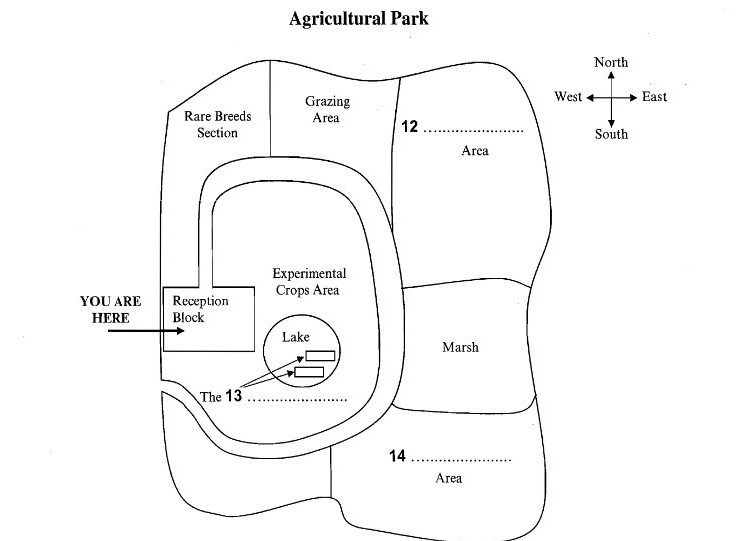
Questions 12–14 Plan Labeling
Label the plan below.
Write NO MORE THAN TWO WORDS for each answer.
Questions 15–20 One Choice
Choose the correct letter, A, B or C.
Answers & Explanations Summary
| # | Answer | Evidence | Explanation |
|---|---|---|---|
| Q11 | B | Our remit is to give educational opportunities to the wider public as well as to offer research sites for a wide variety of agriculturists and other scientists | Excerpt/Transcript Explanation: The transcript says that the park's official mission is to help the public learn new things and to give scientists a place to work on their research projects. Answer Explanation: The answer means that the two most important goals of the park are teaching people (education) and providing a place for scientists to do studies (research). Reason For Correctness: The correct answer is B because the speaker explicitly states that their 'remit'—which means their main job or goal—is twofold. First, they provide 'educational opportunities' for people to learn. Second, they provide 'research sites' for scientists like agriculturists to conduct studies. While the park is open to the public for visits, the speaker focuses on education and research as the core reasons for the park's existence. |
| Q12 | the Forest / Forest | Then further east . . . in the largest section of our Park is the Forest Area | Excerpt/Transcript Explanation: The transcript explains that the Forest Area is located further to the east and is the biggest part of the park. Answer Explanation: The answer is the Forest area, which is a place with many trees. Reason For Correctness: The correct answer is determined by following the directions mentioned in the transcript. The speaker describes moving east from the grazing area into the biggest part of the park, which is the Forest Area. This matches the label for that specific location on the map. |
| Q13 | Fish Farms / Fish Farm | These two small rectangular shapes here . . . are the Fish Farms where we rear fish for sale | Excerpt/Transcript Explanation: The transcript explains that the two small box-like shapes on the map are called the Fish Farms. This is the area where they take care of fish so they can sell them. Answer Explanation: The answer is Fish Farm(s), which refers to a place where people raise and grow fish. Reason For Correctness: The correct answer is determined by the speaker's description of the park's layout on a map. They point out two small rectangular shapes located in the middle area of the park and identify them specifically as the Fish Farms. This is where they raise fish to be sold later. |
| Q14 | Market Garden | In the south-eastern corner, beyond the marsh, is our Market Garden area, growing vegetables and flowers | Excerpt/Transcript Explanation: The transcript tells us that if you look at the bottom-right corner of the park map, past the wetland area for birds, you will find the 'Market Garden'. Answer Explanation: The answer is 'Market Garden', which refers to a specific place in the park where plants like vegetables and flowers are grown. Reason For Correctness: The correct answer is 'Market Garden' because the speaker describes the layout of the park and identifies the south-eastern corner as the location for this area. It is situated past (beyond) the marsh area. In this section, they grow flowers and vegetables. The term 'Market Garden' is used specifically to name this part of the park. |
| Q15 | C | All these areas can be visited by the general public for almost all the year . . . although . . . please take note of the large signs at the entrance to each area which tell . . . which tell you when certain areas are being used for particular controlled experiments and are therefore temporarily out of bounds to the public | Excerpt/Transcript Explanation: The transcript explains that people can visit these areas for most of the year. However, during certain times when experiments happen, those areas become 'temporarily out of bounds.' This means they are closed to the public for a short time. Answer Explanation: The answer means that the areas used for experiments are not open to visitors for a limited period of time each year. Reason For Correctness: The correct answer is C because the speaker mentions that while the park is mostly open, specific areas are 'temporarily out of bounds' when they are used for experiments. The word 'temporarily' means for a short time, which matches the idea of being closed for a short time every year. This contrasts with being 'open' almost all the year. |
| Q16 | A | Well you have a choice of means . . . all environmentally friendly . . . cars are banned in the park. We have bicycles which you can hire behind the Reception block . . . here . . . the healthy ones of you can go on foot and finally there's our electric tram, powered from solar cells | Excerpt/Transcript Explanation: The transcript explains that because normal cars are forbidden, visitors have three options: renting bicycles, walking on their own feet, or taking a special tram that uses power from the sun. Answer Explanation: The answer means that visitors can move through the park using an electric tram, by walking on foot, or by riding a bicycle. Reason For Correctness: The correct answer is A because the transcript clearly lists three ways to travel around the park and explicitly mentions that cars are not allowed. The speaker says visitors can hire 'bicycles', the active ones can go 'on foot' (which means walking), and there is also an 'electric tram'. Choice B is wrong because it mentions a solar car, but the transcript says cars are banned. Choice C is wrong because it mentions a bus, which is not mentioned as a choice for moving around. |
| Q17 | C | A good place to start on your tour is the Rare Breeds section. We keep goats, sheep and hens and other kinds of poultry. We are also thinking of bringing in cows and horses but we do not, as yet, have facilities for these bigger animals | Excerpt/Transcript Explanation: The transcript states that the park currently has goats, sheep, and hens. It explains that they are planning to get cows and horses later, but they do not have them right now. Answer Explanation: The answer C means that the park currently has goats and hens in its Rare Breeds section. Reason For Correctness: The correct answer is chosen because the transcript explicitly lists the animals currently living in the park. It mentions that they 'keep' (have or look after) goats, sheep, and hens. While the speaker mentions cows and horses, they clarify that these animals are only being considered for the future and are not there yet because the park lacks the necessary 'facilities' (buildings or equipment). Therefore, any choice including horses or cows is incorrect for the current time. |
| Q18 | B | These are very popular with the public but of course we mustn't lose sight of the main purpose of having this section, not as such to preserve rare animals but to maintain the diversity of breeds to broaden the gene pool for agricultural development | Excerpt/Transcript Explanation: The transcript says that even though many people like the Rare Breeds section, the real reason it exists is to keep many different types of animals. This variety helps with farming science. Answer Explanation: The answer means that the park wants to have many different kinds of animals living there. Reason For Correctness: The correct answer is B because the speaker explains that the most important reason (main purpose) for the Rare Breeds area is to keep a 'diversity of breeds.' In English, 'diversity' is a synonym for 'variety.' The text mentions that they do this to help make farming better in the future, rather than just saving individual animals or showing them to people. |
| Q19 | C | May will be perhaps our most spectacular month with the arrival of the Canada geese and when our fruit trees will be in full blossom, but there are interesting events on all year round . . . for example John Havers, our expert fly fisherman, is currently giving displays on the lake | Excerpt/Transcript Explanation: The transcript explains that while birds and flower blossoms are special for the month of May, the fishing expert is 'currently' (right now) giving shows on the lake. Answer Explanation: The answer means that visitors can watch a person show how to fish at the park right now. Reason For Correctness: The correct answer is C because the speaker uses the word 'currently' when talking about the fishing expert. 'Currently' means at the present time. The other options, like the birds arriving and the trees having flowers (blossom), are things that happen specifically in the month of May, not necessarily right now. The word 'displays' is used here to mean 'demonstrations' or shows. |
| Q20 | A | there is a wide selection of books on wildlife, some of them written by local authors, and the history of farming, including organic farming | Excerpt/Transcript Explanation: The transcript states that the shop offers many books about wildlife (animals) and the history of farming. Answer Explanation: The answer is A, which means the shop sells books about animals. Reason For Correctness: The correct answer is A because the transcript explicitly mentions that the shop has a large collection of books about 'wildlife'. In English, 'wildlife' is a common term used to describe animals, especially those living in nature. While the speaker mentions 'local authors', this refers to the people who wrote the books, not the topic of the books (which would be 'local traditions'). Similarly, 'history of farming' is mentioned, but not the history of the park itself. |
Transcript
Welcome to Green Vale Agricultural Park. As you know, we have only been open a week so you are amongst our first visitors. We have lots of fascinating indoor and outdoor exhibits on our huge complex, spreading hundreds of hectares. Our remit is to give educational opportunities to the wider public as well as to offer research sites for a wide variety of agriculturists and other scientists.
Let's start by seeing what there is to do. As you can see here on our giant wall plan, we are now situated in the Reception block . . . here. As you walk out of the main door into the park there is a path you can follow. If you follow this route you will immediately come into the Rare Breeds section, where we keep a wide variety of animals which I shall be telling you a little more about later. Next to this . . . moving east . . . is the large grazing area for the rare breeds. Then further east . . . in the largest section of our Park is the Forest Area. South of the grazing area and in fact just next to the Reception block is our Experimental Crop Area. In the middle of the Park . . . this circular area is our lake . . . These two small rectangular shapes here . . . are the Fish Farms where we rear fish for sale. To the east of those is the marsh area which attracts a great many migrant birds. In the south-eastern corner, beyond the marsh, is our Market Garden area, growing vegetables and flowers.
All these areas can be visited by the general public for almost all the year . . . although . . . please take note of the large signs at the entrance to each area which tell . . . which tell you when certain areas are being used for particular controlled experiments and are therefore temporarily out of bounds to the public.
You can see for yourself what a huge area the park covers and a key question is always, how can we move around? Well you have a choice of means . . . all environmentally friendly . . . cars are banned in the park. We have bicycles which you can hire behind the Reception block . . . here . . . the healthy ones of you can go on foot and finally there's our electric tram, powered from solar cells. You find more information about this at the front entrance.
A good place to start on your tour is the Rare Breeds section. We keep goats, sheep and hens and other kinds of poultry. We are also thinking of bringing in cows and horses but we do not, as yet, have facilities for these bigger animals. The animals are fed in public twice a day and a short lecture given on their feeding habits and nutritional needs. These are very popular with the public but of course we mustn't lose sight of the main purpose of having this section, not as such to preserve rare animals but to maintain the diversity of breeds to broaden the gene pool for agricultural development. Green Vale changes with the seasons with different events happening at different times of the year. May will be perhaps our most spectacular month with the arrival of the Canada geese and when our fruit trees will be in full blossom, but there are interesting events on all year round . . . for example John Havers, our expert fly fisherman, is currently giving displays on the lake. Each of the sections has its own seasonal calendar . . . please consult the summary board at the main entrance. And the final section, as we return to the Reception blocks, is the orchard.
Do take time to browse round our shop . . . there is a wide selection of books on wildlife, some of them written by local authors, and the history of farming, including organic farming, something which the park will be diversifying into in the coming months.