
Hydroculture - IELTS Listening Answers & Explanations
From IELTS Simulation Tests Academic Listening Test 08 · Part 3 · Questions 21–30
Audio
Questions
Questions 21–22 Sentence Completion
Complete the sentences below.
Write ONE WORD ONLY for each answer.
- In hydroculture, plants are grown with their roots in water so 21 is necessary for the upper part of the plant.
- LECA is made from 22.
Questions 23–25 Diagram Labeling
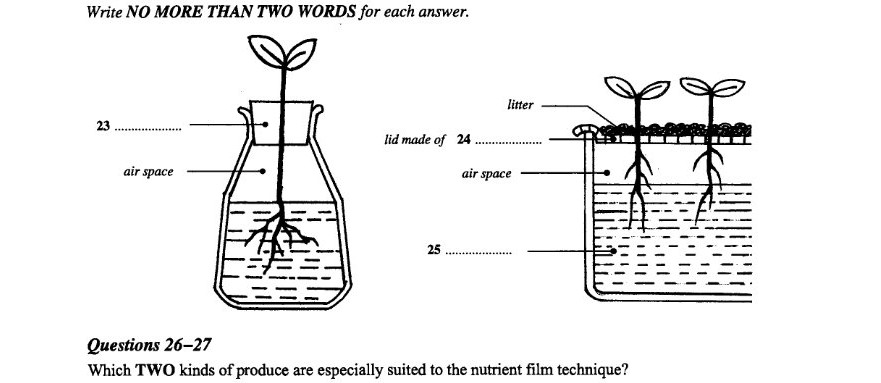
Label the diagram below.
Write NO MORE THAN TWO WORDS for each answer.
Questions 26–27 Two Choices
Choose TWO letters.
Questions 28–29 Two Choices
Choose TWO letters.
Questions 30–30 Short Answers
Write NO MORE THAN TWO WORDS for the answer.
Answers & Explanations Summary
| # | Answer | Evidence | Explanation |
|---|---|---|---|
| Q21 | support | TONY: In the true hydroponics method the roots are bathed with water and nutrient solution while support for the plant must be provided above the container | Excerpt/Transcript Explanation: The transcript explains that when plant roots are kept in water, extra physical support must be given above the container to keep the plant in place. Answer Explanation: The answer "support" refers to a structure or hold that keeps the plant standing upright. Reason For Correctness: The correct answer is confirmed when Tony describes the hydroponics method. He states that the roots stay in water and nutrient solution, but "support" must be given to the plant above the container to hold it up. Therefore, "support" is the missing word that fits the sentence. |
| Q22 | clay | TONY: It's a natural product manufactured from clay it's colourful, lightweight and perfect for allergy sufferers |
Excerpt/Transcript Explanation: The transcript shows Tony explaining that LECA is a natural product produced or made from clay. Answer Explanation: The answer "clay" is a natural, sticky earthy material that becomes hard when baked or dried. Reason For Correctness: The correct answer is "clay" because Tony explains what LECA is made of when the lecturer asks about it. He states that it is "manufactured from clay." In this context, "manufactured from" means "made from." |
| Q23 | the cork / cork | LECTURER: How did you get the plant through the cork? TONY: We made a hole through the centre and cut the cork in half so we could fit it around the plant stem and we padded the hole with cotton wool | Excerpt/Transcript Explanation: The transcript shows the lecturer and Tony discussing how they prepared the cork by cutting a hole in the middle and slicing it in half to hold the plant stem securely. Answer Explanation: The answer refers to "cork", a lightweight material often used to plug or seal bottles and jars, used here to hold the plant. Reason For Correctness: The correct answer is "cork" because the lecturer asks how the students managed to put the plant through the cork, and Tony explains that they cut the cork in half and made a hole in the middle to fit around the plant stem. |
| Q24 | wire mesh | LECTURER: Be sure to explain the purpose of the rigid lid—it's wire mesh, isn't it?—and why the litter layer is important too. ANNIE: Well, the mesh is just a platform to keep the litter out of the water and the primary function of the litter is to exclude light from the root space | Excerpt/Transcript Explanation: The transcript states that the hard cover (lid) of the container is made from wire mesh, which acts like a shelf to keep the covering material (litter) away from the water below. Answer Explanation: The answer refers to a material made of connected metal wires forming a net-like structure or grid, used as a rigid lid or platform. Reason For Correctness: The correct answer is "wire mesh" because when discussing the design of the larger container, the lecturer identifies the rigid lid holding the layer of litter as "wire mesh". Annie confirms this by explaining that the "mesh" functions as a platform to keep the litter above and out of the nutrient water solution. |
| Q25 | nutrient solution | We haven't quite finished the preparation yet, but over here you can see a bigger container—in fact, any wide container can be used—with the nutrient solution in the bottom, air space above and then we've made a rigid lid and we've covered that with a layer of litter |
Excerpt/Transcript Explanation: The transcript states that inside the container, the liquid containing nutrients sits at the bottom, beneath the air space and the covered lid. Answer Explanation: The answer refers to the liquid mixture containing plant food or nutrients located at the bottom of the growing container. Reason For Correctness: The correct answer is "nutrient solution" because Annie describes the setup of the container, explaining that it has "the nutrient solution in the bottom" with an air space above it and a rigid lid covered with litter. |
| Q26 | — | — | |
| Q27 | B / E | Well, we're going to demonstrate the nutrient film technique which is popular with some commercial growers, particularly for the cultivation of crops such as runner beans and tomatoes | Excerpt/Transcript Explanation: The transcript states that commercial growers like using the nutrient film method especially to grow runner beans and tomatoes. Answer Explanation: The answer choices (beans and tomatoes) identify the two types of crops that are especially well-suited to being grown using the nutrient film technique. Reason For Correctness: The correct answer choices are beans and tomatoes because Tony explicitly mentions that the nutrient film technique is popular among commercial growers "particularly for the cultivation of crops such as runner beans and tomatoes." In contrast, potatoes and yams are not suitable because they grow underground, and Tony explains that peas were "awfully tricky to grow using this method." |
| Q28 | — | — | |
| Q29 | C / E | TONY: You can have the solution moistening a substratum of rock wool at the bottom of the container. LECTURER: Rock wool? TONY: It's the same as mineral wool—you know a lightweight, fibrous material—the kind of thing used for insulation. Or, you can use a layer of paper fibre | Excerpt/Transcript Explanation: The transcript explains that the liquid solution can wet a base layer made of rock wool, which is also called mineral wool. In addition, Tony says you can use paper fibre as an alternative material for this layer. Answer Explanation: The answer states that mineral wool (choice C) and paper fibre (choice E) are two materials suitable for use as a substratum. Reason For Correctness: The correct answer is supported by Tony's description of alternative substratum materials. When asked about options for holding the solution, Tony mentions using a substratum of "rock wool" and clarifies that it is "the same as mineral wool." Immediately after, he mentions that "a layer of paper fibre" can also be used. |
| Q30 | outright failure / failure | ANNIE: And there's always the potential of outright failure when changing systems from one you know and understand to an innovative one | Excerpt/Transcript Explanation: The transcript explains that switching from a familiar growing system to a new, unfamiliar one carries the risk of complete failure. Answer Explanation: The answer means a complete breakdown or total lack of success. Reason For Correctness: The correct answer is "(outright) failure" because Annie explains the danger commercial growers face when switching methods. In her statement, "potential of" matches the keyword "risk" in the question, and "changing systems from one you know and understand to an innovative one" means "moving from an old system to a new one". |
Transcript
LECTURER: Good morning Annie, Tony. How are you?
ANNIE: Fine, thanks.
LECTURER: Well, tell me what you have here.
ANNIE: We thought we'd look at different methods of hydroculture.
LECTURER: Uh huh.
TONY: In the true hydroponics method the roots are bathed with water and nutrient solution while support for the plant must be provided above the container.
LECTURER: And...alternatively?
ANNIE: Alternatively, the plants can grow with their roots in a substratum such as sand, vermiculite or LECA granules.
TONY: LECA stands for Lightweight Expanded Clay Aggregate and vermiculite is...
LECTURER: Thank you Tony, I know what vermiculite is...but you should be prepared to give details about all these things to the visitors. Can you explain what the advantage of LECA is over traditional soil?
TONY: It's a natural product...manufactured from clay...it's colourful, lightweight and...perfect for allergy sufferers.
LECTURER: That's right. Now tell me why.
ANNIE: Because it's clean and hygienic, bacteria and soil diseases don't get a chance.
LECTURER: Well, you could say that on this chart here... "Ideal for household plants".
ANNIE: And we'll point out that the growing medium itself makes no contribution to feeding, which is provided in solution with the water.
LECTURER: Good, now tell me what you've got here.
ANNIE: This is a simple version of the first method, using a wide-necked jar which we've filled with water and nutrients, leaving space at the top. As the roots need to be in darkness we'll cover the sides of the glass with brown paper later.
LECTURER: How did you get the plant through the cork?
TONY: We made a hole through the centre and cut the cork in half so we could fit it around the plant stem and we padded the hole with cotton wool.
LECTURER: That's a good demonstration of the principle involved, and ideal for a house plant but many people will want to see a wider application—what about more plants?
ANNIE: We haven't quite finished the preparation yet, but over here you can see a bigger container—in fact, any wide container can be used—with the nutrient solution in the bottom, air space above...and then we've made a rigid lid and we've covered that with a layer of litter.
LECTURER: What have you used for litter?
ANNIE: We've used wood shavings...
LECTURER: Untreated?
ANNIE: Definitely. That's most important—you can use a variety of materials for litter but obviously nothing toxic and treated timber contains some nasty chemicals so, if you're using sawdust or wood shavings, they have to be from natural timber.
LECTURER: A good point...
TONY: Yes, we'll make a note of that when we list possible ingredients for litter.
LECTURER: Be sure to explain the purpose of the rigid lid—it's wire mesh, isn't it?—and why the litter layer is important too.
ANNIE: Well, the mesh is just a platform to keep the litter out of the water and the primary function of the litter is to exclude light from the root space...
LECTURER: Mmm. What you have so far is ideal for the home or office but what about commercial applications?
TONY: Well, we're going to demonstrate the nutrient film technique which is popular with some commercial growers, particularly for the cultivation of crops such as runner beans and tomatoes. Producers would really like to see some innovation in the cultivation of potatoes and yams too but obviously this technique is only suitable for those crops which grow above ground.
LECTURER: What about peas?
TONY: Well, we found peas were awfully tricky to grow using this method although we're still unsure as to the reason.
LECTURER: Where's the exhibit? I don't see it anywhere.
ANNIE: Well, that's because we haven't finished it yet because we're going to have to procure some mature plants first. We didn't think far enough ahead to have started them off earlier. And when we do get them, we'll have to handle them carefully.
TONY: Yes, because when our model is finished, you'll see how the plants are held in position by a plastic tube which almost encloses them completely and is quite loosely fastened around the stems.
LECTURER: Ye..es, and the feeding or watering system?
ANNIE: Well, it's a bit different—on a large scale like this, you need to have the food solution trickle down through the tubes...
TONY: Yes, but the solution must also be rich in oxygen...
LECTURER: And what—it just bathes the roots?
TONY: That's one way of doing it.
LECTURER: What's the other way?
TONY: You can have the solution moistening a substratum of rock wool at the bottom of the container.
LECTURER: Rock wool?
TONY: It's the same as mineral wool—you know a lightweight, fibrous material—the kind of thing used for insulation. Or, you can use a layer of paper fibre.
LECTURER: Oh, yes...something that has the capacity to absorb the solution, right?
ANNIE: Well, you do need to experiment a little. For example, we tried coconut fibre...
TONY: But it just didn't have the properties we were looking for...
LECTURER: I see.
TONY: In our display you'll only see the basics—the kind of thing that can be done at home in the back yard, but commercial enterprises do need a lot more equipment and the media used in substrata are constantly changing as new developments are made. The cost of upgrading is ongoing.
ANNIE: And there's always the potential of outright failure when changing systems from one you know and understand to an innovative one.
LECTURER: Of course. There's no room for guesswork in business—you have to try to get everything right first time.