
Minster Park - IELTS Listening Answers & Explanations
From Cambridge IELTS 15 Academic Listening Test 2 · Part 2 · Questions 11–20
Audio
Questions
Questions 11–14 One Choice
Choose the correct letter, A, B or C.
Minster Park
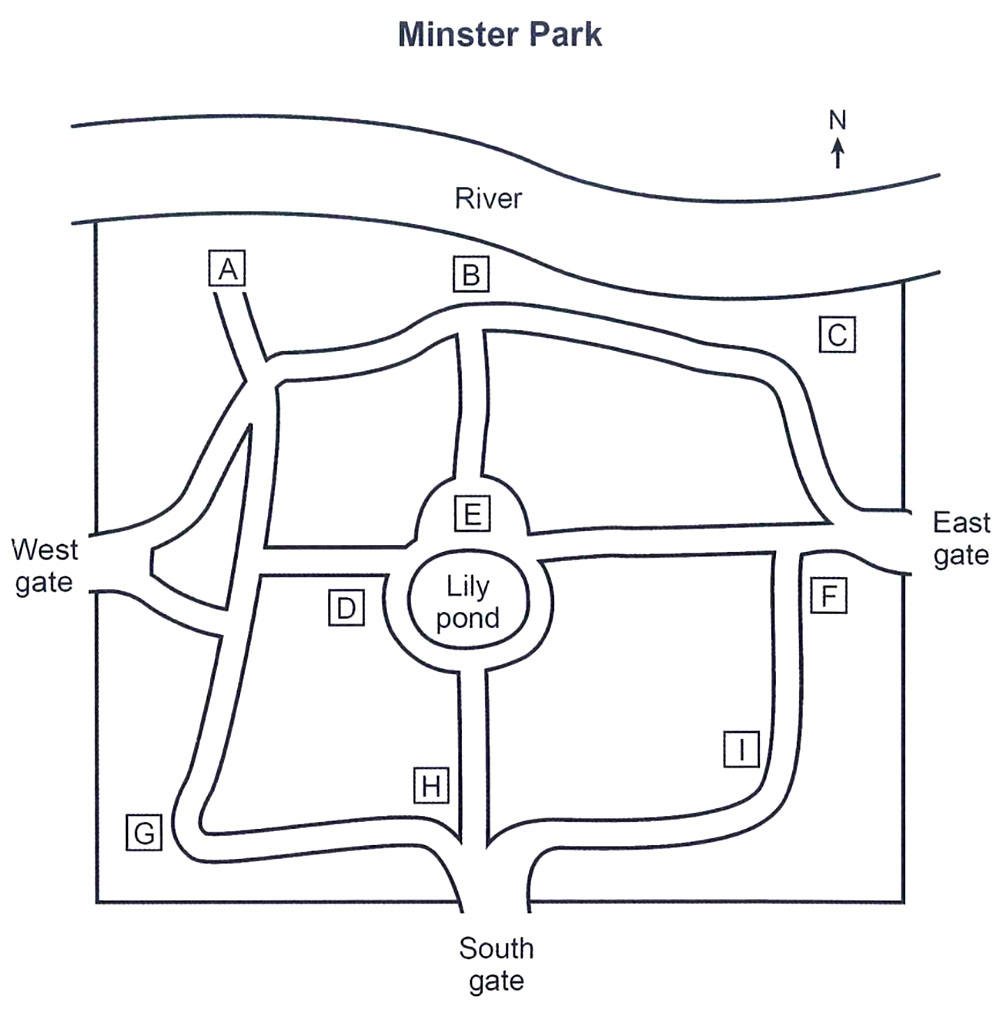
Questions 15–20 Map Labeling
Label the map below.
Write the correct letter, A-I, next to Questions.
Answers & Explanations Summary
| # | Answer | Evidence | Explanation |
|---|---|---|---|
| Q11 | C | unlike many public parks that started in private ownership, as the garden of a large house, for instance, Minster was some waste land, which people living nearby started planting with flowers in 1892. | Excerpt/Transcript Explanation: The transcript is saying that Minster Park was not originally part of a private house's garden like many other parks. Instead, it was wasteland that local people started turning into a park by planting flowers in 1892. Answer Explanation: The answer means that the park was established as a shared area set up by the local community. Reason For Correctness: The correct answer is C (as a shared area set up by the local community) because the excerpt mentions that Minster Park started as wasteland and people living nearby began planting flowers there in 1892. This shows that it was not initially a formal city council amenity or part of a private house's land, but rather a community effort to create a shared area for everyone. |
| Q12 | A | Diane Gosforth was one of those people, and she organised petitions and demonstrations | Excerpt/Transcript Explanation: The transcript mentions that Diane Gosforth organized petitions and demonstrations. Answer Explanation: The answer suggests that Diane Gosforth was a resident who helped to lead a campaign. Reason For Correctness: The correct answer is that Diane Gosforth was a resident who helped lead a campaign because the excerpt mentions her organizing petitions and demonstrations, which are actions commonly associated with leading a campaign. |
| Q13 | B | Soon after this the First World War broke out, in 1914, and most of the park was dug up and planted with vegetables, which were sold locally. | Excerpt/Transcript Explanation: The transcript tells us that during the First World War in 1914, the park was mainly used for planting vegetables, which were then sold locally. Answer Explanation: The answer choice B means that the park was used for growing vegetables. Reason For Correctness: The correct answer is B because the information from the excerpt directly states that during the First World War, the park's space was utilized for planting vegetables, which were later sold locally. This aligns perfectly with answer choice B, making it the correct selection. |
| Q14 | C | The changes finally got going in 2016, and were finished on schedule last year. | Excerpt/Transcript Explanation: The transcript tells us that the changes to Minster Park began in the year 2016 and were completed on time the following year. Answer Explanation: The answer choice C, which is 2016, matches the year mentioned in the excerpt. Reason For Correctness: The correct answer is C (2016) because the information in the excerpt directly states that the physical transformation of Minster Park started in 2016, aligning perfectly with the answer choice C. |
| Q15 | E | but it’s now immediately to the north of the lily pond, almost in the centre of the park | Excerpt/Transcript Explanation: The transcript mentions that the statue of Diane Gosforth is located to the north of the lily pond, which is almost at the center of the park. Answer Explanation: The answer 'E' corresponds to the statue of Diane Gosforth on the map. Reason For Correctness: The correct answer is E because the excerpt clearly states the location of the statue, which matches the position of E on the map. |
| Q16 | C | There’s a new area of wooden sculptures, which are on the river bank, where the path from the east gate makes a sharp bend. | Excerpt/Transcript Explanation: The transcript mentions a new area with wooden sculptures located on the river bank where the path from the east gate sharply bends. Answer Explanation: The answer represents the specific location of the wooden sculptures on the map. Reason For Correctness: The correct answer 'C' is based on the description that indicates the wooden sculptures are near the river bank where the path takes a sharp bend, which matches the location marked with 'C' on the map. |
| Q17 | B | that’s between the river and the path that leads from the pond to the river. | Excerpt/Transcript Explanation: The transcript mentions a location that is positioned between the river and a path connecting the pond to the river. Answer Explanation: The answer 'B' corresponds to the location of the playground on the map. Reason For Correctness: The correct answer is 'B' because the description in the excerpt matches the position of the playground on the map, which is indeed located between the river and the path connecting the pond to the river. Therefore, based on the given information, the playground is appropriately labeled as 'B'. |
| Q18 | A | That’s near the west gate – you go north from there towards the river and then turn left to reach it. | Excerpt/Transcript Explanation: The transcript is describing a location near the west gate. It advises to go north from there toward the river and then turn left to reach the location. Answer Explanation: The answer chosen indicates the location in the maze related to the directions provided in the excerpt. Reason For Correctness: The correct answer matches the described location near the west gate that can be reached by going north towards the river and then turning left, aligning perfectly with the guidance given in the excerpt. |
| Q19 | G | They’re still in the south-west corner of the park, where there’s a right-angle bend in the path. | Excerpt/Transcript Explanation: The transcript mentions that they are still located in the bottom left corner of the park, where the path makes a right-angle turn. Answer Explanation: The answer G is the correct choice for the location of the tennis courts. Reason For Correctness: The correct answer is G because the south-west corner of the park, where the path makes a right-angle bend, indicates the location of the tennis courts on the map, which is consistent with choice G. |
| Q20 | D | This is right next to the lily pond on the same side as the west gate. | Excerpt/Transcript Explanation: The transcript mentions a location next to a lily pond on the same side as the west gate. Answer Explanation: The answer indicates that the fitness area is labeled with the letter D on the map. Reason For Correctness: The correct answer is D because the description in the transcript matches the location of the fitness area on the map, which is on the same side as the west gate and next to the lily pond. |
Transcript
WOMAN:
I’m very pleased to welcome this evening’s guest speaker, Mark Logan, who’s going to tell us about the recent transformation of Minster Park. Over to you, Mark.
MARK:
Thank you. I’m sure you’re all familiar with Minster Park. It’s been a feature of the city for well over a century, and has been the responsibility of the city council for most of that time. What perhaps isn’t so well known is the origin of the park: unlike many public parks that started in private ownership, as the garden of a large house, for instance, Minster was some waste land, which people living nearby started planting with flowers in 1892. It was unclear who actually owned the land, and this wasn’t settled until 20 years later, when the council took possession of it.
You may have noticed the statue near one of the entrances. It’s of Diane Gosforth, who played a key role in the history of the park. Once the council had become the legal owner, it planned to sell the land for housing. Many local people wanted it to remain a place that everyone could go to, to enjoy the fresh air and natural environment – remember the park is in a densely populated residential area. Diane Gosforth was one of those people, and she organised petitions and demonstrations, which eventually made the council change its mind about the future of the land.
Soon after this the First World War broke out, in 1914, and most of the park was dug up and planted with vegetables, which were sold locally. At one stage the army considered taking in over for troop exercises and got as far as contacting the city council, then decided the park was too small to be of use. There were occasional public meetings during the war, in an area that had been retained as grass.
After the war, the park was turned back more or less to how it had been before 1914, and continued almost unchanged until recently. Plans for transforming it were drawn up at various times, most recently in 2013, though they were revised in 2015, before any work had started. The changes finally got going in 2016, and were finished on schedule last year.
————————
OK, let me tell you about some of the changes that have been made – and some things that have been retained. If you look at this map, you’ll see the familiar outline of the park, with the river forming the northern boundary, and a gate in each of the other three walls. The statue of Diane Gosforth has been moved: it used to be close to the south gate, but it’s now immediately to the north of the lily pond, almost in the centre of the park, which makes it much more visible.
There’s a new area of wooden sculptures, which are on the river bank, where the path from the east gate makes a sharp bend.
There are two areas that are particularly intended for children. The playground has been enlarged and improved, and that’s between the river and the path that leads from the pond to the river.
Then there’s a new maze, a circular series of paths, separated by low hedges. That’s near the west gate – you go north from there towards the river and then turn left to reach it.
There have been tennis courts in the park for many years, and they’ve been doubled, from four to eight. They’re still in the south-west corner of the park, where there’s a right-angle bend in the path.
Something else I’d like to mention is the new fitness area. This is right next to the lily pond on the same side as the west gate.
Now, as you’re all gardeners, I’m sure you’ll like to hear about the plants that have been chosen for the park.