
Preparations For Teaching Practice - IELTS Listening Answers & Explanations
From IELTS Practice Test Plus 3 Academic Listening Test 2 · Part 3 · Questions 21–30
Audio
Questions
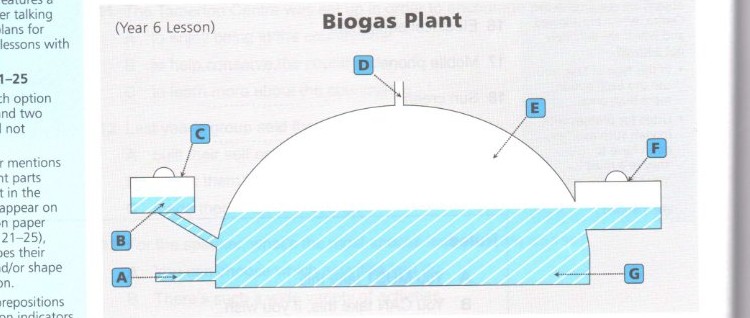
Questions 21–25 Diagram Labeling
Label the diagram below.
Write the correct letter, A-G, next to questions 21-25 below.
Questions 26–30 Flow Chart Completion
Complete the flow chart below.
Choose FIVE answers from the box and write the correct letter, A-G, next to questions 26-30.
A. Identify sequence. | B. Ask questions. | C. Copy.
D. Demonstrate meaning. | E. Distribute worksheet. | F. Draw pictures.
G. Present sentences.
LESSON OUTLINE YEAR THREE
TOPIC: ENERGY
ACTIVITIES
Teacher: Introduce word
Pupils: look and listen
↓
Teacher: 26
Pupils: look and listen
↓
Teacher: Present question
Pupils: respond
↓
Teacher: 27
Pupils: 28 and expand
↓
Teacher: Display pictures
Pupils: 29
↓
Teacher: 30
Pupils: write
↓
Teacher: Monitor pupils
Answers & Explanations Summary
| # | Answer | Evidence | Explanation |
|---|---|---|---|
| Q21 | C | The smaller container on the left is where you put the waste you've collected | Excerpt/Transcript Explanation: The transcript explains that there is a small tank or box on the left side of the diagram. This is the place where people put the trash or old material they have gathered to make fuel. Answer Explanation: The answer C refers to the part of the drawing that shows the small box on the left side. Reason For Correctness: The correct answer is C because Eve mentions that the small container located on the left is used to hold the waste that has been gathered. In the diagram, letter C points to this specific part on the left side of the machinery. Key words to listen for are 'smaller container' and 'left', which identify the specific area for the waste. |
| Q22 | G | And that's slurry on the base of the larger tank | Excerpt/Transcript Explanation: The transcript explains that the slurry is located at the very bottom part of the main container. Answer Explanation: The answer G is the letter on the diagram that marks where the substance called "slurry" is found. Reason For Correctness: The correct answer is G because Eve identifies slurry as the mixture located at the bottom, or 'base,' of the big container. In a biogas plant, this mixture of waste and water stays at the bottom while gas rises to the top. |
| Q23 | A | Tutor: So, is that pipe at the bottom where the water comes in? Eve: Yes it is. As the slurry mixture digests, it produces gas, and that rises to the top of the dome. Then when it's needed, it can be piped off for use as fuel in homes or factories. It's very simple | Excerpt/Transcript Explanation: The transcript shows the teacher asking about a pipe at the bottom that brings water into the tank, and Eve confirms this is exactly what that pipe does. Answer Explanation: The answer A is the part of the diagram that shows where water goes into the machine. Reason For Correctness: The correct answer is A because the professor asks if the 'pipe at the bottom' is where the 'water comes in.' An 'inlet' is a technical word for an opening or pipe where something enters. Eve confirms that this pipe is for the water, which matches the label 'water inlet.' |
| Q24 | E | As the slurry mixture digests, it produces gas, and that rises to the top of the dome | Excerpt/Transcript Explanation: The transcript explains that as the mixture is processed, it makes gas, and that gas moves up into the highest area of the structure. Answer Explanation: The answer E is the location where gas is found in the diagram of the biogas plant. Reason For Correctness: The correct answer E is chosen because the transcript describes the process of creating fuel from waste. Eve explains that when the mixture (slurry) breaks down or 'digests', it creates gas. She specifically points out that this gas moves upward or 'rises to the top of the dome'. Therefore, the label at the highest point of the main tank (E) represents the gas. |
| Q25 | F | That's the overflow tank, that container on the right. As the slurry expands, some of it flows into that, and then once some of the gas has been piped off, the slurry level goes down again and the overflow tank empties again | Excerpt/Transcript Explanation: The transcript talks about a container on the right side called the overflow tank. It says that when the waste mixture gets bigger, it moves into that tank. Answer Explanation: The answer is the letter F which matches the part of the picture used for the overflow tank. Reason For Correctness: The correct answer is F because Eve identifies the overflow tank as the container located on the right side of the equipment. She explains that it works like a safety valve to handle pressure. If the liquid (slurry) inside the main tank takes up too much space (expands), the extra liquid goes into this container on the right. |
| Q26 | D | Then I'll do a little mime, you know, run on the spot or something to convey the sense | Excerpt/Transcript Explanation: The transcript shows Eve's plan to act out the word by running in one place to help the children understand what the word 'energy' smells and feels like. Answer Explanation: The answer means that the teacher will use physical actions to show the students the meaning of a word. Reason For Correctness: The correct answer is D because Eve explains that she will use a 'mime'—which involves acting without speaking—by 'running on the spot'. She does this to 'convey the sense' (meaning) of the word 'energy' to her young students. This specific teaching technique is a way to demonstrate the meaning through movement so that the students can understand the concept visually. |
| Q27 | G | Then I've produced a set of simple statements, like energy makes cars move along the road and energy makes our bodies grow. There are eight altogether First, I'll write them up on the board, and then I'll read them out loud, and I'll get the pupils to copy them out in their notebooks |
Excerpt/Transcript Explanation: The transcript explains that Eve has prepared eight sentences about energy. She plans to show these to the class by writing them on the board and reading them to the students. Answer Explanation: The answer 'G' means the teacher shows several sentences to the students to start the next part of the lesson. Reason For Correctness: The correct answer is 'G' because Eve, the trainee teacher, mentions that she has prepared eight 'statements.' A 'statement' is another word for a sentence. To 'present' these, she explains that she will 'write them up on the board' so the children can see them before they move on to the next task. |
| Q28 | C | First, I'll write them up on the board, and then I'll read them out loud, and I'll get the pupils to copy them out in their notebooks. I'll also ask them to think up one more similar statement by themselves and add it to the list | Excerpt/Transcript Explanation: The transcript explains that the teacher will show sentences to the class, and the students will write those sentences down. After that, the students will try to write one more sentence of their own to add to the group. Answer Explanation: The answer "C" means the students will write down exactly what the teacher has written on the board into their own books. Reason For Correctness: The correct answer is "C" because the teacher, Eve, explains that after she writes and reads sentences (statements), she will have the students "copy" them into their notebooks. In the flow chart, this happens at the same step where students "expand" the list. This expansion refers to her plan for the students to create and add one new statement of their own to the list they just copied. |
| Q29 | A | And I'll get the pupils to work out what order the pictures should come in, in terms of the energy chain | Excerpt/Transcript Explanation: The transcript shows that the teacher wants her students to decide the correct order for the pictures based on how energy moves from one thing to another. Answer Explanation: The answer A means that the students will figure out the correct order of the items shown to them. Reason For Correctness: The correct answer is A because, in the transcript, Eve explains that she will show pictures like the sun, plants, and food. She then states that she wants the students to 'work out what order' these pictures belong in. In English, 'order' is a synonym for 'sequence,' and to 'identify' means to 'work out' or find the correct answer. |
| Q30 | E | And to finish off, I've made a gap-fill exercise to give out. They'll be doing that individually, and while they're writing, I'll walk round and check their work | Excerpt/Transcript Explanation: The transcript shows that for the final activity, the teacher hands out a specific writing task (a gap-fill exercise) for the students to complete at their desks. Answer Explanation: The answer means the teacher gives papers with a task (a worksheet) to the students. Reason For Correctness: The correct answer is E because Eve says she will end the lesson with a 'gap-fill exercise.' In a school setting, giving out a 'gap-fill exercise' is the same as 'distributing a worksheet.' The transcript also mentions the pupils will be 'writing' while the teacher 'walks round and checks,' which matches the flow chart steps for the teacher giving out work and then monitoring the class. |
Transcript
Narrator: Test 2, section 3. You will hear a trainee teacher called Eve, talking to her university tutor about her preparations for teaching practice. Before you listen, you have some time to look at questions 21 to 25. Now listen and answer questions 21 to 25.
Tutor: Hello Eve. Come in and sit down. How's it going?
Eve: Fine thanks. I'm looking forward to my teaching practice next week.
Tutor: Good. Now you've got two classes, haven't you? Year 3 and Year 6. Have you done your lesson plans?
Eve: Well, I've decided to take the topic of renewable energy. I haven't done a lesson plan for Year 6 yet, but I thought I'd base their lesson on an example of very simple technology. So, I've brought this diagram to show you. I got it from the internet.
Tutor: Let's see. A biogas plant. So this is equipment for producing fuel from organic waste?
Eve: Yes. The smaller container on the left is where you put the waste you've collected.
Tutor: Right, and from there it's piped into the larger tank.
Eve: That's right. And that's slurry on the base of the larger tank.
Tutor: Right, and what exactly is slurry?
Eve: It's a mixture of organic waste and water.
Tutor: So, is that pipe at the bottom where the water comes in?
Eve: Yes it is. As the slurry mixture digests, it produces gas, and that rises to the top of the dome. Then when it's needed, it can be piped off for use as fuel in homes or factories. It's very simple.
Tutor: I suppose there's some kind of safety valve to prevent pressure build-up.
Eve: That's the overflow tank, that container on the right. As the slurry expands, some of it flows into that, and then once some of the gas has been piped off, the slurry level goes down again and the overflow tank empties again.
Tutor: I see. Well I think that's suitably simple for the age level it's for. I look forward to seeing the whole lesson plan.
Eve: Thanks. And can I show you my ideas for the Year 3 lesson?
Tutor: Of course. Let's look.
Narrator: Before you listen to the rest of the conversation, you have some time to look at questions 26 to 30. Now listen and answer questions 26 to 30.
Eve: I thought I'd introduce the topic by writing the word energy on the board and reinforcing the spelling and the pronunciation. Then I'll do a little mime, you know, run on the spot or something to convey the sense.
Tutor: I'd keep it brief at this stage.
Eve: Yes, I will. Then I'll wipe the word off and write the question "where does energy come from?" and see what the pupils come up with.
Tutor: Fine. I'd suggest that you just brainstorm at this stage and don't reject any of their suggestions.
Eve: Yes, that's what I was going to do. Then I've produced a set of simple statements, like energy makes cars move along the road and energy makes our bodies grow. There are eight altogether.
Tutor: Are you going to give them out as a handout or write them up on the board?
Eve: First, I'll write them up on the board, and then I'll read them out loud, and I'll get the pupils to copy them out in their notebooks. I'll also ask them to think up one more similar statement by themselves and add it to the list.
Tutor: Good idea.
Eve: After that, I thought I'd vary things a bit by sticking some pictures up. Of things like the sun and plants and food and petrol and a running child. And I'll get the pupils to work out what order the pictures should come in, in terms of the energy chain.
Tutor: I think that's a very good idea. You could move the pictures around as the pupils give you directions.
Eve: Yes, I think they'd enjoy that. And to finish off, I've made a gap-fill exercise to give out. They'll be doing that individually, and while they're writing, I'll walk round and check their work.
Tutor: Good. And have you worked out the timing of all that? It'll probably take you right through to the end of the lesson.
Narrator: That is the end of section 3. You now have half a minute to check your answers. Now turn to section 4.