
Preparing a Presentation on Solar Water Heating - IELTS Listening Answers & Explanations
From Expert on Cambridge IELTS 08 Academic Listening Test 4 · Part 3 · Questions 21–30
Audio
Questions
Questions 21–25 One Choice
Circle the correct letter A-C.
Questions 26–30 Diagram Labeling
Label the following diagram.
Answers & Explanations Summary
| # | Answer | Evidence | Explanation |
|---|---|---|---|
| Q21 | B | I've got all the information, but I can't seem to organise it into a presentation | Excerpt/Transcript Explanation: The transcript shows Lyn stating that she collected all the facts, but she is struggling to arrange everything into a proper presentation. Answer Explanation: The answer means that Lyn is finding it hard to put her information into good order for her talk. Reason For Correctness: The correct answer is B because Lyn clearly explains her problem at the start of the conversation. When Miley asks about the project, Lyn says she already has all the facts and details, but she cannot arrange or structure them into a presentation. The keyword in the question is "difficulty", which matches Lyn's words "can't seem to organise". Choice A is incorrect because she says she has "all the information", and Choice C is incorrect because Miley mentions the time limit, not Lyn as the main reason for her problem. |
| Q22 | B | in this presentation I am focusing on solar power and its application as a domestic water heater | Excerpt/Transcript Explanation: The transcript says that during her presentation, the speaker will concentrate specifically on solar power and how it is used to heat water in homes. Answer Explanation: The answer B means that the main topic of her talk is water heaters that run on solar energy. Reason For Correctness: The correct answer is B because Lyn clearly states what she will concentrate on in her talk. She explains that she is focusing on using solar energy to heat domestic water, which directly means solar-powered water heaters. Keywords to note are 'focusing on', 'solar power', and 'domestic water heater'. |
| Q23 | C | As most people are aware, fossil fuels and other such non-renewable sources are by definition finite, so something needs to be in operation soon | Excerpt/Transcript Explanation: The transcript states that fossil fuels cannot be replaced and have an end, which is why other energy sources must be used soon. Answer Explanation: The answer means that we must search for new types of energy because fossil fuels will run out eventually. Reason For Correctness: The correct answer is C because Lyn explains that we need to look for alternative energy sources because fossil fuels are "finite." The word **finite** means limited or having an end, which directly matches the idea that **fossil fuels are limited**. |
| Q24 | A | solar power converters use this energy without needing any complex moving parts | Excerpt/Transcript Explanation: The transcript explains that the machines turning sunlight into power work without any complicated moving pieces, meaning they use simple mechanisms. Answer Explanation: The answer means that solar power is a great choice because we can collect and use it using machines that are simple and not complicated. Reason For Correctness: The correct answer is A because Lyn states that solar power equipment collects and uses this energy "without needing any complex moving parts." The phrase "without needing any complex moving parts" matches the idea of "simple technology." Choice B is incorrect because Lyn mentions scientists argue sunlight is "not finite" (it is not considered truly infinite, or there is debate around it being finite, but more importantly, it is not simply stated as infinite). Choice C is incorrect because she notes it does not work as well in cooler places like the UK compared to warmer climates. |
| Q25 | A | Given a sufficient size of solar panel and water storage tank, solar power can provide all of our water-heating requirements in June and July, and even provide the majority until October. From October to the end of the year, this figure falls dramatically. December is the least productive, being able to supply less than 5% of the average household's hot water requirement. It is at this point that solar power needs to be supplemented with a more traditional form of heating. From January solar power becomes more effective at a rate of about 20% per month, although this rise decelerates to around 16% by May | Excerpt/Transcript Explanation: The transcript explains that solar heating meets 100% of hot water needs in June and July, drops to under 5% in December, and begins to rise again starting in January. Answer Explanation: The answer A refers to the graph that correctly shows the changes in solar water-heating power throughout the year. Reason For Correctness: The correct answer is A because Lyn describes how solar energy provides hot water during different months of the year. She explains that it supplies 100% ("all") in June and July, continues to provide most of the hot water through October, and then drops sharply to below 5% in December. Starting in January, it increases steadily again. Graph A accurately matches these percentages and trends across the months. |
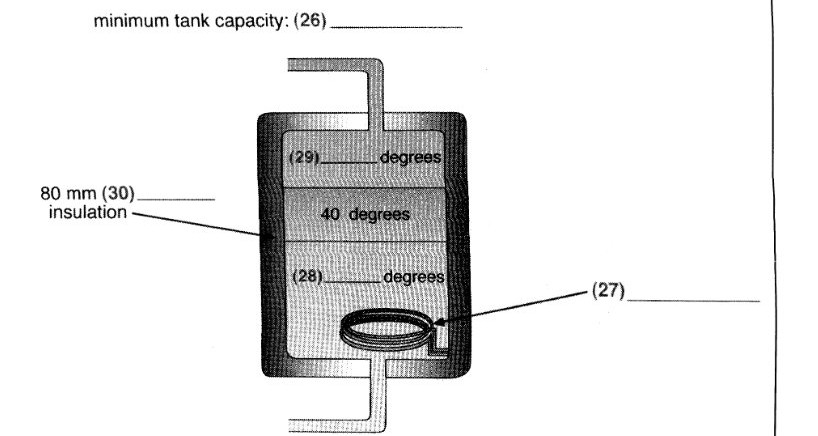
| Q26 | 40 litres / 40 liters | the ideal water tank in the UK has a capacity of 45 to 50 litres, but must be at least 40 litres to be effective | Excerpt/Transcript Explanation: The transcript states that while the best tank size is between 45 and 50 litres, the tank has to hold at least 40 litres to work properly. Answer Explanation: The answer refers to 40 litres, which represents the minimum capacity a water tank must hold to work effectively. Reason For Correctness: The correct answer is 40 litres because Lyn mentions that although a tank ideally holds 45 to 50 litres, it "must be at least 40 litres to be effective". Key terms like "at least" indicate this is the minimum capacity required for the tank. |
| Q27 | solar coil | The solar coil is put in the bottom of the tank to heat the water | Excerpt/Transcript Explanation: The transcript explains that the solar coil is placed in the bottom section of the water tank in order to heat the water. Answer Explanation: The answer "solar coil" refers to a curved metal pipe heated by sun energy that sits inside the tank to warm up the water. Reason For Correctness: The correct answer is "solar coil" because when Lyn describes the parts of the water tank illustration, she specifically identifies the component located at the bottom used to heat the water as the "solar coil". |
| Q28 | 20 | The bottom half of the tank is normally 20 degrees, and this is why it is important not to have a tank that is too large as it would take too much energy to heat | Excerpt/Transcript Explanation: The transcript explains that the lower section of the water heater tank usually stays at 20 degrees. Answer Explanation: The answer means the temperature number 20 (degrees). Reason For Correctness: The correct answer is 20 because Lyn explains the temperatures in different parts of the water tank. She specifically mentions that the "bottom half of the tank" usually has a temperature of "20 degrees". Therefore, the label for this lower section is 20. |
| Q29 | 65 | Don't forget that hot water rises, so the top third of the tank is the hottest, and reaches an average temperature of 65 degrees | Excerpt/Transcript Explanation: The transcript states that warm water floats to the top, so the upper third of the tank has the highest temperature and gets to an average of 65 degrees. Answer Explanation: The answer is the number 65, which refers to 65 degrees (the temperature of the water at the top section of the tank). Reason For Correctness: The correct answer is 65 because Lyn describes the different temperature levels in the water tank. She explains that warmer water goes up, making the very top third section the hottest part, where it reaches an average temperature of 65 degrees. |
| Q30 | rigid foam | Miley: And what's this second layer around the tank? Lyn: Oh that's Insulation. Because the tank is often either outside or just under the roof, rigid foam is used as an Insulation layer | Excerpt/Transcript Explanation: The transcript explains that the outer protective layer surrounding the water tank is insulation made out of rigid foam. Answer Explanation: The answer "rigid foam" refers to a stiff, firm type of lightweight spongy material used to keep heat from escaping. Reason For Correctness: The correct answer is confirmed when Miley asks about the second layer around the water tank. Lyn explains that this layer is insulation and specifically states that "rigid foam is used as an Insulation layer". Therefore, the material labeling that layer is "rigid foam". |
Transcript
Miley: Hi Lyn. How's your project coming along?
Lyn: Oh, not very well. I've got all the information, but I can't seem to organise it into a presentation.
Miley: Well you'd better hurry. You only have one more week.
Lyn: Yes, that's OK, it's just that ... ohh ... (sound of desperation).
Miley: Well, why don't you try your presentation on me. Maybe I can help.
Lyn: Really? Great! OK., well, I've chosen solar power for my subject, and I'm going to talk specifically about domestic water heating. You know, like the ones popular in America. I've got some facts here.
Miley: That's good, but just start your presentation from the beginning.
Lyn: Oh, right. Here we go then. There are many reasons why we should be looking elsewhere for energy sources. As most people are aware, fossil fuels and other such non-renewable sources are by definition finite, so something needs to be in operation soon. Currently, there are a number of alternative energy sources available which can, with a little preparation, be used to provide for a significant part of our domestic energy requirements, in this presentation I am focusing on solar power and its application as a domestic water heater. As a renewable energy source, solar power is in many ways ideal. The amount of the sun's energy which reaches the Earth every minute exceeds the energy that the global population consumes in a year. Although scientists argue that it is not finite, sunlight is certainly a long-lasting resource which is not depleted through use, and solar power converters use this energy without needing any complex moving parts. Once collected and stored, solar energy can be used for many purposes, but it is becoming increasingly popular as a domestic heating source. Generally a building that is heated by solar power will have its water heated by solar power as well, and this has even worked in areas that are not exposed to long hours of direct sunlight such as the United Kingdom, although not so well as in warmer climates ... (long pause)
Miley: Why have you stopped?
Lyn: Well, that's all I've got so far.
Miley: Oh. Well, start by talking about how effective it is.
Lyn: Oh, OK. Well, there are a number of factors that influence how efficient solar power can be. The first, obviously, is the amount of sunlight, and this is dependent on season, time of day, and climate. Although the UK has something of a bad reputation for sunshine, it is actually quite productive during some parts of the year. Given a sufficient size of solar panel and water storage tank, solar power can provide all of our water-heating requirements in June and July, and even provide the majority until October. From October to the end of the year, this figure falls dramatically. December is the least productive, being able to supply less than 5% of the average household's hot water requirement. It is at this point that solar power needs to be supplemented with a more traditional form of heating. From January solar power becomes more effective at a rate of about 20% per month, although this rise decelerates to around 16% by May.
Miley: Now say something about this water heater. Do you have any Information about that?
Lyn: Yes, I've got an Illustration of a water tank here.
Miley: That's good, but you'll have to describe it.
Lyn: Right. Well, the ideal water tank in the UK has a capacity of 45 to 50 litres, but must be at least 40 litres to be effective. The solar coil is put in the bottom of the tank to heat the water. Now, remember that solar-heated water will not get quite as hot as fossil fuel water heaters. The bottom half of the tank is normally 20 degrees, and this is why it is important not to have a tank that is too large as it would take too much energy to heat. In this illustration, it rises to 40 degrees from halfway up. Don't forget that hot water rises, so the top third of the tank is the hottest, and reaches an average temperature of 65 degrees.
Miley: And what's this second layer around the tank?
Lyn: Oh that's Insulation. Because the tank is often either outside or just under the roof, rigid foam is used as an Insulation layer. It should be at least 50 mm thick all around.
Miley: That seems like a good presentation. All you need to do is to prepare some short notes and a larger illustration so you can use it as a demonstration and you'll be fine.
Lyn: You think so? Well, thanks very much for the help. Maybe I can do the same for you one day.
Miley: Maybe. Anyway, I have to go. Good luck!
Lyn: Thanks. Bye.