
Supersave Supermarket’s Website Design - IELTS Listening Answers & Explanations
From IELTS Practice Test Plus 2 Academic Listening Test 5 · Part 4 · Questions 31–40
Audio
Questions
Questions 31–34 Flow Chart Completion
Complete the flow chart below.
Write ONE WORD for each answer.
Research methodology
STAGE 1
Discussion with supermarket department manager to decide on the store's 31 for the website
↓
Decision to investigate website use as a 32 way for customers to communicate problems
STAGE 2
Design of questionnaire to identify customers' experiences and 33 to problems
↓
Data collected from 34 with customers in four branches of the supermarket
↓
Analysis of responses
Questions 35–40 One Choice
Choose the correct letter, A, B or C

Answers & Explanations Summary
| # | Answer | Evidence | Explanation |
|---|---|---|---|
| Q31 | requirements | First, I had an interview with Mr Dunne, who is in charge of Supersave's customer care department. I discussed the project with him in order to identify the supermarket's requirements | Excerpt/Transcript Explanation: The transcript shows that the speaker met with the person in charge of customer care to learn what the supermarket needed (its requirements) for the website project. Answer Explanation: The answer refers to the specific needs or things that the supermarket wanted for the new website. Reason For Correctness: The correct answer is derived from the first stage of the speaker's project. The speaker explains that they spoke with Mr. Dunne, the department manager, to find out exactly what the supermarket needed for the website. In the transcript, the word used for these needs is 'requirements,' which fits perfectly into the template describing the goal of their discussion. |
| Q32 | private | So he said a website which allowed members of the public to get in touch with the organisation and bring the problem to their attention in a private manner might be very useful, and we agreed that I'd work on this | Excerpt/Transcript Explanation: The transcript shows that the manager suggested a website so people could report problems in a private way, and the student agreed to do this. Answer Explanation: The answer 'private' means something that is done hidden from other people or done alone rather than in public. Reason For Correctness: The correct answer comes from the conversation with Mr. Dunne. He mentions that shoppers feel uncomfortable complaining to a person directly. Therefore, they decided to make a website so customers could send their complaints in a 'private' way. 'Private' describes a method of communication where only the sender and the receiver know about the message, avoiding the discomfort of a face-to-face interaction. |
| Q33 | attitudes | I needed to find out about the customers' experiences of problems, together with their attitudes towards making complaints, both directly and indirectly | Excerpt/Transcript Explanation: The transcript explains that the researcher wanted to discover what happened to customers and how they felt about telling the store when something went wrong. Answer Explanation: The answer "attitudes" means the feelings or thoughts people have about a specific topic. Reason For Correctness: The correct answer is "attitudes" because the speaker created a questionnaire to understand two main things from the customers. They wanted to know about the "experiences" people had (the actual problems) and their "attitudes" (how they felt or what they thought) about making complaints when those problems occurred. |
| Q34 | interviews | I decided to do interviews rather than rely on distribution of the questionnaire, as I felt this was likely to lead to a higher take-up rate. I visited four Supersave stores, two in the city centre and two in the outskirts and altogether I interviewed 101 respondents | Excerpt/Transcript Explanation: The transcript shows that the speaker did not just hand out papers (questionnaires); they personally went to four different stores to conduct interviews (talking to people) to get their data. Answer Explanation: The answer 'interviews' refers to the set of meetings where the researcher asked people questions face-to-face to get information for the project. Reason For Correctness: The correct answer is 'interviews' because the speaker specifically mentions choosing this method to gather data from customers. In the fourth paragraph, they explain that they visited four stores (two in the city centre and two in the outskirts) and spoke directly with 101 people. This method was chosen over just handing out questionnaires because it helped get more people to participate (a higher take-up rate). |
| Q35 | B | I found that out of the total number of customers investigated, 64 percent had at some stage encountered a problem in a Supersave store | Excerpt/Transcript Explanation: The transcript says that among all the customers who were interviewed, 64 percent of them had a problem at a Supersave store at some time. Answer Explanation: The answer shows that 64% of the people surveyed said they had a problem at the supermarket. Reason For Correctness: The correct answer is found by looking at the results of the survey mentioned in the talk. The speaker explains that after interviewing 101 customers, they figured out the percentages for different answers. The speaker specifically says that 64 percent of these people had 'encountered' a problem, which is another way of saying they 'experienced' a problem. |
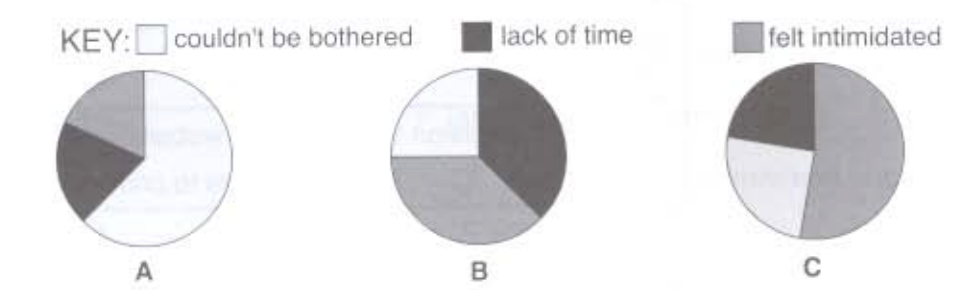
| Q36 | C | Well, about 25 percent of the people I interviewed said the reason was that they couldn't be bothered, and a slightly smaller percentage said they didn't have enough time, but 55 percent said the reason was that they felt intimidated | Excerpt/Transcript Explanation: The transcript provides the exact percentages for the items in the chart: 25% were not bothered, less than 25% lacked time, and 55% felt intimidated. Answer Explanation: The answer C is the pie chart that shows the right sizes for each reason customers gave for not complaining to the store staff. Reason For Correctness: The correct answer is C because it accurately reflects the data mentioned in the talk. The speaker lists three specific reasons: 55% of people felt 'intimidated' (meaning they felt nervous or scared), which is more than half of the circle. Another 25% 'couldn't be bothered' (meaning they were not interested or active enough), which is exactly one-quarter of the circle. Lastly, a 'slightly smaller' number of people didn't have enough time. Pie chart C is the only one that shows a large section for being intimidated, a perfect quarter for being unbothered, and a smaller section for lack of time. |
| Q37 | B | Mr Dunne said he felt that the pages would benefit his organisation by giving customers a new way of expressing their complaints, and by making it easier to collect complaints, identify specific places where service and customer care were not as good as they should be, and act upon them accordingly | Excerpt/Transcript Explanation: The transcript shows that the manager thinks the website is useful for finding out exactly which parts of their customer service need help so they can fix those issues. Answer Explanation: The answer means that the website will help the supermarket find specific parts of their service or locations that are having trouble. Reason For Correctness: The correct answer is B because the manager, Mr. Dunne, explicitly mentions that the website makes it easier to 'identify specific places where service and customer care were not as good as they should be.' This allows the supermarket to see exactly where improvements are needed, which is the same as identifying 'problem areas.' |
| Q38 | B | But this access wasn't always direct - for some people it was through their children and grandchildren and neighbours and so on, rather than being readily available in their own homes | Excerpt/Transcript Explanation: The transcript explains that some people can only use the internet by asking family members or neighbors for help, instead of having a computer ready to use in their own house. Answer Explanation: The answer means that some shoppers do not have a computer of their own in their house. Reason For Correctness: The correct answer is B because the student mentions that while many people can use the internet, it is not always easy for them to do so from home. The student explains that some people have to use the computers of their family or neighbors. This shows that the main issue is not a total lack of 'access' (Choice C), but rather a lack of personal ownership or 'direct' access in their own residence. Keywords to note are 'direct' access and 'readily available', which contrast with having to use someone else's device. |
| Q39 | A | Another thing to consider is that at the moment I can only base our conclusions on data gathered from a tiny fraction of the supermarket's customer base. In order to get a better idea of how the site is doing and to see how well I have met my objectives, the site will need to have been up and running for at least a few months | Excerpt/Transcript Explanation: The transcript explains that the current information is based on only a 'tiny fraction' (very small number) of customers. It says the website needs to be active for 'at least a few months' so they can see if it really works for everyone. Answer Explanation: The answer means that because the researcher only talked to a very small number of the store's total customers, they need to watch how the website is used over a longer period of time. Reason For Correctness: The correct answer is A because the speaker mentions that their current information comes from a 'tiny fraction' (a very small part) of all the supermarket's customers. In research, a 'sample' is the group of people you study to represent everyone. Since this group was very small, the results might not be complete yet. To fix this, more 'observation' (watching how people use the site) is needed over several months to get better data. |
| Q40 | C | But also, the site could boost morale by making staff come together to overcome the constructive criticism, and they may gain more job satisfaction by knowing that they are making a difference to the customer | Excerpt/Transcript Explanation: The transcript explains that the website might help staff feel better about their work (boost morale) because it encourages them to join forces and work as a team to handle feedback from customers. Answer Explanation: The answer means that the website might encourage employees at the supermarket to work more closely with each other. Reason For Correctness: The correct answer is C because the speaker mentions a potential positive effect on the employees. Specifically, the speaker says that the website could encourage staff to 'come together' to deal with criticism. In English, 'coming together' to solve a problem is a synonym for cooperation. This matches choice C, which mentions 'greater cooperation.' Options A and B are not supported by the text: management support is not discussed, and the speaker actually suggests staff might feel more criticized, not less. |
Transcript
For my website design project, I decided to approach Supersave supermarkets, because I have an evening job at the supermarket, so I already have a slight insight into their organisational goals and workings.
The field research for my project was in two stages. First, I had an interview with Mr Dunne, who is in charge of Supersave's customer care department. I discussed the project with him in order to identify the supermarket's requirements. Mr Dunne said customers are often unwilling to make a face-to-face complaint when they've experienced difficulties with a product, or a member of staff, or anything related to the supermarket. So he said a website which allowed members of the public to get in touch with the organisation and bring the problem to their attention in a private manner might be very useful, and we agreed that I'd work on this.
For the second stage of my research, I devised a questionnaire to put to Supersave customers. I needed to find out about the customers' experiences of problems, together with their attitudes towards making complaints, both directly and indirectly. I used a mixture of closed questions such as 'Have you ever experienced a problem at any Supersave store?' and open questions such as 'What would you find helpful about a customer complaint website?'
I decided to do interviews rather than rely on distribution of the questionnaire, as I felt this was likely to lead to a higher take-up rate. I visited four Supersave stores, two in the city centre and two in the outskirts and altogether I interviewed 101 respondents. Then finally, I analysed the results.
I found the results of the questionnaires to be very informative. I found that out of the total number of customers investigated, 64 percent had at some stage encountered a problem in a Supersave store. Out of these people, the vast majority said that they hadn't reported the problem to any member of staff - they'd just kept it to themselves. The next thing I tried to find out was why they hadn't complained. Well, about 25 percent of the people I interviewed said the reason was that they couldn't be bothered, and a slightly smaller percentage said they didn't have enough time, but 55 percent said the reason was that they felt intimidated. I finally asked if they would be more likely to complain if they didn't have to do it face-to-face, and nearly everyone I asked said that they would - 95 percent, to be exact.
I then set about designing the website to meet these needs. Once I'd completed the website, I made another appointment with Mr Dunne, to find out what he thought of it.
Mr Dunne said he felt that the pages would benefit his organisation by giving customers a new way of expressing their complaints, and by making it easier to collect complaints, identify specific places where service and customer care were not as good as they should be, and act upon them accordingly. Supersave is already a highly customer-orientated organisation and he thought our website would be an excellent addition to their customer care effort.
This is all well and good but there still remains the general problem with websites, that there's a lack of access to on-line computers. Surprisingly, in my survey I found that 88 percent of those interviewed had access to the Internet, which I felt was quite high. But this access wasn't always direct - for some people it was through their children and grandchildren and neighbours and so on, rather than being readily available in their own homes. This could prove to be a major drawback to the site, but it is still better to have it now to get the edge over competitors, however slight, and in the very near future it is expected that almost everyone will have direct access to the Internet.
Another thing to consider is that at the moment I can only base our conclusions on data gathered from a tiny fraction of the supermarket's customer base. In order to get a better idea of how the site is doing and to see how well I have met my objectives, the site will need to have been up and running for at least a few months. After this time, it'll be possible to see whether or not people are actually using the site, and if it's helping to make improvements to their customer service.
It would also be interesting to study the effect of the site on staff at the supermarket. Morale could be dented, as more complaints come in. Staff may feel they are being unfairly criticised and that there is no need for another way for customers to complain. But also, the site could boost morale by making staff come together to overcome the constructive criticism, and they may gain more job satisfaction by knowing that they are making a difference to the customer.
So, overall, I feel my website has met my objectives, but there is scope for improvement and expansion. Are there any questions?