
Ted and Cleo’s Research Assigment - IELTS Listening Answers & Explanations
From IELTS Simulation Tests Academic Listening Test 07 · Part 3 · Questions 21–30
Audio
Questions
Questions 21–23 One Choice
Choose the correct letter, A, B or C.
Questions 24–28 Note Completion
Complete the notes below.
Write NO MORE THAN THREE WORDS for each answer.
Department of Education Questionnaire
Reasons for Studying Abroad
Study abroad...
• ...is the best way to learn a language
• ...provides a 24
• ...allows you to experience another culture first-hand
• ...helps you 25
• ...gives you the opportunity to make new friends
• ...helps you 26
• ...enables you to 27
• ...increases the value of your degree
• ...improves 28
• ...expands your world view
Questions 29–30 Visual Labeling
Label the diagram below.
Choose your answers from the box below and write the letters A–H next to questions 29–30.
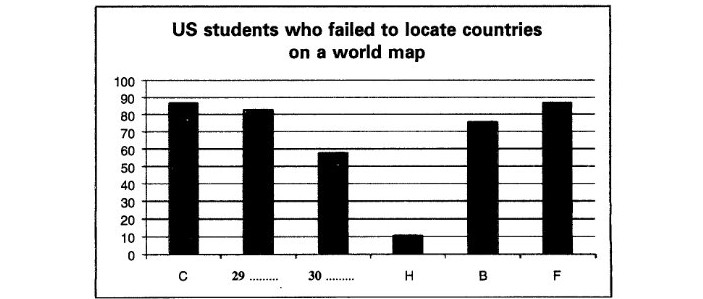
A. Afghanistan | B. Saudi Arabia | C. Iraq
D. Japan | E. Mexico | F. Iran
G. Sweden | H. USA
Answers & Explanations Summary
| # | Answer | Evidence | Explanation |
|---|---|---|---|
| Q21 | A | I suggest we do a survey of international students, collate the responses, make a graph and exhibit our findings in the form of a poster | Excerpt/Transcript Explanation: The transcript shows Ted explaining the plan for their assignment: they will ask students questions, organize the answers, draw a graph, and present the final findings on a poster. Answer Explanation: The answer means that Ted and Cleo will display the final results of their project on a poster. Reason For Correctness: The correct answer is A because Ted clearly states how they should present what they learn. While they will conduct a "survey" and create a "graph" to organize their data, Ted suggests that they will "exhibit our findings" (present their results) specifically "in the form of a poster." |
| Q22 | C | TED: Yes, I know there are a lot of internationals there too but I think a random sample from foreign students on campus might give us a better range of answers | Excerpt/Transcript Explanation: The transcript shows Ted stating that picking foreign students at random from around the campus will result in a better variety of answers. Answer Explanation: The answer C means that they plan to choose international students by picking them by chance from anywhere around the university campus. Reason For Correctness: The correct answer is C because Ted explains that rather than limiting themselves to specific departments like the Language School or Business School, choosing a "random sample from foreign students on campus" will provide a wider variety of answers. |
| Q23 | B | TED: No, no need, the students are going to rank them according to their views | Excerpt/Transcript Explanation: The transcript shows Ted stating directly that the students participating in the survey will rank the reasons based on their personal opinions. Answer Explanation: The answer means that the international students taking the survey will need to put the listed reasons in order of importance. Reason For Correctness: The correct answer is B because Ted and Cleo decide to give survey respondents a list of 10 reasons and ask them to order them. Ted specifically notes that the foreign students will "rank them according to their views" (and earlier mentions asking respondents to "place them in order of importance"). Meanwhile, Cleo and Ted themselves will collate the answers, not the foreign students. |
| Q24 | chance to travel | CLEO: I know— 'Study abroad gives you the chance to travel' | Excerpt/Transcript Explanation: The transcript shows Cleo suggesting the second reason for studying overseas: it gives students an opportunity to travel. Answer Explanation: The answer "chance to travel" means having the opportunity to visit and explore different places around the world. Reason For Correctness: The correct answer is "chance to travel" because when discussing the second reason for studying abroad, Cleo suggests the phrase "Study abroad gives you the chance to travel". In the notes, the phrase "gives you the" is paraphrased as "provides a", so "chance to travel" completes the bullet point accurately within the word limit. |
| Q25 | develop new skills | TED: Let's make that a separate reason. How about 'Study abroad umm will compel you to develop new skills' |
Excerpt/Transcript Explanation: The transcript shows Ted proposing the fourth point for their survey, which is that studying abroad forces or pushes students to build new abilities. Answer Explanation: The answer "develop new skills" means to learn and improve fresh abilities or practical knowledge. Reason For Correctness: The correct answer is "develop new skills" because in the dialogue, Ted and Cleo are listing ten reasons for studying abroad in order. After the third reason about experiencing a different culture, Ted suggests creating a separate fourth reason: "Study abroad...umm...will compel you to develop new skills". In the notes, this matches the prompt "helps you [develop new skills]". |
| Q26 | learn about yourself | CLEO: We could make that the next one and call it something like 'Study abroad provides the opportunity to learn about yourself' | Excerpt/Transcript Explanation: The transcript shows Cleo proposing that studying in another country gives students a chance to discover more about who they are. Answer Explanation: The answer "learn about yourself" means to understand your own character, values, feelings, and personal strengths better. Reason For Correctness: The correct answer is "learn about yourself" because in the dialogue, Cleo suggests the next reason on their list by saying, "Study abroad provides the opportunity to learn about yourself." In the summary notes, this matches the bullet point "...helps you [learn about yourself]". |
| Q27 | study different subjects | TED: Academic what? Let's simplify it—make it ' the opportunity to study different subjects' |
Excerpt/Transcript Explanation: The transcript shows Ted suggesting that one of the reasons for studying abroad should be having the chance to learn various subjects. Answer Explanation: The answer means to take classes or learn about various academic topics in another country. Reason For Correctness: The correct answer is "study different subjects" because Cleo and Ted discuss academic reasons for studying abroad. When Cleo tries to phrase the reason, Ted suggests simplifying it to "the opportunity to study different subjects." In the notes, the phrase "enables you to" directly corresponds to having "the opportunity to." |
| Q28 | employment opportunities | TED: 'Study abroad enhances employment opportunities' | Excerpt/Transcript Explanation: The transcript states Ted's exact words when proposing that studying overseas makes job prospects better. Answer Explanation: The answer means chances or possibilities of getting a job in the future. Reason For Correctness: The correct answer is "employment opportunities" because Ted suggests the ninth reason as "Study abroad enhances employment opportunities." In the notes, the word "improves" replaces the synonym "enhances" from the recording. |
| Q29 | A | TED: I know and, not surprisingly I suppose Afghanistan didn't fare much better—83% couldn't locate it on the map |
Excerpt/Transcript Explanation: The transcript shows Ted stating that 83% of the students could not find Afghanistan on a world map. Answer Explanation: The answer is A, which corresponds to Afghanistan. Reason For Correctness: The correct answer is A because Ted specifically points out that 83% of the surveyed students were unable to find Afghanistan on the map. Keywords to notice are "Afghanistan" and "83% couldn't locate it on the map". |
| Q30 | D | CLEO: But Asia didn't come off much better—over half the students couldn't find Japan on the map | Excerpt/Transcript Explanation: The transcript states that more than 50% of the students failed to find Japan on the map. Answer Explanation: The answer is option D, which corresponds to Japan. Reason For Correctness: The correct answer is D because the speaker discusses how American students performed in geography on the National Geographic survey. Cleo mentions that more than half of the surveyed students were unable to locate Japan on a world map. |
Transcript
CLEO: Hey, Ted. What are we going to do about this assignment?
TED: Well, Cleo, I think it's pretty straightforward.
CLEO: Oh?
TED: Yeah, the topic is 'Why Study Abroad?' I suggest we do a survey of international students, collate the responses, make a graph and exhibit our findings in the form of a poster.
CLEO: Wow! You have given this some thought, haven't you?
TED: Of course. This is only the first assignment—there'll be a lot more to come so let's get this one out of the way quickly.
CLEO: Well, how do we do the survey?
TED: I think we need to find a good selection of foreign students.
CLEO: So...how about we go over to the English Language School at lunchtime and talk to some of the students there.
TED: That's not a bad idea—but we shouldn't limit ourselves to that Department.
CLEO: Why not?
TED: Well, think about it...They'll all give the same reason— 'to learn English'.
CLEO: Of course, you're right. Well, one of us could cover the Language School and the other could go around the Business School.
TED: Yes, I know there are a lot of internationals there too but I think a random sample from foreign students on campus might give us a better range of answers.
CLEO: Mmm. What are we going to ask them— 'Why are you studying abroad?'
TED: An open question like that could mean we get hundreds of different responses—it would be better if we made up, say, 10 reasons, and asked each respondent to place them in order of importance.
CLEO: You're right. That would certainly make collation easier. Any ideas about what these 10 reasons might be?
TED: Sure—I've got enough foreign friends to know quite a lot about what motivates them.
CLEO: Okay. Number 1 is...?
TED: I think that's obvious—how about 'Study abroad is the best way to learn a language'? And number 2 is obvious as well.
CLEO: I know— 'Study abroad gives you the chance to travel'?
TED: What's third?
CLEO: It's either culture or friendship...
TED: Okay, let's go for culture— 'Study abroad gives you first-hand experience of a different culture'?
CLEO: Not just that—but it gives you new experiences as well—not all of them are good but it's meeting those challenges and adapting to new situations and solving problems and so on.
TED: Let's make that a separate reason. How about 'Study abroad...umm...will compel you to develop new skills'?
CLEO: Sounds good. Then, 'Study abroad promotes international friendship'.
TED: What are we up to now?
CLEO: Umm, wait. That was number five...
TED: Do you think 'learning about yourself' is the same as 'developing new skills'?
CLEO: No, I think it's quite different—probably more closely related to culture—you really mean embracing new concepts and perceptions, don't you?
TED: Yes, and reconsidering one's own beliefs and values, or, at least, seeing them through new eyes.
CLEO: We could make that the next one and call it something like 'Study abroad provides the opportunity to learn about yourself'.
TED: We ought to throw in a few about study and work because I'm sure that rates highly with many foreign students.
CLEO: Of course. 'Study abroad gives you the opportunity to expand your academic...umm...'
TED: Academic what? Let's simplify it—make it '...the opportunity to study different subjects'.
CLEO: Yes, good. It can also enhance the value of your degree.
TED: How's that?
CLEO: Well, I think you can take courses you would never have had the opportunity to take on your home campus and employers will know also that your language skills have been given quite a boost.
TED: Isn't that the same as number seven?
CLEO: No, I think it's a separate issue.
TED: Alright. Keep it. Now, I think this next one is more important?
CLEO: Shall I change the order?
TED: No, no need, the students are going to rank them according to their views.
CLEO: So what is it?
TED: 'Study abroad enhances employment opportunities'.
CLEO: Ugh, why didn't I think of that? Anyway, there's one even more obvious than that.
TED: Let me guess: 'Study abroad broadens your mind'?
CLEO: Exactly.
TED: Okay, now we have ten. Let's print off 100 questionnaires and go and do the survey.
CLEO: Did you hear about the National Geographic survey of American students between the ages of 18 and 24?
TED: Yes, it sounds as if they could benefit from study abroad—Did you know that only one percent of US students currently study abroad? Anyway, back to that National Geographic survey—it was carried out internationally—and it was Sweden that came out on top.
CLEO: It's really amazing, isn't it; when given a map of the world, only 13% of American students were able to find Iraq and the same for Iran.
TED: I know...and, not surprisingly I suppose...Afghanistan didn't fare much better—83% couldn't locate it on the map. There must be something about that region...76% couldn't identify Saudi Arabia either.
CLEO: But Asia didn't come off much better—over half the students couldn't find Japan on the map! But do you know what's really incredible?
TED: Yes, I do: 11% of them couldn't even find their own country!
CLEO: It's no wonder the USA scored near the bottom, only two points above Mexico which was ranked last!