
Whale Survey - IELTS Listening Answers & Explanations
From IELTS Recent Actual Test 4 Academic Listening Test 6 · Part 3 · Questions 21–30
Audio
Questions
Questions 21–27 Note Completion
Write NO MORE THAN TWO WORDS AND/OR A NUMBER for each answer.
Whale Survey
Considerations:
• The 21 should be carefully chosen.
• State of the sea: 22 or choppy
• And state of 23
• Visibility: 24
• Details in need of attention: the appearance of 25
Need to evaluate or identify:
• the 26 and appearance of whales
• scales: the 27 and species, the possible age etc.
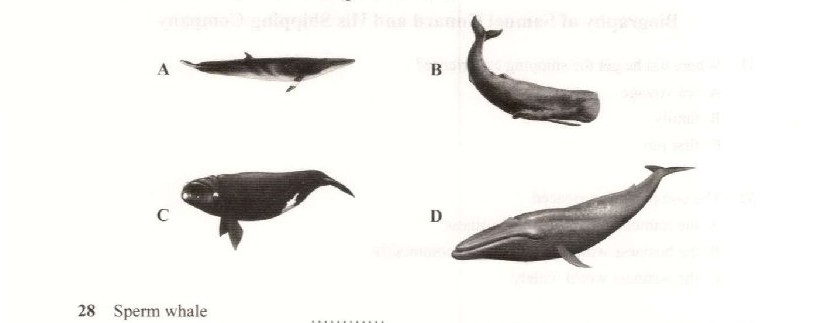
Questions 28–30 Visual Labeling
Match the following type of whales with the pictures given according to different feature descriptions.
Write the correct letter, A-D, next to Questions 28-30.
Answers & Explanations Summary
| # | Answer | Evidence | Explanation |
|---|---|---|---|
| Q21 | watching time | Yeah, the watching time should be carefully chosen since I've heard a lot of unnecessary failures concerning picking the wrong time when it all went stormy and murky and then nothing was seen during the whole field trip | Excerpt/Transcript Explanation: The transcript shows Dave agreeing that the time chosen for watching the whales is very important and must be selected with care to ensure the survey is successful. Answer Explanation: The answer means the specific period of the day or time set aside for observing the whales. Reason For Correctness: The correct answer is 'watching time' because Dave explicitly mentions that the 'watching time' should be 'carefully chosen' to avoid issues like bad weather or poor visibility that lead to failed observations. This matches the first bullet point in the list of considerations for the survey. |
| Q22 | calm | Dave: I think we'd better hope for the best that it will be calm, with no choppy status | Excerpt/Transcript Explanation: The transcript shows Dave expressing his hope that the sea state is 'calm' rather than 'choppy' during their field trip. Answer Explanation: The answer 'calm' describes the desired state of the water's surface during the whale research, meaning it is still and not rough. Reason For Correctness: The correct answer is determined by the conversation about the conditions of the sea. Karen points out they need to watch the sea's surface to avoid bad conditions. Dave then says he hopes the sea will be 'calm' instead of having a 'choppy' status, which refers to rough waves. |
| Q23 | weather | Karen: What about the weather conditions? Dave: That definitely should be taken into account as it correlates with all the former factors | Excerpt/Transcript Explanation: The transcript shows Karen asking if they should think about the weather, and Dave confirms that it must be taken into account, or considered, for their study. Answer Explanation: The answer 'weather' refers to the environmental conditions like rain, wind, or sun that occur during the survey. Reason For Correctness: The correct answer is 'weather' because it is one of the main factors the students decide to record for their whale research. After discussing the state of the sea (calm or choppy), Karen specifically asks about 'weather conditions,' and Dave agrees that they are very important to consider. |
| Q24 | 100 metres / 100 meters | Karen: Shouldn't there be a set limit for the visibility level, say 50 metres? Dave: Cetaceans are really sensitive to sound. They are able to know that something's coming after them so they would hide in order to avoid possible danger. So, let's make it 100 metres, shall we? Karen: Yeah, that might be better | Excerpt/Transcript Explanation: The transcript shows Karen asking if they should use 50 metres for visibility. Dave says that whales (cetaceans) are scared of noise and will hide, so he suggests they use 100 metres instead. Karen agrees with this change. Answer Explanation: The answer is the distance of 100 metres. Reason For Correctness: The correct answer is 100 metres because during their talk, Karen and Dave discuss what the visibility limit should be. While Karen first suggests 50 metres, Dave explains that whales are sensitive to sound and might hide. Therefore, he suggests a bigger distance of 100 metres to better observe them, and Karen agrees that this is a better idea. |
| Q25 | fishing boats | Oh, in that case, we'd also need to pay attention to the appearance of the fishing boats, you know, for all the noise that they would make | Excerpt/Transcript Explanation: The transcript shows Karen suggesting that the team must watch for fishing boats because of the loud sounds they produce. Answer Explanation: The answer is fishing boats, which are types of watercraft used for catching fish at sea. Reason For Correctness: The correct answer is correct because Karen mentions that the researchers need to look for fishing boats. This is a detail that requires attention because these boats create noise, and whales are very sensitive to sound. If there is a lot of noise from boats, it can change how whales behave or where they go. |
| Q26 | individual behaviours / behaviours / individual behaviour / behaviour / individual behaviors / behaviors / individual behavior / behavior | So, to understand marine mammal's social interactions, we'll need to use passive acoustic recordings to track and assess the individual behaviours of whales as well as to identify their appearance | Excerpt/Transcript Explanation: The transcript states that to learn about how these sea animals live together, the team must record sounds to follow and check the specific ways single whales behave and notice what they look like. Answer Explanation: The answer identifies the actions or habits of single whales that the researchers need to study. Reason For Correctness: The correct answer is "(individual) behaviour(s)/behavior(s)" because Dave explains that they will use special sound equipment to watch and judge how each whale acts. He says they will 'track and assess' these 'individual behaviours' to learn more about how the animals interact. This matches the part of the task about things they need to 'evaluate' or 'identify.' |
| Q27 | group size | Karen: OK. Then what about scales? Dave: Oh, for each sighting, the number of animals should be counted, the group size, I mean. Also, we need to identify the species, possible age and sex of the individuals | Excerpt/Transcript Explanation: The transcript shows Karen asking about 'scales' in their study. Dave responds by saying they must count how many animals are in a group, which he calls the 'group size', along with other details like their species and age. Answer Explanation: The answer 'group size' refers to the number of whales swimming together in one bunch that the researchers need to count. Reason For Correctness: The correct answer is 'group size' because the student, Dave, explains exactly what he means by the word 'scales' mentioned by Karen. He says they need to count the number of whales seen together, which he clarifies as the 'group size', before moving on to identifying species and age. |
| Q28 | B | Its unique body is unlikely to be confused with any other species and that distinctive shape comes from its very large, block-shaped head, which can be one-quarter to one-third of its length. The sperm whale's flukes are triangular and very thick. It has a series of little bumps on the back of its fluke instead of having a dorsal fin. The largest bump is called the 'hump' by whalers, and can be mistaken for a dorsal fin because of its shape and size | Excerpt/Transcript Explanation: The transcript describes what a sperm whale looks like, including its huge square-shaped head and the little bumps on its back where a normal fin would usually be. Answer Explanation: The answer is option B, which is the picture showing the sperm whale. Reason For Correctness: The correct answer is B because the text explains the unique look of the sperm whale. The speaker mentions it has a very large, block-shaped head and no normal dorsal fin on its back. Instead, it has small bumps, including one bigger one often called a 'hump'. These features help identify the correct picture. |
| Q29 | C | Then there is the Northern right whale. Right whales have round bodies with arching rostrums, V-shaped blowholes and dark gray or black skin. The most distinguishing feature of a right whale is the rough patches of skin on its head which appear white due to parasitism by whale lice. It has no back fins at all | Excerpt/Transcript Explanation: The transcript describes the Northern right whale as a whale with a round body and white marks on its head from lice. It also clearly says this whale does not have any fins on its back. Answer Explanation: The answer C is the letter for the image that shows a Northern right whale based on its features. Reason For Correctness: The correct answer is identified using Dave's description of the Northern right whale's unique look. He points out that it has a "round" body and white "patches" on its head. Most importantly, he mentions it has "no back fins," which is a key way to tell it apart from other whales in the pictures. |
| Q30 | A | Common minke whales are distinguished from other whales by a white band they have on each flipper. Their long back and tiny dorsal fin, two-thirds of the way down their back is quite distinctive | Excerpt/Transcript Explanation: The transcript explains that Minke whales are special because they have a white stripe on their side fins and a very small fin located far back on their long body. Answer Explanation: The answer is A, which identifies the picture representing the Minke whale based on its physical characteristics. Reason For Correctness: The correct answer is determined by the specific physical markers mentioned by Dave. He notes that Minke whales have a 'white band' on their flippers and a 'tiny dorsal fin' located towards the back of their body. These unique features (white bands and a small back fin) are the primary way to tell them apart from other whales described in the text. |
Transcript
Karen: Hi Dave, as you know, I've asked you to come here today to discuss the assignment for our Biology class. We must decide what we should do about this very important research work.
Dave: The Whale Survey? Yeah, I was also hoping to share some ideas with you. So, let's start!
Karen: OK, I've dug into some journal articles to see what sort of questions we should consider. Most of them include watching time and strongly urge it to be the top concern. What do you say?
Dave: Yeah, the watching time should be carefully chosen since I've heard a lot of unnecessary failures concerning picking the wrong time when it all went stormy and murky and then nothing was seen during the whole field trip. I mean, they could have avoided that easily.
Karen: Right! Then we should also pay close attention to the sea's surface, because no one wants to encounter the failures you just mentioned.
Dave: I think we'd better hope for the best that it will be calm, with no choppy status.
Karen: What about the weather conditions?
Dave: That definitely should be taken into account as it correlates with all the former factors. Most important of all, as a sighting is made, position and environmental parameters are recorded on standardised sighting pro formats, including: time, visibility, position of the ship (using a global positioning system), wind speed, and wind direction.
Karen: Shouldn't there be a set limit for the visibility level, say 50 metres?
Dave: Cetaceans are really sensitive to sound. They are able to know that something's coming after them so they would hide in order to avoid possible danger. So, let's make it 100 metres, shall we?
Karen: Yeah, that might be better. Oh, in that case, we'd also need to pay attention to the appearance of the fishing boats, you know, for all the noise that they would make.
Dave: That's right. Although observations were regularly made, we know very little about whale vocalisation and how they use sound in their behavioural and social interactions. So, to understand marine mammal's social interactions, we'll need to use passive acoustic recordings to track and assess the individual behaviours of whales as well as to identify their appearance.
Karen: OK. Then what about scales?
Dave: Oh, for each sighting, the number of animals should be counted, the group size, I mean. Also, we need to identify the species, possible age and sex of the individuals.
Dave: Speaking of identifying species, we need to find out the unique physical features of each whale. Let's start with the sperm whale. The sperm whale is the largest toothed whale, yet it's only a quarter of that of the blue whale. Its unique body is unlikely to be confused with any other species and that distinctive shape comes from its very large, block-shaped head, which can be one-quarter to one-third of its length. The sperm whale's flukes are triangular and very thick. It has a series of little bumps on the back of its fluke instead of having a dorsal fin. The largest bump is called the 'hump' by whalers, and can be mistaken for a dorsal fin because of its shape and size.
Then there is the Northern right whale. Right whales have round bodies with arching rostrums, V-shaped blowholes and dark gray or black skin. The most distinguishing feature of a right whale is the rough patches of skin on its head which appear white due to parasitism by whale lice. It has no back fins at all.
The blue whale's body can be various shades of bluish-grey dorsally and somewhat lighter underneath. It has a long tapering body that appears stretched in comparison to the stockier build of other whales. The head is flat, U-shaped and has a prominent ridge running from the blowhole to the top of its upper lip.
Lastly are the minke whales. They are the second smallest baleen whale. The minke whale is black, gray or purple in colour. Common minke whales are distinguished from other whales by a white band they have on each flipper. Their long back and tiny dorsal fin, two-thirds of the way down their back is quite distinctive.