
A Chronicle Of Timekeeping - IELTS Reading Answers & Explanations
From Cambridge IELTS 08 Academic Reading Test 1 · Part 1 · Questions 1–13
Reading Passage
You should spend about 20 minutes on Questions 1–13, which are based on Reading Passage 1 below.
A Chronicle of Timekeeping
Our conception of time depends on the way we measure it
A According to archaeological evidence, at least 5,000 years ago, and long before the advent of the Roman Empire, the Babylonians began to measure time, introducing calendars to co-ordinate communal activities, to plan the shipment of goods and, in particular, to regulate planting and harvesting. They based their calendars on three natural cycles: the solar day, marked by the successive periods of light and darkness as the earth rotates on its axis; the lunar month, following the phases of the moon as it orbits the earth; and the solar year, defined by the changing seasons that accompany our planet's revolution around the sun.
B Before the invention of artificial light, the moon had greater social impact. And, for those living near the equator in particular, its waxing and waning was more conspicuous than the passing of the seasons. Hence, the calendars that were developed at the lower latitudes were influenced more by the lunar cycle than by the solar year. In more northern climes, however, where seasonal agriculture was practised, the solar year became more crucial. As the Roman Empire expanded northward, it organised its activity chart for the most part around the solar year.
C Centuries before the Roman Empire, the Egyptians had formulated a municipal calendar having 12 months of 30 days, with five days added to approximate the solar year. Each period of ten days was marked by the appearance of special groups of stars called decans. At the rise of the star Sirius just before sunrise, which occurred around the all-important annual flooding of the Nile, 12 decans could be seen spanning the heavens. The cosmic significance the Egyptians placed in the 12 decans led them to develop a system in which each interval of darkness (and later, each interval of daylight) was divided into a dozen equal parts. These periods became known as temporal hours because their duration varied according to the changing length of days and nights with the passing of the seasons. Summer hours were long, winter ones short; only at the spring and autumn equinoxes were the hours of daylight and darkness equal. Temporal hours, which were first adopted by the Greeks and then the Romans, who disseminated them through Europe, remained in use for more than 2,500 years.
D In order to track temporal hours during the day, inventors created sundials, which indicate time by the length or direction of the sun's shadow. The sundial's counterpart, the water clock, was designed to measure temporal hours at night. One of the first water clocks was a basin with a small hole near the bottom through which the water dripped out. The falling water level denoted the passing hour as it dipped below hour lines inscribed on the inner surface. Although these devices performed satisfactorily around the Mediterranean, they could not always be depended on in the cloudy and often freezing weather of northern Europe.
E The advent of the mechanical clock meant that although it could be adjusted to maintain temporal hours, it was naturally suited to keeping equal ones. With these, however, arose the question of when to begin counting, and so, in the early 14th century, a number of systems evolved. The schemes that divided the day into 24 equal parts varied according to the start of the count: Italian hours began at sunset, Babylonian hours at sunrise, astronomical hours at midday and 'great clock' hours, used for some large public clocks in Germany, at midnight. Eventually these were superseded by 'small clock', or French, hours, which split the day into two 12-hour periods commencing at midnight.
F The earliest recorded weight-driven mechanical clock was built in 1283 in Bedfordshire in England. The revolutionary aspect of this new timekeeper was neither the descending weight that provided its motive force nor the gear wheels (which had been around for at least 1,300 years) that transferred the power; it was the part called the escapement. In the early 1400s came the invention of the coiled spring or fusee which maintained constant force to the gear wheels of the timekeeper despite the changing tension of its mainspring. By the 16th century, a pendulum clock had been devised, but the pendulum swung in a large arc and thus was not very efficient.
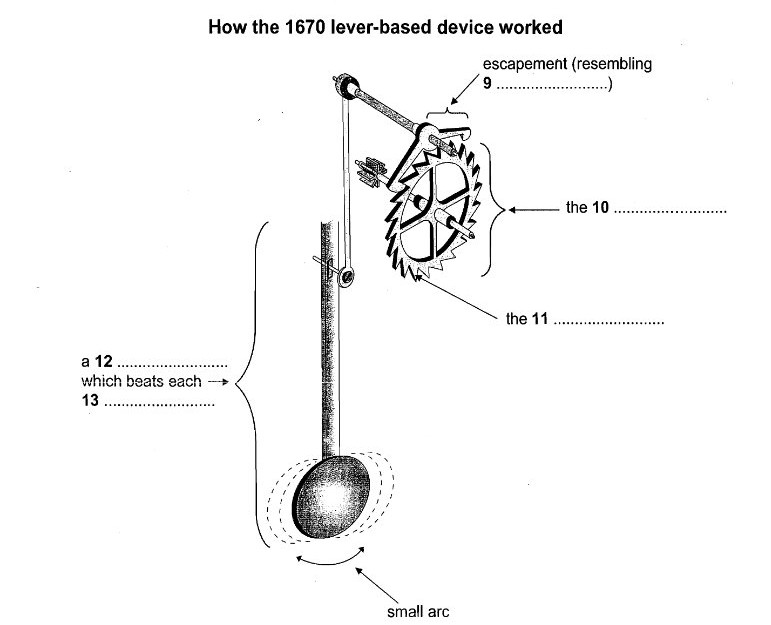
G To address this, a variation on the original escapement was invented in 1670, in England. It was called the anchor escapement, which was a lever-based device shaped like a ship's anchor. The motion of a pendulum rocks this device so that it catches and then releases each tooth of the escape wheel, in turn allowing it to turn a precise amount. Unlike the original form used in early pendulum clocks, the anchor escapement permitted the pendulum to travel in a very small arc. Moreover, this invention allowed the use of a long pendulum which could beat once a second and thus led to the development of a new floor-standing case design, which became known as the grandfather clock.
H Today, highly accurate timekeeping instruments set the beat for most electronic devices. Nearly all computers contain a quartz-crystal clock to regulate their operation. Moreover, not only do time signals beamed down from Global Positioning System satellites calibrate the functions of precision navigation equipment, they do so as well for mobile phones, instant stock-trading systems and nationwide power-distribution grids. So integral have these time-based technologies become to day-to-day existence that our dependency on them is recognised only when they fail to work.
Questions
Questions 1–4 Matching Information
Reading Passage 1 has eight paragraphs, A-H.
Which paragraph contains the following information?
Write the correct letter, A-H.
Questions 5–8 Matching Features
Look at the following events and the list of nationalities below.
Match each event with the correct nationality, A-F.
A. Babylonians
B. Egyptians
C. Greeks
D. English
E. Germans
F. French
Questions 9–13 Diagram Labeling
Label the diagram below.
Choose NO MORE THAN TWO WORDS from the passage for each answer.
Answers & Explanations Summary
| # | Answer | Evidence | Explanation |
|---|---|---|---|
| Q1 | D | Although these devices performed satisfactorily around the Mediterranean, they could not always be depended on in the cloudy and often freezing weather of northern Europe | Excerpt/Passage Explanation: The passage explains that while these early timekeeping tools worked well in warm areas, they were not reliable in northern Europe because it was often cloudy or extremely cold (freezing). Answer Explanation: The answer identifies Paragraph D as the section of the text that mentions a specific problem with old time-measuring tools when the weather got very cold. Reason For Correctness: The correct answer is Paragraph D because it discusses early inventions like sundials and water clocks. It explains that these tools were not reliable in northern Europe because of the "freezing weather." In this context, "freezing" is a synonym for cold temperatures, and saying they "could not always be depended on" means they were affected by those conditions. |
| Q2 | B | Hence, the calendars that were developed at the lower latitudes were influenced more by the lunar cycle than by the solar year. In more northern climes, however, where seasonal agriculture was practised, the solar year became more crucial | Excerpt/Passage Explanation: The passage says that in places near the middle of the Earth (lower latitudes), the moon's cycle was used for calendars. However, in northern places where people farmed, the sun's cycle (solar year) was more important for the calendar. Answer Explanation: The answer identifies the paragraph that explains why the location of a group of people changed the way they made their calendars for farming. Reason For Correctness: The correct answer is Paragraph B because it discusses how geography (the place on Earth) influenced calendar development. It explains that people living in 'northern climes' (northern areas) who did 'seasonal agriculture' (farming) needed a calendar based on the sun to track the seasons, while people near the equator (lower latitudes) used the moon instead. |
| Q3 | F | By the 16th century, a pendulum clock had been devised, but the pendulum swung in a large arc and thus was not very efficient | Excerpt/Passage Explanation: The passage explains that the pendulum clock was first invented by the 1500s (the 16th century), though this early version was not very good at its job. Answer Explanation: The answer is paragraph F because it mentions the early creation of the pendulum clock and how it worked at first. Reason For Correctness: The correct answer is paragraph F because it introduces the first mention of the pendulum clock's existence in history. It uses the word 'devised,' which is a synonym for 'invented' or 'created,' to explain that these clocks were first made by the 16th century. While paragraph G talks about improvements to the pendulum clock, paragraph F describes its initial appearance and its original, inefficient design. |
| Q4 | E | The schemes that divided the day into 24 equal parts varied according to the start of the count: Italian hours began at sunset, Babylonian hours at sunrise, astronomical hours at midday and 'great clock' hours, used for some large public clocks in Germany, at midnight | Excerpt/Passage Explanation: The passage explains that different groups of people had different ways to divide the day into 24 equal hours, with some groups starting their count at sunset and others starting at sunrise or noon. Answer Explanation: The answer E refers to paragraph E of the reading passage. Reason For Correctness: The correct answer is E because this paragraph describes how several different groups (societies) in the 14th century all worked to divide the day into 24 'equal parts'. The use of the word 'equal' indicates 'uniform hours', and the text mentions specific different groups such as the Italians, Babylonians, and Germans (using 'great clock' hours) all having their own systems at that same time in history. |
| Q5 | B | Centuries before the Roman Empire, the Egyptians had formulated a municipal calendar having 12 months of 30 days, with five days added to approximate the solar year | Excerpt/Passage Explanation: The passage explains that long ago, the Egyptian people made a calendar for their community. In this calendar, there were 12 months, and every single one of those months was 30 days long, making them all equal. Answer Explanation: The answer B refers to the Egyptians. Reason For Correctness: The correct answer is B because the text mentions that the Egyptians created a 'municipal' (which means city or civil) calendar. In this calendar, they decided that each of the 12 months would have exactly 30 days. This means all the months were equal in length, which matches the description in the question. |
| Q6 | F | Eventually these were superseded by 'small clock', or French, hours, which split the day into two 12-hour periods commencing at midnight | Excerpt/Passage Explanation: The passage explains that the French timing system became more common than previous methods. This specific system divided the 24-hour day into two separate periods, and each one lasted 12 hours. Answer Explanation: The answer is F because it refers to the French group of people, who created a system that cut the 24-hour day into two parts of 12 hours each. Reason For Correctness: The correct answer is F because paragraph E describes how the French system, known as 'small clock' hours, finally became the standard. This system is defined by splitting the day into two 12-hour periods. Because a whole day is 24 hours, two 12-hour periods are exactly two equal halves. The keywords 'French' and 'split the day into two 12-hour periods' directly link the nationality to the action of dividing the day equally. |
| Q7 | D | To address this, a variation on the original escapement was invented in 1670, in England. It was called the anchor escapement, which was a lever-based device shaped like a ship's anchor. The motion of a pendulum rocks this device so that it catches and then releases each tooth of the escape wheel, in turn allowing it to turn a precise amount. Unlike the original form used in early pendulum clocks, the anchor escapement permitted the pendulum to travel in a very small arc. Moreover, this invention allowed the use of a long pendulum which could beat once a second and thus led to the development of a new floor-standing case design, which became known as the grandfather clock | Excerpt/Passage Explanation: The passage explains that in England, a new part for clocks was invented. This new part made it possible to use long pendulums, which resulted in the creation of a new clock shape that stands on the floor. Answer Explanation: The answer is D, which means the English people are the ones who created a new shape for a clock container. Reason For Correctness: The correct answer is English because paragraph G states that a device called the anchor escapement was invented in England. This specific invention allowed clocks to use a long pendulum. Because the pendulum was long, a new 'floor-standing case design' (a cabinet shape) was made, which is popularly known as the grandfather clock. Therefore, the development of this new cabinet shape is linked to an invention from England. |
| Q8 | A | According to archaeological evidence, at least 5,000 years ago, and long before the advent of the Roman Empire, the Babylonians began to measure time, introducing calendars to co-ordinate communal activities, to plan the shipment of goods and, in particular, to regulate planting and harvesting | Excerpt/Passage Explanation: The passage says that very long ago, the Babylonians created calendars. These calendars were used to help people do things together in their community and to plan work, like sending items to different places and managing farm tasks like planting and picking crops. Answer Explanation: The answer means that the people from Babylon (the Babylonians) made a system of days and months to help everyone work together and follow the same schedule for jobs and community events. Reason For Correctness: The correct answer is supported by the first paragraph of the passage. It explains that the Babylonians were the ones who started to measure time with calendars to organize group tasks and specifically to manage work schedules, such as moving goods and farming. Keywords like 'co-ordinate communal activities' match the idea of public events, while 'plan the shipment of goods' and 'regulate planting and harvesting' match the idea of work schedules. |
| Q9 | ship's anchor / anchor / an anchor / the anchor | It was called the anchor escapement, which was a lever-based device shaped like a ship's anchor | Excerpt/Passage Explanation: The passage explains that this specific part of the clock was given its name because its physical shape is the same as the anchor found on a ship. Answer Explanation: The answer is a part of a clock mechanism that is shaped like the heavy metal hook used to keep a boat in one place. Reason For Correctness: The correct answer is found in Paragraph G, which describes a specific invention from 1670. The text says that this new part, called the anchor escapement, was a device that looked just like a ship's anchor. This description identifies what the object is and what it looks like, making it the right name to label a diagram of this part. |
| Q10 | escape wheel / wheel | The motion of a pendulum rocks this device so that it catches and then releases each tooth of the escape wheel, in turn allowing it to turn a precise amount | Excerpt/Passage Explanation: The passage explains that a moving pendulum makes a device swing so that it grabs and then lets go of the teeth on a part called the escape wheel, allowing the wheel to rotate a tiny, exact amount. Answer Explanation: The answer identifies a specific circular part of a clock's movement mechanism that has teeth and rotates in small, controlled steps. Reason For Correctness: The correct answer is found in the description of the anchor escapement in paragraph G. This device was invented to make clocks more accurate. The text explains that as a pendulum moves, it causes a lever to rock back and forth. This rocking lever touches and then lets go of the teeth on the 'escape wheel,' which controls the speed at which the clock's gears turn. Therefore, the part of the diagram being labeled is this specific wheel. |
| Q11 | tooth | The motion of a pendulum rocks this device so that it catches and then releases each tooth of the escape wheel, in turn allowing it to turn a precise amount | Excerpt/Passage Explanation: The passage explains that when the pendulum moves back and forth, it causes a part to grab and then let go of every small point—or tooth—on the wheel, which ensures the wheel turns very accurately. Answer Explanation: The answer refers to one of the many pointed parts on the edge of a wheel inside a clock's mechanism. Reason For Correctness: The correct answer is found in paragraph G, which describes a mechanism called the anchor escapement. It explains that as a pendulum swings (rocks), it moves a device that catches and then lets go of each 'tooth' of the wheel (the escape wheel). This process controls the movement of the wheel so it turns exactly the right amount to keep time correctly. |
| Q12 | long pendulum / pendulum | Moreover, this invention allowed the use of a long pendulum which could beat once a second and thus led to the development of a new floor-standing case design, which became known as the grandfather clock | Excerpt/Passage Explanation: The passage explains that a new invention made it possible to include a tall, swinging part called a long pendulum, which resulted in the design of the tall clocks we call grandfather clocks. Answer Explanation: The answer identifies a specific part of a clock—a long swinging rod—that allowed for more accurate timekeeping in large clocks. Reason For Correctness: The correct answer is found in paragraph G, which discusses improvements to clock design. The text explains that the 'anchor escapement' invention made it possible to use a 'long pendulum.' This specific part was significant because it led to the creation of the well-known 'grandfather clock' style. The words 'long pendulum' directly name the component described in the text relating to these large, floor-standing clocks. |
| Q13 | second | Moreover, this invention allowed the use of a long pendulum which could beat once a second and thus led to the development of a new floor-standing case design, which became known as the grandfather clock | Excerpt/Passage Explanation: The passage explains that there was a new invention that allowed clocks to use a very long pendulum. This long pendulum was special because it would swing or "beat" exactly one time per second, which led to the building of the tall clock we call a grandfather clock. Answer Explanation: The answer refers to a unit of time (a second) that describes how often the long pendulum in a clock moves back and forth. Reason For Correctness: The correct answer is "second" because the text explains that the invention of the anchor escapement made it possible to using a long pendulum in clocks. This specific type of pendulum was very accurate because it was designed to "beat once a second," which means it completed one movement exactly every second. This invention resulted in the creation of the tall "grandfather clock." |