
A Remarkable Beetle - IELTS Reading Answers & Explanations
From Cambridge IELTS 03 Academic Reading Test 2 · Part 1 · Questions 1–13
Reading Passage
You should spend about 20 minutes on Questions 1-13 which are based on Reading Passage 1 below.
A Remarkable Beetle
Some of the most remarkable beetles are the dung beetles, which spend almost their whole lives eating and breeding in dung.
More than 4,000 species of these remarkable creatures have evolved and adapted to the world's different climates and the dung of its many animals. Australia's native dung beetles are scrub and woodland dwellers, specialising in coarse marsupial droppings and avoiding the soft cattle dung in which bush flies and buffalo flies breed.
In the early 1960s George Bornemissza, then a scientist at the Australian Government's premier research organisation, the Commonwealth Scientific and Industrial Research Organisation (CSIRO), suggested that dung beetles should be introduced to Australia to control dung-breeding flies. Between 1968 and 1982, the CSIRO imported insects from about 50 different species of dung beetle, from Asia, Europe and Africa, aiming to match them to different climatic zones in Australia. Of the 26 species that are known to have become successfully integrated into the local environment, only one, an African species released in northern Australia, has reached its natural boundary.
Introducing dung beetles into a pasture is a simple process: approximately 1,500 beetles are released, a handful at a time, into fresh cow pats in the cow pasture. The beetles immediately disappear beneath the pats digging and tunnelling and, if they successfully adapt to their new environment, soon become a permanent, self sustaining part of the local ecology. In time they multiply and within three or four years the benefits to the pasture are obvious.
Dung beetles work from the inside of the pat so they are sheltered from predators such as birds and foxes. Most species burrow into the soil and bury dung in tunnels directly underneath the pats, which are hollowed out from within. Some large species originating from France excavate tunnels to a depth of approximately 30 cm below the dung pat. These beetles make sausage-shaped brood chambers along the tunnels. The shallowest tunnels belong to a much smaller Spanish species that buries dung in chambers that hang like fruit from the branches of a pear tree. South African beetles dig narrow tunnels of approximately 20 cm below the surface of the pat. Some surface-dwelling beetles, including a South African species, cut perfectly-shaped balls from the pat, which are rolled away and attached to the bases of plants.
For maximum dung burial in spring, summer and autumn, farmers require a variety of species with overlapping periods of activity. In the cooler environments of the state of Victoria, the large French species (2.5 cms long) is matched with smaller (half this size), temperate-climate Spanish species. The former are slow to recover from the winter cold and produce only one or two generations of offspring from late spring until autumn. The latter, which multiply rapidly in early spring, produce two to five generations annually. The South African ball-rolling species, being a subtropical beetle, prefers the climate of northern and coastal New South Wales where it commonly works with the South African tunnelling species. In warmer climates, many species are active for longer periods of the year.
Dung beetles were initially introduced in the late 1960s with a view to controlling buffalo flies by removing the dung within a day or two and so preventing flies from breeding. However, other benefits have become evident. Once the beetle larvae have finished pupation, the residue is a first-rate source of fertiliser. The tunnels abandoned by the beetles provide excellent aeration and water channels for root systems. In addition, when the new generation of beetles has left the nest the abandoned burrows are an attractive habitat for soil-enriching earthworms. The digested dung in these burrows is an excellent food supply for the earthworms, which decompose it further to provide essential soil nutrients. If it were not for the dung beetle, chemical fertiliser and dung would be washed by rain into streams and rivers before it could be absorbed into the hard earth, polluting water courses and causing blooms of blue-green algae. Without the beetles to dispose of the dung, cow pats would litter pastures making grass inedible to cattle and depriving the soil of sunlight. Australia's 30 million cattle each produce 10-12 cow pats a day. This amounts to 1.7 billion tonnes a year, enough to smother about 110,000 sq km of pasture, half the area of Victoria.
Dung beetles have become an integral part of the successful management of dairy farms in Australia over the past few decades. A number of species are available from the CSIRO or through a small number of private breeders, most of whom were entomologists with the CSIRO's dung beetle unit who have taken their specialised knowledge of the insect and opened small businesses in direct competition with their former employer.
Glossary
1. dung: the droppings or excreta of animals
2. cow pats: droppings of cows
Questions
Questions 1–5 Yes / No / Not Given
Do the following statements reflect the claims of the writer in Reading Passage 1?
YES if the statement reflects the claims of the writer
NO if the statement contradicts the claims of the writer
NOT GIVEN if it is impossible to say what the writer thinks about this
Questions 6–8 Diagram Labeling
Label the tunnels on the diagram below. Choose your labels from the box below the diagram.
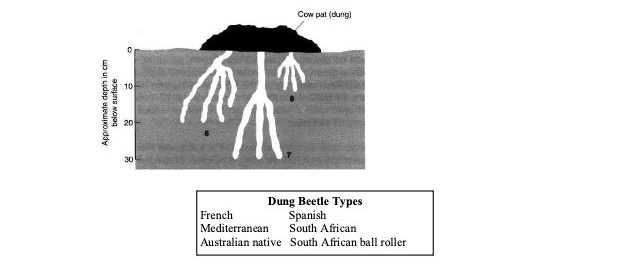
French | Mediterranean | Australian native
Spanish | South African | South African ball roller
Questions 9–13 Table Completion
Complete the table below.
Choose NO MORE THAN THREE WORDS OR A NUMBER from Reading Passage 1 for each answer.
| Species | Size | Preferred climate | Complementary species | Start of active period | Number of generations per year |
|---|---|---|---|---|---|
| French | 2.5 cm | cool | Spanish | late spring | 1-2 |
| Spanish | 1.25 cm | 9 | 10 | 11 | |
| South African ball roller | 12 | 13 |
Answers & Explanations Summary
| # | Answer | Evidence | Explanation |
|---|---|---|---|
| Q1 | NOT GIVEN | Australia's native dung beetles are scrub and woodland dwellers, specialising in coarse marsupial droppings and avoiding the soft cattle dung in which bush flies and buffalo flies breed | Excerpt/Passage Explanation: The passage identifies bush flies and buffalo flies as two types of insects that use soft cattle dung to breed, but it does not give any information about which fly is easier to control. Answer Explanation: The answer is NOT GIVEN because the text does not say whether bush flies are easier to manage than buffalo flies. Reason For Correctness: The correct answer is NOT GIVEN because, although both bush flies and buffalo flies are mentioned as pests that breed in cattle dung, the writer never compares the difficulty of controlling one versus the other. The passage explains that beetles were introduced to control flies, but it does not rank the flies by how easy they are to stop. Without a specific comparison of difficulty in the text, we cannot determine if the statement is true or false. |
| Q2 | NO | Between 1968 and 1982, the CSIRO imported insects from about 50 different species of dung beetle, from Asia, Europe and Africa, aiming to match them to different climatic zones in Australia | Excerpt/Passage Explanation: The passage states that the research group (CSIRO) brought approximately 50 types of beetles from other continents to Australia over several years. Answer Explanation: The answer is NO because the statement says something that is not true according to the reading passage. Reason For Correctness: The correct answer is NO because the passage explains that while there are over 4,000 species of dung beetles in the whole world, the CSIRO only brought about 50 species to Australia. The word 'imported' in the text means 'brought from another country.' Since 50 is a much smaller number than 4,000, the statement is a contradiction of the facts provided in the text. |
| Q3 | YES | Between 1968 and 1982, the CSIRO imported insects from about 50 different species of dung beetle | Excerpt/Passage Explanation: The passage says that the CSIRO brought many types of dung beetles into Australia over a time period that lasted from 1968 to 1982. Answer Explanation: The answer YES means that the statement is true based on the information provided in the passage. Reason For Correctness: The correct answer is YES because the text mentions that the organization named CSIRO brought beetles into Australia starting in 1968 and ending in 1982. If you subtract 1968 from 1982, it equals exactly 14 years. The word 'imported' used in the text has the same meaning as 'brought' in the question. |
| Q4 | YES | Of the 26 species that are known to have become successfully integrated into the local environment, only one, an African species released in northern Australia, has reached its natural boundary | Excerpt/Passage Explanation: The passage states that 26 types of beetles are now successfully living as a part of the local nature in Australia. Answer Explanation: The answer YES means that according to the reading, at least 26 types of beetles that were brought to Australia are now living there permanently as part of the nature. Reason For Correctness: The correct answer is YES because the passage states that 26 species have 'become successfully integrated into the local environment.' In this context, being 'integrated' means the same as 'become established,' which means they are living and surviving in the new area. Since the text mentions 26 such species, it confirms the statement. |
| Q5 | NO | In time they multiply and within three or four years the benefits to the pasture are obvious | Excerpt/Passage Explanation: The passage explains that after the beetles are released, it takes three or four years for them to increase in number and for the positive changes in the field to become easy to see. Answer Explanation: The answer "NO" means the statement is not true according to the passage. Reason For Correctness: The correct answer is NO because the passage states that the benefits to the cattle fields (pastures) take time to show. Improvements are not "immediate" (happening right away) because the beetles need to grow their population first. The text mentions that it takes about "three or four years" before the improvements can be clearly seen. |
| Q6 | South African | South African beetles dig narrow tunnels of approximately 20 cm below the surface of the pat | Excerpt/Passage Explanation: The passage explains that beetles from South Africa make thin holes (tunnels) about 20 centimeters deep under the cow waste. Answer Explanation: The answer refers to a specific group of beetles from South Africa that make tunnels of a particular size and depth. Reason For Correctness: The correct answer is determined by matching the tunnel's description in the text with the options provided. The passage mentions three different tunnel depths: French beetles dig 30 cm deep, Spanish beetles make the shallowest tunnels, and South African beetles dig narrow tunnels about 20 cm deep. Based on this information, the label for the 20 cm deep tunnel is 'South African'. |
| Q7 | French | Some large species originating from France excavate tunnels to a depth of approximately 30 cm below the dung pat | Excerpt/Passage Explanation: The passage explains that certain big beetles from France dig tunnels into the ground that go about 30 centimeters deep beneath the pile of animal waste. Answer Explanation: The answer refers to a specific type of dung beetle that comes from France. Reason For Correctness: The correct answer is French because the passage describes the different ways various beetle species dig their tunnels. It specifically mentions that large species from France dig tunnels reaching a depth of about 30 cm under the waste. This detailed description of the tunnel depth and origin allows us to identify the 'French' beetle as the correct label for diagrams showing the deepest tunnels. |
| Q8 | Spanish | The shallowest tunnels belong to a much smaller Spanish species that buries dung in chambers that hang like fruit from the branches of a pear tree | Excerpt/Passage Explanation: The passage explains that a small kind of beetle from Spain makes tunnels that are not very deep. These tunnels have small rooms for their waste that look like fruit hanging on a tree branch. Answer Explanation: The answer is the Spanish dung beetle, which is the type of beetle that makes one of the tunnels shown in the picture. Reason For Correctness: The correct answer is chosen because the passage describes different types of beetle tunnels. It says that the Spanish beetle makes the shallowest tunnels, which means they are the closest to the surface and not deep in the ground. The description also mentions that their tunnels have parts that look like fruit hanging from a tree. If the diagram shows a tunnel that is very short or has fruit-like shapes, it belongs to the Spanish beetle. |
| Q9 | temperate | In the cooler environments of the state of Victoria, the large French species (2.5 cms long) is matched with smaller (half this size), temperate-climate Spanish species | Excerpt/Passage Explanation: The passage explains that in certain cool areas, the large French beetle is used alongside a smaller Spanish beetle that naturally lives in a temperate (mild) climate. Answer Explanation: The answer identifies the type of weather or environment that the Spanish dung beetle prefers to live in. Reason For Correctness: The correct answer is found in the sixth paragraph, which discusses how farmers use different beetles together. The text specifically refers to the "temperate-climate Spanish species." In this context, "temperate-climate" describes the preferred climate for this specific beetle, directly filling the required information in the table. |
| Q10 | early spring | The latter, which multiply rapidly in early spring, produce two to five generations annually | Excerpt/Passage Explanation: The passage explains that the Spanish dung beetles (the second group mentioned) begin to increase their numbers very quickly once the spring season starts. Answer Explanation: The answer 'early spring' indicates the time of year when the Spanish species of dung beetle begins its period of rapid growth and activity. Reason For Correctness: The correct answer is 'early spring' because the passage contrasts the French species with the Spanish species. It mentions that 'the latter' (referring to the Spanish species) multiplies quickly at this specific time. In the context of the table, this growth marks the start of their active period for the year. |
| Q11 | two to five | The latter, which multiply rapidly in early spring, produce two to five generations annually | Excerpt/Passage Explanation: The passage says that the Spanish beetles (the latter) have many babies quickly and produce between two and five groups of offspring in one year. Answer Explanation: The answer means that this specific type of beetle has between two and five groups of babies every year. Reason For Correctness: The correct answer is found because the passage compares two types of beetles: the French species (the 'former') and the Spanish species (the 'latter'). It explicitly states that the Spanish species produces between two and five generations of babies each year. The word 'annually' matches the table's requirement for 'per year'. |
| Q12 | sub-tropical | The South African ball-rolling species, being a subtropical beetle, prefers the climate of northern and coastal New South Wales where it commonly works with the South African tunnelling species | Excerpt/Passage Explanation: The passage says that this specific beetle is a subtropical type and mentions the warm, coastal areas in Australia where it prefers to live. Answer Explanation: The answer refers to a specific kind of warm weather environment that the beetle likes. Reason For Correctness: The correct answer is 'sub-tropical' because the text explains that the South African ball-rolling species is a 'subtropical beetle'. This tells us that its 'preferred climate' is subtropical (or sub-tropical), which fits the missing information in the table for this specific species. |
| Q13 | South African tunneling / South African tunnelling | The South African ball-rolling species, being a subtropical beetle, prefers the climate of northern and coastal New South Wales where it commonly works with the South African tunnelling species | Excerpt/Passage Explanation: The passage explains that the South African ball-rolling beetle lives in warm coastal areas and often works alongside the South African tunnelling beetle. Answer Explanation: The answer is a specific type of beetleจาก South Africa that builds tunnels underground. Reason For Correctness: The correct answer is found in the paragraph describing different species and their environments. The text states that the South African ball-rolling species "commonly works with" the South African tunnelling species in warmer climates. In the context of the table, "works with" is a synonym for being a complementary species, as they function together in the same habitat. |