
AIRPORTS ON WATER - IELTS Reading Answers & Explanations
From Cambridge IELTS 02 Academic Reading Test 1 · Part 1 · Questions 1–13
Reading Passage
You should spend about 20 minutes on Questions 1 - 13 which are based on Reading Passage 1 below.
AIRPORTS ON WATER
River deltas are difficult places for map makers. The river builds them up, the sea wears them down; their outlines are always changing. The changes in China's Pearl River delta, however, are more dramatic than these natural fluctuations. An island six kilometres long and with a total area of 1248 hectares is being created there. And the civil engineers are as interested in performance as in speed and size. This is a bit of the delta that they want to endure.
The new island of Chek Lap Kok, the site of Hong Kong's new airport, is 83% complete. The giant dumper trucks rumbling across it will have finished their job by the middle of this year and the airport itself will be built at a similarly breakneck pace.
As Chek Lap Kok rises, however, another new Asian island is sinking back into the sea. This is a 520-hectare island built in Osaka Bay, Japan, that serves as the platform for the new Kansai airport. Chek Lap Kok was built in a different way, and thus hopes to avoid the same sinking fate.
The usual way to reclaim land is to pile sand rock on to the seabed. When the seabed oozes with mud, this is rather like placing a textbook on a wet sponge; the weight squeezes the water out, causing both water and sponge to settle lower. The settlement is rarely even; different parts sink at different rates. So buildings, pipes, roads and so on tend to buckle and crack. You can engineer around these problems, or you can engineer them out. Kansai took the first approach; Chek Lap Kok is taking the second.
The differences are both political and geological. Kansai was supposed to be built just one kilometre offshore, where the seabed is quite solid. Fishermen protested, and the site was shifted a further five kilometres. That put it in deeper water (around 20 metres) and above a seabed that consisted of 20 metres of soft alluvial silt and mud deposits. Worse, below it was a not-very-firm glacial deposit hundreds of metres thick.
The Kansai builders recognised that settlement was inevitable. Sand was driven into the seabed to strengthen it before the land-fill was piled on top, in an attempt to slow the process; but this has not been as effective as had been hoped. To cope with settlement, Kansai's giant terminal is supported on 900 pillars. Each of them can be individually jacked up, allowing wedges to be added underneath. That is meant to keep the building level. But it could be a tricky task.
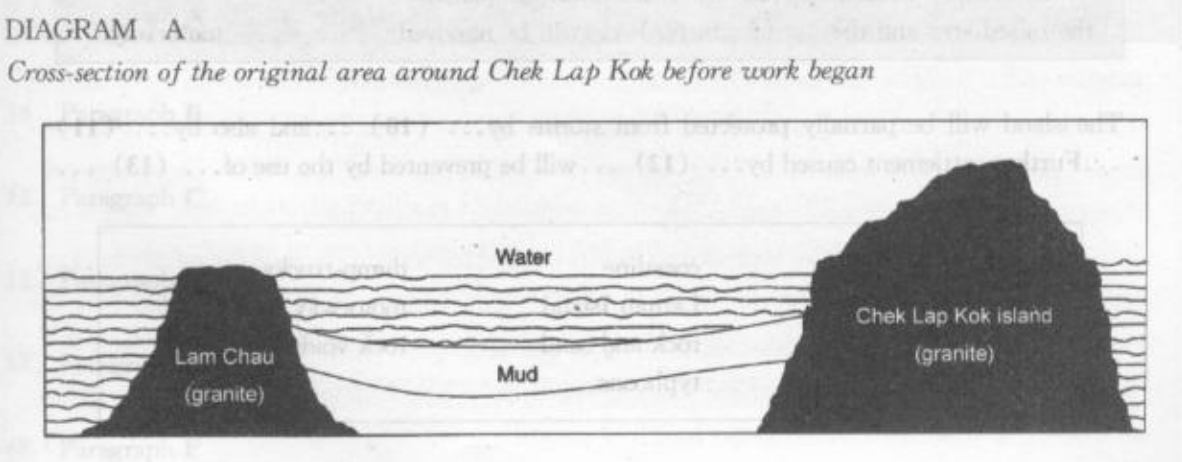
Conditions are different at Chek Lap Kok. There was some land there to begin with, the original little island of Chek Lap Kok and a smaller outcrop called Lam Chau. Between them, these two outcrops of hard, weathered granite make up a quarter of the new island's surface area. Unfortunately, between the islands there was a layer of soft mud, 27 metres thick in places.
According to Frans Uiterwijk, a Dutchman who is the project's reclamation director, it would have been possible to leave this mud below the reclaimed land, and to deal with the resulting settlement by the Kansai method. But the consortium that won the contract for the island opted for a more aggressive approach. It assembled the world's largest fleet of dredgers, which sucked up 150m cubic metres of clay and mud and dumped it in deeper waters. At the same time, sand was dredged from the waters and piled on top of the layer of stiff clay that the massive dredging had laid bare.
Nor was the sand the only thing used. The original granite island which had hills up to 120 metres high was drilled and blasted into boulders no bigger than two metres in diameter. This provided 70m cubic metres of granite to add to the island's foundations. Because the heap of boulders does not fill the space perfectly, this represents the equivalent of 105m cubic metres of landfill. Most of the rock will become the foundations for the airport's runways and its taxiways. The sand dredged from the waters will also be used to provide a two-metre capping layer over the granite platform. This makes it easier for utilities to dig trenches - granite is unyielding stuff. Most of the terminal buildings will be placed above the site of the existing island. Only a limited amount of pile-driving is needed to support building foundations above softer areas.
The completed island will be six to seven metres above sea level. In all, 350m cubic metres of material will have been moved. And much of it, like the overloads, has to be moved several times before reaching its final resting place. For example, there has to be a motorway capable of carrying 150-tonne dump-trucks; and there has to be a raised area for the 15,000 construction workers. These are temporary; they will be removed when the airport is finished.
The airport, though, is here to stay. To protect it, the new coastline is being bolstered with a formidable twelve kilometres of sea defences. The brunt of a typhoon will be deflected by the neighbouring island of Lantau; the sea walls should guard against the rest. Gentler but more persistent bad weather - the downpours of the summer monsoon - is also being taken into account. A mat-like material called geotextile is being laid across the island to separate the rock and sand layers. That will stop sand particles from being washed into the rock voids, and so causing further settlement. This island is being built never to be sunk.
Questions
Questions 1–5 Matching Features
Classify the following statements as applying to
Write the appropriate letters A - C in boxes 1 - 5 on your answer sheet.
A. Chek Lap Kok airport only
B. Kansai airport only
C. Both airports
Questions 6–9 Diagram Labeling
Complete the labels on Diagam B below.
Choose your answers from the box below the diagram and write them in boxes 6 - 9 on your answer sheet.
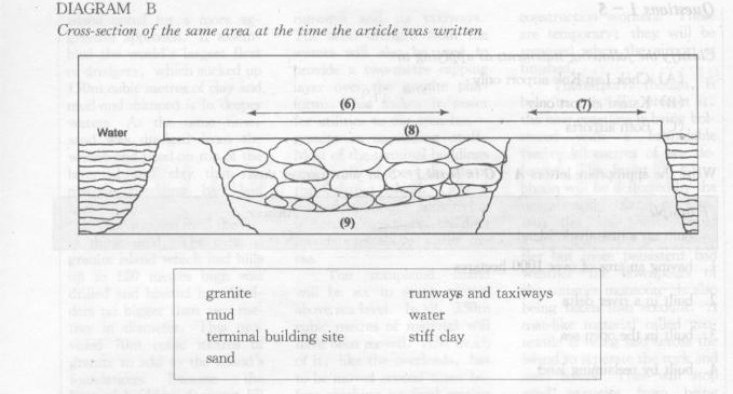
granite | mud | terminal building site
sand | runways and taxiways | water
stiff clay
Questions 10–13 Summary Completion
Complete the summary below.
Choose your answers from the box below the summary and write them in boxes 10 - 13 on your answer sheet.
construction workers | geotextile | rainfall
sea walls | coastline | Lantau Island
rock and sand | typhoons | dump-trucks
motorway | rock voids
When the new Chek Lap Kok airport has been completed, the raised area and the motorway will be removed.
The island will be partially protected from storms by 10 and also by 11. Further settlement caused by 12 will be prevented by the use of 13.
Answers & Explanations Summary
| # | Answer | Evidence | Explanation |
|---|---|---|---|
| Q1 | A | An island six kilometres long and with a total area of 1248 hectares is being created there The new island of Chek Lap Kok, the site of Hong Kong's new airport, is 83% complete This is a 520-hectare island built in Osaka Bay, Japan, that serves as the platform for the new Kansai airport |
Excerpt/Passage Explanation: The passage says that the island being built for the Chek Lap Kok airport has a total area of 1,248 hectares. It also mentions that the island for the Kansai airport is much smaller, with an area of 520 hectares. This shows that only the Chek Lap Kok island is larger than 1,000 hectares. Answer Explanation: The answer means that only the Chek Lap Kok airport is bigger than 1,000 hectares. Reason For Correctness: The correct answer is A because the text provides the exact sizes of the islands for both airports. The island for the Chek Lap Kok airport is 1,248 hectares, which is clearly more than 1,000. In contrast, the island for the Kansai airport is only 520 hectares, which is less than 1,000. Because only Chek Lap Kok meets the size requirement of being over 1,000 hectares, the correct choice is A. |
| Q2 | A | The changes in China's Pearl River delta, however, are more dramatic than these natural fluctuations. An island six kilometres long and with a total area of 1248 hectares is being created there. And the civil engineers are as interested in performance as in speed and size. This is a bit of the delta that they want to endure. The new island of Chek Lap Kok, the site of Hong Kong's new airport, is 83% complete This is a 520-hectare island built in Osaka Bay, Japan, that serves as the platform for the new Kansai airport |
Excerpt/Passage Explanation: The passage describes the location of the two airports. It identifies the Chek Lap Kok airport as being part of the Pearl River delta. It identifies the Kansai airport as being built in Osaka Bay, which is not a river delta. Answer Explanation: The answer means that only the airport called Chek Lap Kok is situated in a river delta (an area where a river splits into several branches before entering the sea). Reason For Correctness: The correct answer is A because the passage specifically mentions that the island of Chek Lap Kok is being built in China's Pearl River delta. At the same time, it explains that the Kansai airport is built in Osaka Bay, which is a different type of location. This comparison shows that only Chek Lap Kok fits the description of being in a "river delta." |
| Q3 | B | Kansai was supposed to be built just one kilometre offshore, where the seabed is quite solid. Fishermen protested, and the site was shifted a further five kilometres. That put it in deeper water (around 20 metres) and above a seabed that consisted of 20 metres of soft alluvial silt and mud deposits | Excerpt/Passage Explanation: The passage explains that the site for Kansai airport was moved several kilometers away from the coast because fishermen complained, which placed the airport in the deep water of the sea. Answer Explanation: The answer means that only the Kansai airport was constructed far from the coast in the deep water of the ocean. Reason For Correctness: The correct answer is B because the text explains that the location for Kansai airport was moved five kilometers further away from the land into "deeper water." This location is considered the open sea. In contrast, the text says that for Chek Lap Kok, "there was some land there to begin with," meaning it was built around existing islands rather than in empty, deep water. Keywords such as "offshore" and "deeper water" specifically describe the sea-based location of Kansai. |
| Q4 | C | The usual way to reclaim land is to pile sand rock on to the seabed. When the seabed oozes with mud, this is rather like placing a textbook on a wet sponge; the weight squeezes the water out, causing both water and sponge to settle lower. The settlement is rarely even; different parts sink at different rates. So buildings, pipes, roads and so on tend to buckle and crack. You can engineer around these problems, or you can engineer them out. Kansai took the first approach; Chek Lap Kok is taking the second | Excerpt/Passage Explanation: The passage explains what it means to reclaim land (putting sand and rock on the sea floor) and notes that while the two airports used different engineering techniques to deal with the sinking mud, both Kansai and Chek Lap Kok were built using land reclamation. Answer Explanation: The answer C means that both Kansai airport and Chek Lap Kok airport were constructed by turning areas of water into solid land. Reason For Correctness: The correct answer is C because the text describes 'reclaiming land' as the process of piling material like sand and rock onto the seabed to create a foundation for buildings. It explicitly mentions that there are different methods to handle the problems caused by this process, stating that Kansai used one method while Chek Lap Kok used a different one. Since both airports are mentioned as using these approaches to land reclamation, the statement applies to both. |
| Q5 | B | The usual way to reclaim land is to pile sand rock on to the seabed. When the seabed oozes with mud, this is rather like placing a textbook on a wet sponge; the weight squeezes the water out, causing both water and sponge to settle lower. The settlement is rarely even; different parts sink at different rates. So buildings, pipes, roads and so on tend to buckle and crack. You can engineer around these problems, or you can engineer them out. Kansai took the first approach; Chek Lap Kok is taking the second | Excerpt/Passage Explanation: The passage states that the normal way to make land is to put sand and rock on the bottom of the sea. It explains that Kansai airport chose this first, standard method, while Chek Lap Kok used a different method. Answer Explanation: The answer means that only the Kansai airport was constructed using the standard or normal method for creating new land from the ocean. Reason For Correctness: The correct answer is B because the passage defines the "usual way" (conventional method) to create new land as piling sand and rock on the seabed. It then explains that there are two ways to handle the problems this causes: engineers can either work with the problems or remove them. The text clearly states that Kansai used the first approach (the "usual" or conventional way), while Chek Lap Kok took a different, more aggressive approach by removing the mud entirely. |
| Q6 | runways and taxiways | Most of the rock will become the foundations for the airport's runways and its taxiways | Excerpt/Passage Explanation: The passage explains that most of the broken stones are used to create the strong bottom layer for the paths where airplanes land and move. Answer Explanation: The answer refers to the specific parts of the airport where airplanes land, take off, and drive slowly on the ground. Reason For Correctness: The correct answer is identified by looking at how the materials were used to build the new island. The passage explains that the granite hills were broken into many rocks to be used as a base. It specifically states that these rocks serve as the foundations for the 'runways and taxiways.' Therefore, on a diagram showing the layers or sections of the island construction, this label identifies what is built on the rock foundation. |
| Q7 | terminal building site | Most of the terminal buildings will be placed above the site of the existing island | Excerpt/Passage Explanation: The passage states that the majority of the airport's main structures will be built on the location of the original land. Answer Explanation: The answer identifies the specific location where the main airport buildings for passengers will be constructed. Reason For Correctness: The correct answer is determined by looking at where different parts of the airport are placed according to the text. The passage explains that while some areas are for runways, most of the main buildings (the terminal buildings) are specifically positioned on top of the original land that was there before the expansion, which is called the 'existing island'. |
| Q8 | sand | The sand dredged from the waters will also be used to provide a two-meter capping layer over the granite platform | Excerpt/Passage Explanation: The passage states that sand collected from the water is placed on top of the hard granite base to form a two-meter thick top layer. Answer Explanation: The answer is sand, which is a grainy material usually found on beaches or sea floors, used in this project to cover the hard rock layer. Reason For Correctness: The correct answer is sand because the passage explains that it is used to create a 'capping layer' on top of the granite rock foundation. The engineers used sand for the top two meters of the platform because granite is too hard ('unyielding') to dig through. By using a layer of sand, it becomes much easier for workers to dig the trenches needed for utilities like pipes and electrical lines. |
| Q9 | stiff clay | At the same time, sand was dredged from the waters and piled on top of the layer of stiff clay that the massive dredging had laid bare | Excerpt/Passage Explanation: The passage explains that once the soft material on the seabed was cleared out by machines, a firm layer of clay was found. Sand was then poured on top of this clay to help form the base of the island. Answer Explanation: The answer refers to a firm, hard layer of soil that was found deep underwater after the soft mud was removed to provide a strong base for the new airport. Reason For Correctness: The correct answer is supported by the part of the passage describing how the engineers prepared the ground for the island. Instead of leaving the soft mud, which would cause the airport to sink, they cleared it away until they reached a much stronger layer. The passage calls this layer 'stiff clay' and explains that sand was placed directly on top of it to build the island's foundation. This ensures the ground is solid enough to support the heavy airport structures. |
| Q10 | Lantau Island | The brunt of a typhoon will be deflected by the neighbouring island of Lantau; the sea walls should guard against the rest | Excerpt/Passage Explanation: The passage explains that most of the heavy impact from a large storm will be blocked by the nearby island of Lantau, while walls built along the coast will protect against whatever is left. Answer Explanation: The answer identifies a nearby island that helps block the strongest part of a big storm to protect the airport. Reason For Correctness: The correct answer is found in the final paragraph, which discusses how the new airport is protected from nature. The text states that the 'brunt' (the main force) of a 'typhoon' (a type of powerful storm) will be 'deflected' (pushed away or blocked) by a neighboring island called Lantau. In the summary, 'storms' is used as a general word for 'typhoons.' Therefore, Lantau Island is one of the two things (the other being sea walls) that provides this protection. |
| Q11 | sea walls | The brunt of a typhoon will be deflected by the neighbouring island of Lantau; the sea walls should guard against the rest | Excerpt/Passage Explanation: The passage says that a large storm (typhoon) will be mostly blocked by a nearby island called Lantau, and the walls built along the sea will protect the airport from whatever is left of the storm. Answer Explanation: The answer 'sea walls' refers to the strong structures built around the edge of the island to block waves and protect it from the ocean during bad weather. Reason For Correctness: The correct answer is found in the final paragraph, which discusses how the airport is protected from weather. The passage uses the word 'typhoon', which is a type of 'storm'. It states that the neighboring island of Lantau will take the main force of a storm, but the 'sea walls' are specifically built to 'guard against' the remaining power of the storm and waves. Therefore, sea walls acting alongside Lantau Island provide the necessary protection. |
| Q12 | rainfall | Gentler but more persistent bad weather - the downpours of the summer monsoon - is also being taken into account. A mat-like material called geotextile is being laid across the island to separate the rock and sand layers. That will stop sand particles from being washed into the rock voids, and so causing further settlement | Excerpt/Passage Explanation: The passage explains that builders must consider steady bad weather like summer rain. They use a fabric called geotextile to keep rock and sand layers separate so that the rain does not wash the sand into gaps in the rock, which would make the island sink. Answer Explanation: The answer refers to the heavy rain that falls during specific seasons, often called monsoon rains. Reason For Correctness: The correct answer is 'rainfall' because the text explains that heavy rains ('downpours of the summer monsoon') can wash sand particles into the empty spaces between rocks ('rock voids'). This movement of sand into those spaces is what leads to 'further settlement' (the ground sinking more). In the summary, 'rainfall' acts as the synonym for 'downpours' responsible for this potential problem. |
| Q13 | geotextile | A mat-like material called geotextile is being laid across the island to separate the rock and sand layers. That will stop sand particles from being washed into the rock voids, and so causing further settlement | Excerpt/Passage Explanation: The passage explains that builders use a material like a rug to keep the rock and sand layers distinct. This stops sand from flowing into empty spots between rocks, which prevents the ground from shifting or sinking. Answer Explanation: The answer is a type of fabric or cloth material used in construction to keep layers of soil and rock in place. Reason For Correctness: The correct answer is geotextile because the passage describes it as a 'mat-like material' used to protect the island. It is placed between levels of rock and sand to keep them separate. When heavy rain (the monsoon downpours/rainfall) occurs, water tries to wash sand into the gaps between the rocks. By stopping this movement, the material prevents the ground from sinking, which is referred to in the text as 'settlement'. |