
Angelo Mosso’s Pioneering Work In The Study Of Human Physiology - IELTS Reading Answers & Explanations
From Road to IELTS Academic Reading Test 6 · Part 2 · Questions 14–26
Reading Passage
You should spend about 20 minutes on Questions 14–26, which are based on Reading Passage 2 on the following pages.
Angelo Mosso’s Pioneering Work in the Study of Human Physiology
A Scientists in the late nineteenth century were beginning to investigate the functions of blood circulation, trying to tease out the reasons for variations in pulse and pressure, and to understand the delivery of energy to the functioning parts of our bodies. Angelo Mosso (1846–1910) was one such pioneer, an Italian physiologist who progressed to become a professor of both pharmacology and physiology at the University of Turin. As was true of many of his enlightened, well-educated contemporaries, Mosso was concerned about the effect of the industrial revolution on the poorer working classes. Hard physical labour and an excessively long working day shortened lives, created conditions conducive to accidents, and crippled the children who were forced into such work at a very early age. One of his most influential contributions to society came from his work and writings on fatigue.
B Early experimenters in any field find themselves having to construct previously unknown equipment to investigate fields of study as yet unexplored. Mosso had reviewed the work of fellow scientists who had worked on isolated muscles, such as those extracted from frogs, and who had observed movement and fatigue when these were stimulated electrically. He found two major issues with their methodolgy: there was a lack of evidence both that the findings would be relevant to the human body, and that the dynamometers used to measure the strength of movement could give accurate results. He therefore became determined to construct an instrument to measure human muscular effort and record the effects of fatigue with greater precision.
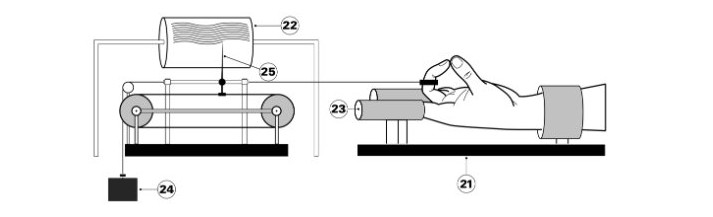
C His device was named an ergograph, meaning “work recorder”. To modern eyes it seems remarkably simple, but such is true of many inventions when viewed with hindsight. It allowed the measurement of the work done by a finger as it was repetitively curled up and straightened. There were basically two parts. One held the hand in position, palm up, by strapping down the arm to a wooden base; this was important to prevent any unintentional movement of the hand while the experiment was taking place. The other part was a recording device that drew the movements of the finger vertically on a paper cylinder which revolved by tiny increments as the experiment proceeded. The index and ring fingers of the hand were each inserted into a brass tube to hold them still. The middle finger was encircled with a leather ring tied to a wire which was connected to a weight after passing through a pulley. The finger had to raise and lower the weight, with the length and speed of these flexions recorded on the paper by a stylus. In this way, he not only learned the fatigue profiles of his subjects but could observe a relationship between performance, tiredness and the emotional state of his subjects.
D Mosso’s interest in the interaction between psychology and physiology led to another machine and further groundbreaking research. He was intrigued to observe the pulsing of circulating blood in patients who had suffered traumatic damage to the skull, or cranium. In these patients, a lack of bone covering the brain allowed the strength of the heart’s pumping to be seen beneath the skin. He carried out experiments to see whether certain intellectual activities, such as reading or solving a problem, or emotional responses, such as to a sudden noise, would affect the supply of blood to the brain. He detected some changes in blood supply, and then wanted to find out if the same would be true of individuals with no cranial damage.
E His solution was to design another instrument to measure brain activity in uninjured subjects. He designed a wooden table-top for the human subject to lie on, which was placed over another table, balanced on a fulcrum (rather like a seesaw) that would allow the subject to tilt, with head a little higher than feet, or vice versa. Heavy weights beneath the table maintained the stability of the whole unit as the intention was to measure very tiny variations in the balance of the person. Once the upper table was adjusted to be perfectly horizontal, only the breathing created a slight regular oscillation. This breathing and pulses measured in the hands and feet were also recorded.
F Once all was in equilibrium, Mosso would ring a bell, while out of sight of the subject. His hypothesis was that this aural stimulus would have to be interpreted by the brain, and that an increased blood flow would result in a slight head-down tilt of the table. Mosso followed the bell-ringing with a wide range of intellectual stimuli, such as reading from a newspaper, a novel, or a university text. He was no doubt well satisfied to observe that the tilting of the table increased proportionately to the difficulty of the subject matter and the intellectual requirements of the task. Mosso’s experiments indicated a direct link between mental effort and an increased volume of blood in the brain. This research was one of the first attempts to ‘image’ the brain, which is now performed by technology such as MRI (magnetic resonance imaging), commonly used in making medical diagnoses today.
Questions
Questions 14–19 Matching Headings
Reading Passage 2 has six paragraphs, A–F.
Choose the correct heading for paragraphs A–F from the list of headings below.
i. A finely balanced measuring machine
ii. Head injuries are a window into the brain
iii. Measuring changes in body weight
iv. Measuring fatigue through finger movements
v. Reasons for the development of the ergograph
vi. Effects of fatigue on young factory workers
vii. Reasons behind early physiological research
viii. Estimating the difficulty of reading tasks
ix. Mosso’s theory supported by experimental results
Questions 20–20 One Choice
Choose the correct letter, A, B, C or D.
Questions 21–25 Diagram Labeling
Label the diagram below.
Choose NO MORE THAN TWO WORDS from the passage for each answer.
Questions 26–26 One Choice
Choose the correct letter, A, B, C or D.
Answers & Explanations Summary
| # | Answer | Evidence | Explanation |
|---|---|---|---|
| Q14 | vii | Scientists in the late nineteenth century were beginning to investigate the functions of blood circulation, trying to tease out the reasons for variations in pulse and pressure, and to understand the delivery of energy to the functioning parts of our bodies Mosso was concerned about the effect of the industrial revolution on the poorer working classes |
Excerpt/Passage Explanation: The passage explains that scientists wanted to find out why heartbeats and blood pressure change and how the body sends energy to its different parts. It also shows that Mosso was worried about how hard work hurt people, which gave him a reason to study health and tiredness. Answer Explanation: The answer says that this part of the text explains why scientists first started to study how the human body works. Reason For Correctness: The correct answer is vii because Paragraph A talks about why scientists in the late 1800s started studying the human body. It says they wanted to 'understand' how blood moves and how the body uses energy. It also explains that the scientist Angelo Mosso was 'concerned' about poor workers who were getting sick from hard jobs. These goals and worries are the 'reasons' for their early 'research'. |
| Q15 | v | He found two major issues with their methodolgy: there was a lack of evidence both that the findings would be relevant to the human body, and that the dynamometers used to measure the strength of movement could give accurate results. He therefore became determined to construct an instrument to measure human muscular effort and record the effects of fatigue with greater precision | Excerpt/Passage Explanation: The passage explains that Mosso was unhappy with the old ways of measuring muscle work because they were not precise and did not clearly apply to people. For these reasons, he decided to create a new machine to measure how humans get tired. Answer Explanation: The answer 'v' means that Paragraph B discusses the causes or motivations for building the ergograph, which is a tool used to measure physical work. Reason For Correctness: The correct answer is 'v' because Paragraph B describes the problems Mosso found with existing scientific methods. He noticed that previous experiments used frog muscles instead of humans and that the available measuring tools were not accurate. Because of these specific 'reasons,' he decided to build a better 'instrument' (the ergograph) to get better data on human fatigue. |
| Q16 | iv | the length and speed of these flexions recorded on the paper by a stylus. In this way, he not only learned the fatigue profiles of his subjects | Excerpt/Passage Explanation: The passage explains that the speed and distance of the finger's movements were written down on paper. By doing this, the scientist was able to find information about how tired (fatigue) the people in the experiment were. Answer Explanation: The answer 'iv' means that the main theme of Paragraph C is tracking how tired a person gets by looking at the way they move their finger. Reason For Correctness: The correct answer is 'iv' because Paragraph C describes a specific machine called the ergograph. This tool was used to measure the 'work done by a finger' as it moved back and forth. By recording these movements (flexions), Mosso could see the 'fatigue profiles' of the people he was testing, which shows how their energy changed as they got more tired. The paragraph explains the physical setup of the hand and the finger moving a weight to collect this data. |
| Q17 | ii | He was intrigued to observe the pulsing of circulating blood in patients who had suffered traumatic damage to the skull, or cranium. In these patients, a lack of bone covering the brain allowed the strength of the heart’s pumping to be seen beneath the skin | Excerpt/Passage Explanation: The passage explains that because some patients had head injuries and were missing part of their skull bone, Mosso could see the blood moving in their brains through their skin. Answer Explanation: The answer 'ii' means that looking at people with head wounds helped scientists see inside the brain. Reason For Correctness: The correct answer is chosen because Paragraph D explains how Mosso looked at patients who had traumatic damage to the skull. Because these people were missing pieces of their skull bone, Mosso could actually observe the pulsing of blood in the brain. This acted as a window (an opening) for him to study how the brain works before he moved on to testing people without injuries. |
| Q18 | i | He designed a wooden table-top for the human subject to lie on, which was placed over another table, balanced on a fulcrum (rather like a seesaw) that would allow the subject to tilt, with head a little higher than feet, or vice versa. Heavy weights beneath the table maintained the stability of the whole unit as the intention was to measure very tiny variations in the balance of the person | Excerpt/Passage Explanation: The passage describes how Mosso built a machine using two tables where the top one could tip up and down on a center point. This setup was strong but very sensitive, made specifically to record even the smallest shifts in how a person's body was balanced. Answer Explanation: The answer is 'A finely balanced measuring machine,' which refers to a device carefully built to detect very small changes in weight distribution or movement. Reason For Correctness: The correct answer is correct because Paragraph E describes the design of a specialized table that sits on a 'fulcrum,' similar to a 'seesaw.' The text explains that this machine was highly sensitive, intended to detect 'very tiny variations' in a person's balance. This precision and the mechanism of the pivot perfectly match the description of a 'finely balanced measuring machine.' |
| Q19 | ix | His hypothesis was that this aural stimulus would have to be interpreted by the brain, and that an increased blood flow would result in a slight head-down tilt of the table Mosso’s experiments indicated a direct link between mental effort and an increased volume of blood in the brain |
Excerpt/Passage Explanation: The passage shows that Mosso had a theory (a hypothesis) that sounds would make the brain work and cause more blood to flow there, making a balanced table tilt. His actual tests later proved that hard thinking and an increase in blood going to the brain were indeed connected. Answer Explanation: The answer means that Paragraph F describes how Mosso's scientific idea about the brain and blood flow was proven correct by the tests he performed. Reason For Correctness: The correct answer is 'ix' because Paragraph F details how Mosso tested his hypothesis (his theory) using specific sounds and reading tasks. At the end of the paragraph, it explains that the results of these experiments showed a clear connection between the brain working hard and more blood moving into the head, which confirmed his original thoughts. |
| Q20 | B | He therefore became determined to construct an instrument to measure human muscular effort and record the effects of fatigue with greater precision | Excerpt/Passage Explanation: The passage states that Mosso decided to build a tool to track how humans use their muscles and get tired so that the results would be more exact. Answer Explanation: The answer means Mosso wanted to create a tool that could measure muscle work and tiredness more correctly than the ones used before. Reason For Correctness: The correct answer is B because the passage explains that Mosso found two main problems with the methods used by other scientists: he wasn't sure if their findings about frog muscles applied to humans, and he thought the tools they used (dynamometers) were not accurate enough. To fix this, he decided to build his own machine, the ergograph, specifically to measure human muscle effort with better accuracy or 'precision'. |
| Q21 | wooden base | One held the hand in position, palm up, by strapping down the arm to a wooden base; this was important to prevent any unintentional movement of the hand while the experiment was taking place | Excerpt/Passage Explanation: The passage explains that one part of the machine kept the hand in the right place by tying the arm down to a base made of wood. Doing this helped stop the hand from moving around during the test. Answer Explanation: The answer is a flat piece of wood used at the bottom of the device to hold the person's arm steady. Reason For Correctness: The correct answer is "wooden base" because the text explains that the machine had a part used to keep the hand and arm in one spot during the experiment. It mentions that the arm was "strapped down" (tied or held firmly) to this "wooden base" so that it would not move by accident. |
| Q22 | paper cylinder | The other part was a recording device that drew the movements of the finger vertically on a paper cylinder which revolved by tiny increments as the experiment proceeded | Excerpt/Passage Explanation: The passage explains that the part of the machine responsible for recording information was a paper cylinder that turned slowly while a stylus drew the finger's movements on its surface. Answer Explanation: The answer refers to a round tube covered in paper that spins slowly to record the movements of a finger during an experiment. Reason For Correctness: The correct answer is "paper cylinder" because paragraph C describes the components of the ergograph, a device used to record work and fatigue. It explains that one part of the machine was a "recording device" that marked finger movements onto a "paper cylinder" as it turned (revolved) little by little (by tiny increments). |
| Q23 | brass tube | The index and ring fingers of the hand were each inserted into a brass tube to hold them still | Excerpt/Passage Explanation: The passage says that two fingers were put into a metal pipe so that they would stay in one spot and not move. Answer Explanation: The answer "brass tube" refers to the metal container or sleeve where the fingers were placed to prevent them from moving. Reason For Correctness: The correct answer is "brass tube" because the passage describes the construction of the ergograph and explains how the hand was kept still. It mentions that while the middle finger did the "work," the fingers on either side (the index and ring fingers) were put into a "brass tube" to ensure they remained stationary. This fits the description of a component used to hold fingers in place. |
| Q24 | a weight / the weight / weight | The middle finger was encircled with a leather ring tied to a wire which was connected to a weight after passing through a pulley. The finger had to raise and lower the weight, with the length and speed of these flexions recorded on the paper by a stylus | Excerpt/Passage Explanation: The passage explains that a person's middle finger was tied to a wire that had a heavy weight on the other end. As the person moved their finger up and down to lift the weight, a special pen (stylus) wrote down the movements on paper. Answer Explanation: The answer is the heavy object that a person had to lift and drop using their finger so that the scientist could measure their effort. Reason For Correctness: The correct answer is found in Paragraph C, which describes a machine called an 'ergograph'. This machine was used to measure how hard a person's finger could work. The text explains that the person's finger was tied to a wire, and that wire was attached to a 'weight'. By pulling on the wire to move the weight up and down, the machine could record how tired the person became. Keywords to look for are 'middle finger', 'connected', and 'weight'. |
| Q25 | a stylus / the stylus / stylus | The finger had to raise and lower the weight, with the length and speed of these flexions recorded on the paper by a stylus | Excerpt/Passage Explanation: The passage explains that when the person moved their finger, the machine wrote down how fast and how far the finger moved on a piece of paper using a tool called a stylus. Answer Explanation: The answer is the stylus, which was a sharp tool used to mark movements on a paper cylinder in Mosso's work recorder. Reason For Correctness: The correct answer is found in Paragraph C, which explains how the ergograph (a machine to record work) functioned. It describes how a finger moved a weight, and these movements (flexions) were marked or written onto paper using a specific tool called a stylus. This tool served as the writing or recording part of the device to capture the data about the person's movements. |
| Q26 | A | Angelo Mosso (1846–1910) was one such pioneer, an Italian physiologist who progressed to become a professor of both pharmacology and physiology at the University of Turin | Excerpt/Passage Explanation: The passage introduces Angelo Mosso as a very early and important scientist (pioneer) who studied how the human body works (physiology). Answer Explanation: The answer means the main reason for the text is to explain the first experiments Angelo Mosso did to find out how the human body works. Reason For Correctness: The correct answer is A because the entire text follows the life and inventions of Angelo Mosso, who is described as a 'pioneer' in his field. It details his specific experiments regarding muscle fatigue using an 'ergograph' and his research on blood flow to the brain using a specialized table. While the text mentions his machine designs, other researchers, and modern technology, these are small parts of the larger description of his early work in physiology—the study of how living bodies function. |