
ELECTRORECEPTION - IELTS Reading Answers & Explanations
From Road to IELTS Academic Reading Test 3 · Part 1 · Questions 1–13
Reading Passage
You should spend about 20 minutes on Questions 1–13, which are based on Reading Passage 1 below.
ELECTRORECEPTION
A Open your eyes in sea water and it is difficult to see much more than a murky, bleary green colour. Sounds, too, are garbled and difficult to comprehend. Without specialised equipment humans would be lost in these deep sea habitats, so how do fish make it seem so easy? Much of this is due to a biological phenomenon known as electroreception – the ability to perceive and act upon electrical stimuli as part of the overall senses. This ability is only found in aquatic or amphibious species because water is an efficient conductor of electricity.
B Electroreception comes in two variants. While all animals (including humans) generate electric signals, because they are emitted by the nervous system, some animals have the ability – known as passive electroreception – to receive and decode electric signals generated by other animals in order to sense their location.
C Other creatures can go further still, however. Animals with active electroreception possess bodily organs that generate special electric signals on cue. These can be used for mating signals and territorial displays as well as locating objects in the water. Active electroreceptors can differentiate between the various resistances that their electrical currents encounter. This can help them identify whether another creature is prey, predator or something that is best left alone. Active electroreception has a range of about one body length – usually just enough to give its host time to get out of the way or go in for the kill.
D One fascinating use of active electroreception – known as the Jamming Avoidance Response mechanism – has been observed between members of some species known as the weakly electric fish. When two such electric fish meet in the ocean using the same frequency, each fish will then shift the frequency of its discharge so that they are transmitting on different frequencies. Doing so prevents their electroreception faculties from becoming jammed. Long before citizens’ band radio users first had to yell “Get off my frequency!” at hapless novices cluttering the air waves, at least one species had found a way to peacefully and quickly resolve this type of dispute.
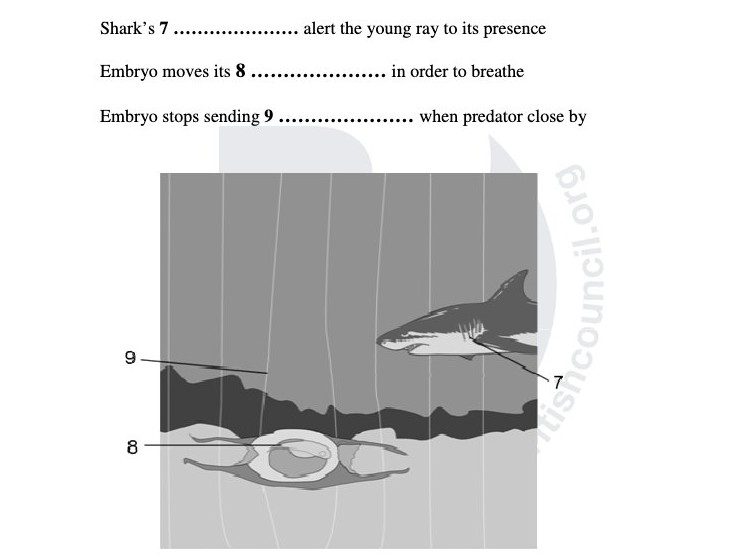
E Electroreception can also play an important role in animal defences. Rays are one such example. Young ray embryos develop inside egg cases that are attached to the sea bed. The embryos keep their tails in constant motion so as to pump water and allow them to breathe through the egg’s casing. If the embryo’s electroreceptors detect the presence of a predatory fish in the vicinity, however, the embryo stops moving (and in so doing ceases transmitting electric currents) until the fish has moved on. Because marine life of various types is often travelling past, the embryo has evolved only to react to signals that are characteristic of the respiratory movements of potential predators such as sharks.
F Many people fear swimming in the ocean because of sharks. In some respects, this concern is well grounded – humans are poorly equipped when it comes to electroreceptive defence mechanisms. Sharks, meanwhile, hunt with extraordinary precision. They initially lock onto their prey through a keen sense of smell (two thirds of a shark’s brain is devoted entirely to its olfactory organs). As the shark reaches proximity to its prey, it tunes into electric signals that ensure a precise strike on its target; this sense is so strong that the shark even attacks blind by letting its eyes recede for protection.
G Normally, when humans are attacked it is purely by accident. Since sharks cannot detect from electroreception whether or not something will satisfy their tastes, they tend to “try before they buy”, taking one or two bites and then assessing the results (our sinewy muscle does not compare well with plumper, softer prey such as seals). Repeat attacks are highly likely once a human is bleeding, however; the force of the electric field is heightened by salt in the blood which creates the perfect setting for a feeding frenzy. In areas where shark attacks on humans are likely to occur, scientists are exploring ways to create artificial electroreceptors that would disorient the sharks and repel them from swimming beaches.
H There is much that we do not yet know concerning how electroreception functions. Although researchers have documented how electroreception alters hunting, defence and communication systems through observation, the exact neurological processes that encode and decode this information are unclear. Scientists are also exploring the role electroreception plays in navigation. Some have proposed that salt water and magnetic fields from the Earth’s core may interact to form electrical currents that sharks use for migratory purposes.
Questions
Questions 1–6 Matching Information
Reading Passage 1 has eight paragraphs, A–H.
Which paragraph contains the following information?
Questions 7–9 Diagram Labeling
Label the diagram.
Choose NO MORE THAN TWO WORDS from the passage for each answer.
Questions 10–13 Summary Completion
Complete the summary below.
Choose NO MORE THAN THREE words from the passage for each answer.
Shark Attack
A shark is a very effective hunter. Firstly, it uses its 10 to smell its target. When the shark gets close, it uses 11 to guide it toward an accurate attack. Within the final few feet the shark rolls its eyes back into its head. Humans are not popular food sources for most sharks due to their 12. Nevertheless, once a shark has bitten a human, a repeat attack is highly possible as salt from the blood increases the intensity of the 13.
Answers & Explanations Summary
| # | Answer | Evidence | Explanation |
|---|---|---|---|
| Q1 | C | These can be used for mating signals and territorial displays as well as locating objects in the water | Excerpt/Passage Explanation: The passage states that animals can use their electric sensors to send messages for mating (finding a partner to have babies) and for protecting their home area. Answer Explanation: The answer is paragraph C, which explains how certain animals use electric signals to find partners and have babies. Reason For Correctness: The correct answer is Paragraph C because it lists the different ways animals use 'active electroreception.' The text specifically mentions that these electric signals are used for 'mating signals.' In biology, mating is the process animals use to reproduce, or create offspring. Therefore, paragraph C contains the information about how electroreception helps with reproduction. |
| Q2 | G | In areas where shark attacks on humans are likely to occur, scientists are exploring ways to create artificial electroreceptors that would disorient the sharks and repel them from swimming beaches | Excerpt/Passage Explanation: The passage states that researchers are looking for ways to build man-made electrical sensors. These sensors would be used to confuse sharks and push them away from places where people swim to prevent attacks. Answer Explanation: The answer means that Paragraph G describes a way this electrical sense could be used in a technology to help people. Reason For Correctness: The correct answer is Paragraph G because it mentions that scientists are trying to make human-made versions of these sensors. Using these tools to keep sharks away from beaches is a way this science can help humans stay safe. The text uses terms like 'artificial electroreceptors' to describe the technology and 'repel' to explain how it would protect swimmers. |
| Q3 | B | some animals have the ability – known as passive electroreception – to receive and decode electric signals generated by other animals in order to sense their location | Excerpt/Passage Explanation: The passage explains that some animals have a skill called 'passive electroreception' which lets them get and understand electric signals that other animals make. Answer Explanation: The answer is Paragraph B, which provides the name for the ability to hear or pick up electrical signals from other animals without making any of their own. Reason For Correctness: The correct answer is B because it defines the term 'passive electroreception.' The word 'passive' indicates that the animal acts as a receiver rather than a sender. The text explains that this skill allows animals to 'receive and decode' (pick up and understand) electric signals produced by others to find where they are. This is contrasted with 'active' electroreception mentioned in Paragraph C, where animals actually create their own signals. |
| Q4 | A | This ability is only found in aquatic or amphibious species because water is an efficient conductor of electricity | Excerpt/Passage Explanation: The passage says that this skill is only for animals that live in water or spend time in water because electricity moves through water very well. Answer Explanation: The answer is Paragraph A, which explains the reason why only animals living in or near water have the special ability to sense electricity. Reason For Correctness: The correct answer is Paragraph A because it directly states that the sense of electroreception is limited to aquatic (water-living) or amphibious (living on both land and water) animals. The reason provided is that water is an efficient conductor, meaning it allows electricity to travel through it easily, which is necessary for this sense to work. |
| Q5 | H | Some have proposed that salt water and magnetic fields from the Earth’s core may interact to form electrical currents that sharks use for migratory purposes | Excerpt/Passage Explanation: The passage suggests that sharks might use electrical currents created by the interaction of salt water and the Earth's magnetic fields to help them travel over long distances for migration. Answer Explanation: The answer identifies paragraph H as the section discussing how animals use their electric sense to travel long distances. Reason For Correctness: The correct answer is paragraph H because it mentions 'navigation' and 'migratory purposes.' Navigation is the act of finding one's way, and migration refers to animals traveling long distances to move from one region to another. The text explains that scientists are looking into how sharks might use electrical currents created by the Earth to help them move along these long paths. |
| Q6 | D | When two such electric fish meet in the ocean using the same frequency, each fish will then shift the frequency of its discharge so that they are transmitting on different frequencies. Doing so prevents their electroreception faculties from becoming jammed | Excerpt/Passage Explanation: The passage explains that when two fish use the same signal speed, they both change to a new speed. This prevents their electric senses from being blocked or confused by the other fish’s signals. Answer Explanation: The answer is paragraph D, which explains a method fish use to keep their electric senses working clearly when they are near other fish. Reason For Correctness: The correct answer is D because it describes the Jamming Avoidance Response. This is a specific behavior where fish change the 'frequency' (the speed of their electric signals) so they do not interfere with or 'jam' the signals of other fish nearby. In this context, 'jamming' the signals is a synonym for 'disrupting' them. |
| Q7 | respiratory movements / signals | the embryo has evolved only to react to signals that are characteristic of the respiratory movements of potential predators such as sharks | Excerpt/Passage Explanation: The passage explains that the baby ray has changed over a long time so that it only responds to the breathing signs or signals made by animals that might want to eat it. Answer Explanation: The answer refers to the specific breathing patterns or signs that a baby ray detects to know if a dangerous hunter is nearby. Reason For Correctness: The correct answer is found in Paragraph E. It explains that because many different sea animals swim past the ray egg, the baby ray has developed a way to identify threats. It specifically looks for 'signals' or 'respiratory movements' (the way an animal breathes) that belong to hunters like sharks. When it senses these, it stops moving to stay safe. |
| Q8 | tail | The embryos keep their tails in constant motion so as to pump water and allow them to breathe through the egg’s casing | Excerpt/Passage Explanation: The passage says that the baby fish move their tails all the time. This movement helps them pull water into their egg so they can get the air they need to live. Answer Explanation: The answer "tail" refers to the back part of a young ray's body that it uses to move and help it breathe. Reason For Correctness: The correct answer is "tail" because paragraph E explains that young ray embryos, which live inside egg cases, keep their tails in "constant motion." This action is necessary because moving this part of their body helps them "pump water," which allows them to "breathe" while they are growing inside the shell. |
| Q9 | electric currents | If the embryo’s electroreceptors detect the presence of a predatory fish in the vicinity, however, the embryo stops moving (and in so doing ceases transmitting electric currents) until the fish has moved on | Excerpt/Passage Explanation: The passage explains that when a baby ray senses a dangerous fish nearby, it will stop all its movement. By doing this, it stops sending out electricity, which helps it stay hidden. Answer Explanation: The answer refers to the flows of electricity that an animal naturally produces and sends into the water. Reason For Correctness: The correct answer is found in Paragraph E, which explains how baby rays protect themselves. As they move to breathe, they create 'electric currents' that other fish can sense. To hide from hunters like sharks, the baby ray will stay perfectly still so that it stops sending these currents into the water. |
| Q10 | olfactory organs | They initially lock onto their prey through a keen sense of smell (two thirds of a shark’s brain is devoted entirely to its olfactory organs) | Excerpt/Passage Explanation: The passage explains that sharks first find animals to eat by using their strong ability to smell, and most of their brain is busy working with the body parts used for smelling. Answer Explanation: The answer refers to the parts of an animal's body that allow it to smell. Reason For Correctness: The correct answer is found in paragraph F, which describes the hunting process of sharks. The passage states that sharks start hunting by using a "sense of smell" and mentions that a large portion of their brain is used for their "olfactory organs." This indicates that these specific organs are the tools the shark uses to smell. |
| Q11 | electric signals | As the shark reaches proximity to its prey, it tunes into electric signals that ensure a precise strike on its target; this sense is so strong that the shark even attacks blind by letting its eyes recede for protection | Excerpt/Passage Explanation: The passage explains that when a shark gets near its target, it pays attention to electrical messages to make sure its bite is correct, even if it cannot see its prey. Answer Explanation: The answer refers to the tiny pulses of electricity that come from the bodies of animals living in the water. Reason For Correctness: The correct answer is found in Section F of the text. It explains that once a shark is near its food (referred to as reaching "proximity"), it switches from using smell to using these electrical pulses. These pulses help the shark make an "accurate attack" (referred to in the text as a "precise strike"). This confirms that the shark uses the "electric signals" to find exactly where to bite. |
| Q12 | sinewy muscle | (our sinewy muscle does not compare well with plumper, softer prey such as seals) | Excerpt/Passage Explanation: The passage explains that human muscle is not a good meal for sharks when compared to the fat and soft bodies of animals like seals. Answer Explanation: The answer means the tough, lean, and stringy body parts that connect the bones in humans. Reason For Correctness: The correct answer is based on paragraph G, which explains why sharks often do not eat humans after taking an initial bite. It states that sharks compare human bodies to their usual food, like seals. Humans have 'sinewy muscle', which is lean and tough, whereas seals are 'plumper' and 'softer'. Because sharks prefer the fat and soft meat of seals, they find humans to be a less popular or desirable food source. |
| Q13 | electric field | Repeat attacks are highly likely once a human is bleeding, however; the force of the electric field is heightened by salt in the blood which creates the perfect setting for a feeding frenzy | Excerpt/Passage Explanation: The passage explains that if a person is bleeding, more attacks are very likely. This happens because the salt in the blood makes the power of the electricity around the body stronger, which causes sharks to act wildly and eat. Answer Explanation: The answer refers to the area of electricity around a person that becomes much stronger when they bleed in salt water. Reason For Correctness: The correct answer is found in Paragraph G. The passage explains that salt in human blood makes the 'electric field' stronger (it is 'heightened'). This stronger signal makes it very likely that a shark will attack again once it has already bitten someone and they have started bleeding. The summary uses the word 'intensity,' which is a synonym for 'force' used in the text. |