
Jethro Tull (1674-1741): Inventor Of The Seed Drill - IELTS Reading Answers & Explanations
From IELTS Vol 8 Academic Reading Test 8 · Part 1 · Questions 1–13
Reading Passage
You should spend about 20 minutes on Questions 1-13, which are based on Reading Passage 1 below.
Jethro Tull (1674-1741): Inventor of the Seed Drill
The English gentleman farmer who revolutionised the practice of agriculture
A Jethro Tull was a major pioneer in the modernisation of agriculture. He was born in 1674 in Berkshire, southern England, into a family of land-owning gentry. He studied first at Oxford University and then at the Inns of Court, London, in preparation for a legal or political career. However, ill health caused him to postpone these plans, and after qualifying as a barrister in 1699, he made a tour of Europe, in the hope that the milder climates of France and Italy would alleviate his breathing problems. In every country through which he passed, he made careful observations of the soil and agricultural production, and on his return to England, the young Tull married, then began farming with his father at Howberry Farm in Oxfordshire.
B Tull was determined to improve farming methods and increase crop yield on the family land, and pursued a number of agricultural experiments there. He particularly wanted to increase efficiency in the sowing of seeds. At that time seeds were still thrown by hand across the field in a haphazard manner, in a traditional method known as broadcasting. Tull soon realised this method of random distribution was inefficient, being wasteful of both seed and labour, so he instructed his staff to sow seeds at very precise, low densities. But by 1701, his frustration with their lack of co-operation prompted him to invent a machine to do the work for him.
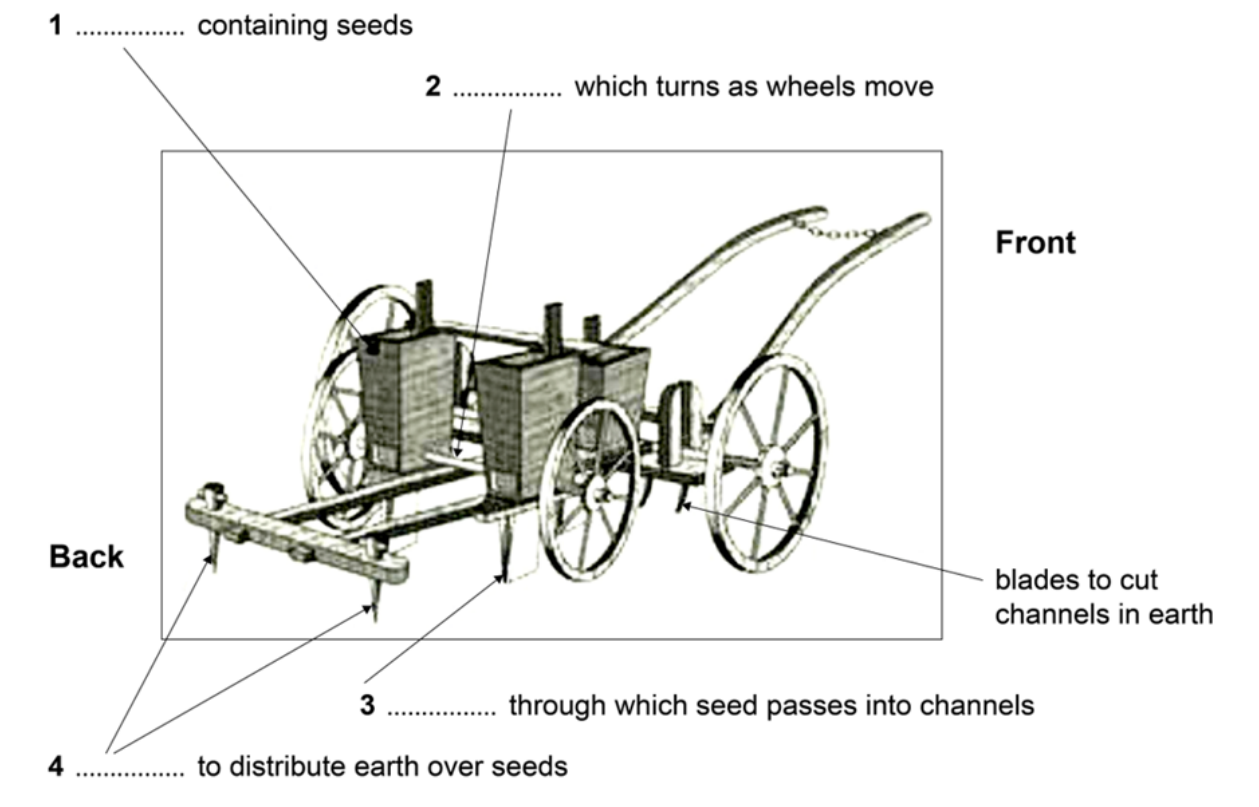
C Earlier in his life, Tull had once dismantled a pipe-organ, and the application of the technology behind this musical instrument inspired him to devise a drill that would distribute precise amounts of seed into pre-cut channels. Basic seeding devices had been known for almost 2000 years, but Tull took the concept a stage further. In his device, as the main wheels of the drill turned, the cylinder rotated against a spring-held tongue. This allowed seed to pass evenly from the hopper above to a funnel below. From here, the seed was directed at regular intervals into three channels, or furrows, in the earth. These were dug to a specific depth by the blades at the front of the machine. Spikes at the back of the machine then turned the soil over to immediately cover the seeds. Tull's 'seed drill' would limit the wastage of seed, and as the seedlings grew in uniform rows, it would also make it easier to remove any unwanted weeds growing among the crop. Accordingly, each plant would have more space to grow, and although there would be fewer plants, the net yield would be greater.
D Initially the machine was only a limited success, and in 1711 Tull decided to travel around Europe again, both to improve his health and to study agricultural techniques there. Upon his return in 1714, he perfected both his system and machinery. Following practices he had observed in the vine-growing methods of southern Europe, he used an animal-drawn hoe to turn over and pulverise the earth between the rows. He wrongly believed that this practice would release enough nutrients in the soil to nourish the crop, and so eliminate the need for manure to be used to fertilise the soil. His experiments were apparently successful, as he did manage to grow wheat in the same field for 13 successive years without the use of manure. However, it is more likely that it was the turning over and pulverisation of the soil that cut down on the volume of weeds competing with the seed.
E Tull's complete system eventually proved to be a major influence in the agricultural revolution, and its impact can still be seen in today's methods. Most subsequent drilling and hoeing implements have been either copies of, or improvements upon his inventions, and his modifications to the basic model of the plough continue to be visible in modern versions. Tull also advocated the use of horses over the oxen, more traditionally used to pull farm machinery, and published a book in 1731 outlining this and other ideas to enhance agricultural efficiency. The book caused great controversy when it appeared, and resistance to his revolutionary theories persisted for many decades. Another century would pass before his eventual vindication. It was only following the editing of his writings in 1822, and the subsequent translations and acceptance in France, that Tull's ideas finally achieved recognition in his native land. Although in his lifetime Tull's methods and inventions were dismissed and ridiculed, they were gradually adopted by large landowners, and in time, came to form the basis of modern agriculture.
Questions
Questions 1–4 Diagram Labeling
Label the diagram below.
Write ONE WORD ONLY from the passage for each answer.
Questions 5–8 Sentence Completion
Complete the sentences below.
Write NO MORE THAN TWO WORDS from the passage for each answer.
- What name was given to the traditional technique of seed-sowing?
5
- What type of agriculture gave Tull inspiration on his second tour of Europe?
6
- What traditional addition to soil did Tull believe to be unnecessary?
7
- What animals did Tull recommend farmers should use to pull their machinery?
8
Questions 9–13 True / False / Not Given
Do the following statements agree with the information given in Reading Passage 1?
Write
TRUE if the statement agrees with the information
FALSE if the statement contradicts the information
NOT GIVEN if there is no information on this
Answers & Explanations Summary
| # | Answer | Evidence | Explanation |
|---|---|---|---|
| Q1 | hopper | This allowed seed to pass evenly from the hopper above to a funnel below | Excerpt/Passage Explanation: The passage says seed passes from the hopper above to a funnel below. Answer Explanation: The answer 'hopper' is the container at the top of the machine that holds the seed. Reason For Correctness: The correct answer is 'hopper' because the passage says the seed moves 'from the hopper above', which matches the top part of the diagram. |
| Q2 | cylinder | In his device, as the main wheels of the drill turned, the cylinder rotated against a spring-held tongue | Excerpt/Passage Explanation: The passage says that when the wheels turned, the cylinder turned against a spring-held tongue. Answer Explanation: The answer 'cylinder' is the part that turns when the wheels of the drill turn. Reason For Correctness: The correct answer is 'cylinder' because the passage names it as the part that 'rotated' as the wheels turned. |
| Q3 | funnel | This allowed seed to pass evenly from the hopper above to a funnel below | Excerpt/Passage Explanation: The passage says seed goes from the hopper above down into a funnel below. Answer Explanation: The answer 'funnel' is the part that receives the seed from the hopper. Reason For Correctness: The correct answer is 'funnel' because the passage says seed passes to 'a funnel below', which is under the hopper in the diagram. |
| Q4 | spikes | Spikes at the back of the machine then turned the soil over to immediately cover the seeds | Excerpt/Passage Explanation: The passage says spikes at the back of the machine turn the soil over and cover the seeds. Answer Explanation: The answer 'spikes' are the parts at the back that cover the seeds with soil. Reason For Correctness: The correct answer is 'spikes' because the passage says they are 'at the back of the machine' and cover the seeds. |
| Q5 | broadcasting | At that time seeds were still thrown by hand across the field in a haphazard manner, in a traditional method known as broadcasting | Excerpt/Passage Explanation: The passage says seeds were thrown by hand across the field in the old method called broadcasting. Answer Explanation: The answer 'broadcasting' is the name of the traditional way of sowing seeds. Reason For Correctness: The correct answer is 'broadcasting' because the passage says 'traditional method known as broadcasting', matching 'traditional technique'. |
| Q6 | vine-growing | Following practices he had observed in the vine-growing methods of southern Europe, he used an animal-drawn hoe to turn over and pulverise the earth between the rows | Excerpt/Passage Explanation: The passage says Tull copied ideas from vine-growing in southern Europe and used a hoe pulled by an animal. Answer Explanation: The answer 'vine-growing' is the type of farming that gave Tull his idea. Reason For Correctness: The correct answer is 'vine-growing' because he 'observed' it in southern Europe, which he visited on his second trip, after 1711. |
| Q7 | manure | He wrongly believed that this practice would release enough nutrients in the soil to nourish the crop, and so eliminate the need for manure to be used to fertilise the soil | Excerpt/Passage Explanation: The passage says Tull wrongly believed that hoeing would give the soil enough nutrients, so manure was not needed. Answer Explanation: The answer 'manure' is the material farmers normally add to the soil, which Tull thought was unnecessary. Reason For Correctness: The correct answer is 'manure' because 'eliminate the need for manure' matches 'unnecessary', and 'fertilise the soil' matches 'addition to soil'. |
| Q8 | horses | Tull also advocated the use of horses over the oxen, more traditionally used to pull farm machinery | Excerpt/Passage Explanation: The passage says Tull supported using horses instead of oxen to pull farm machinery. Answer Explanation: The answer 'horses' are the animals Tull recommended for pulling machinery. Reason For Correctness: The correct answer is 'horses' because 'advocated the use of horses' matches 'recommended', and 'pull farm machinery' matches the question. |
| Q9 | NOT GIVEN | He studied first at Oxford University and then at the Inns of Court, London, in preparation for a legal or political career | Excerpt/Passage Explanation: The passage says Tull studied to prepare for a legal or political career, but his poor health delayed those plans. Answer Explanation: The answer is NOT GIVEN because the passage does not say he worked in the legal profession. Reason For Correctness: The correct answer is NOT GIVEN because the passage mentions only preparation and qualifying as a barrister, not employment in law. |
| Q10 | TRUE | But by 1701, his frustration with their lack of co-operation prompted him to invent a machine to do the work for him | Excerpt/Passage Explanation: The passage says Tull was frustrated with his staff's lack of co-operation, so he invented a machine. Answer Explanation: The answer is TRUE because the staff did not co-operate with him. Reason For Correctness: The correct answer is TRUE because 'lack of co-operation' matches 'unwilling to follow his instructions'. |
| Q11 | TRUE | However, it is more likely that it was the turning over and pulverisation of the soil that cut down on the volume of weeds competing with the seed | Excerpt/Passage Explanation: The passage says the turning over of the soil most likely reduced the number of weeds. Answer Explanation: The answer is TRUE because the passage says the weeds in his field were reduced. Reason For Correctness: The correct answer is TRUE because 'cut down on the volume of weeds' matches 'reduced the amount of weeds'. |
| Q12 | FALSE | Another century would pass before his eventual vindication | Excerpt/Passage Explanation: The passage says it took another hundred years before Tull was proved right. Answer Explanation: The answer is FALSE because Tull did not live to see his ideas accepted. Reason For Correctness: The correct answer is FALSE because 'another century would pass' means acceptance came long after his death. |
| Q13 | NOT GIVEN | The book caused great controversy when it appeared, and resistance to his revolutionary theories persisted for many decades | Excerpt/Passage Explanation: The passage says the book caused a lot of argument and people resisted his ideas for many decades. Answer Explanation: The answer is NOT GIVEN because the passage does not say how many copies the book sold. Reason For Correctness: The correct answer is NOT GIVEN because the passage talks about controversy, not about sales. |