
MIGRATORY BEEKEEPING - IELTS Reading Answers & Explanations
From Cambridge IELTS 01 Academic Reading Test 2 · Part 2 · Questions 13–27
Reading Passage
You should spend about 20 minutes on Questions 13-27 which are based on Reading Passage 2 below.
MIGRATORY BEEKEEPING
Taking Wing
To eke out a full-time living from their honeybees, about half the nation’s 2,000 commercial beekeepers pull up stakes each spring, migrating north to find more flowers for their bees. Besides turning floral nectar into honey, these hardworking insects also pollinate crops for farmers -for a fee. As autumn approaches, the beekeepers pack up their hives and go south, scrambling for pollination contracts in hot spots like California’s fertile Central Valley.
Of the 2,000 commercial beekeepers in the United States about half migrate This pays off in two ways Moving north in the summer and south in the winter lets bees work a longer blooming season, making more honey — and money — for their keepers. Second, beekeepers can carry their hives to farmers who need bees to pollinate their crops. Every spring a migratory beekeeper in California may move up to 160 million bees to flowering fields in Minnesota and every winter his family may haul the hives back to California, where farmers will rent the bees to pollinate almond and cherry trees.
Migratory beekeeping is nothing new. The ancient Egyptians moved clay hives, probably on rafts, down the Nile to follow the bloom and nectar flow as it moved toward Cairo. In the 1880s North American beekeepers experimented with the same idea, moving bees on barges along the Mississippi and on waterways in Florida, but their lighter, wooden hives kept falling into the water. Other keepers tried the railroad and horse-drawn wagons, but that didn’t prove practical. Not until the 1920s when cars and trucks became affordable and roads improved, did migratory beekeeping begin to catch on.
For the Californian beekeeper, the pollination season begins in February. At this time, the beehives are in particular demand by farmers who have almond groves; they need two hives an acre. For the three-week long bloom, beekeepers can hire out their hives for $32 each. It’s a bonanza for the bees too. Most people consider almond honey too bitter to eat so the bees get to keep it for themselves.
By early March it is time to move the bees. It can take up to seven nights to pack the 4,000 or so hives that a beekeeper may own. These are not moved in the middle of the day because too many of the bees would end up homeless. But at night, the hives are stacked onto wooden pallets, back-to-back in sets of four, and lifted onto a truck. It is not necessary to wear gloves or a beekeeper’s veil because the hives are not being opened and the bees should remain relatively quiet. Just in case some are still lively, bees can be pacified with a few puffs of smoke blown into each hive’s narrow entrance.
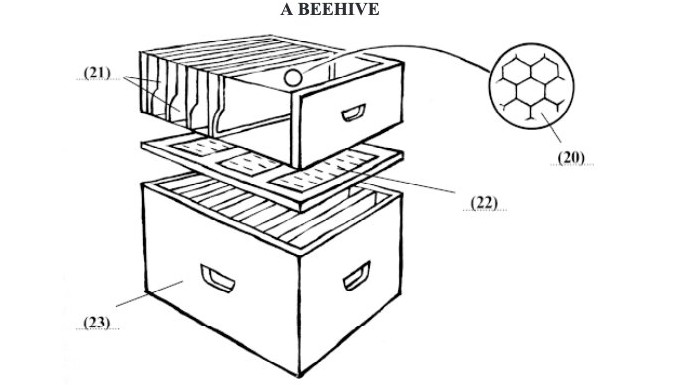
In their new location, the beekeeper will pay the farmer to allow his bees to feed in such places as orange groves. The honey produced here is fragrant and sweet and can be sold by the beekeepers. To encourage the bees to produce as much honey as possible during this period, the beekeepers open the hives and stack extra boxes called supers on top. These temporary hive extensions contain frames of empty comb for the bees to fill with honey. In the brood chamber below, the bees will stash honey to eat later. To prevent the queen from crawling up to the top and laying eggs, a screen can be inserted between the brood chamber and the supers. Three weeks later the honey can be gathered.
Foul smelling chemicals are often used to irritate the bees and drive them down into the hive’s bottom boxes, leaving the honey-filled supers more or less bee free. These can then be pulled off the hive. They are heavy with honey and may weigh up to 90 pounds each. The supers are taken to a warehouse. In the extracting room, the frames are lilted out and lowered into an “uncapper” where rotating blades shave away the wax that covers each cell. The uncapped frames are put in a carousel that sits on the bottom of a large stainless steel drum. The carousel is filled to capacity with 72 frames. A switch is flipped and the frames begin to whirl at 300 revolutions per minute; centrifugal force throws the honey out of the combs. Finally the honey is poured into barrels for shipment.
After this, approximately a quarter of the hives weakened by disease, mites, or an ageing or dead queen, will have to be replaced. To create new colonies, a healthy double hive, teeming with bees, can be separated into two boxes. One half will hold the queen and a young, already mated queen can be put in the other half, to make two hives from one. By the time the flowers bloom, the new queens will be laying eggs, filling each hive with young worker bees. The beekeeper’s family will then migrate with them to their summer location.
Questions
Questions 13–19 Flow Chart Completion
The flow chart below outlines the movements of the migratory beekeeper as described in Reading Passage 2
Complete the flow chart Choose your answers from the box at the bottom of the page and write your answers in boxes 13 19 on your answer sheet.
smoke | barrels | set off
pollinate | combs | full
chemicals | protection | light
machines | screen | empty
pay | charge | split
supers | prepare | queens
BEEKEEPER MOVEMENTS
Example: In February, Californian farmers hire bees to help pollinate almond trees.
In March, beekeepers 13 for migration at night when the hives are 14 and the bees are generally tranquil. A little 15 can ensure that this is the case.
They transport their hives to orange groves where farmers 16 beekeepers for placing them on their land. Here the bees make honey.
After three weeks, the supers can be taken to a warehouse where 17 are used to remove the wax and extract the honey from the 18 .
After the honey collection, the old hives are rejected. Good double hives are 19 and re-queened and the beekeeper transports them to their summer base.
Questions 20–23 Diagram Labeling
Label the diagram below Choose ONE OR TWO WORDS from the Reading Passage for each answer Write your answers in boxes 20-23 on your answer sheet.
Questions 24–27 Yes / No / Not Given
Do the following statements agree with the information given in Reading Passage 2? In boxes 24-27 write.
YES if the statement agrees with the information given
NO if the statement contradicts the information given
NOT GIVEN if there is no information about this
Answers & Explanations Summary
| # | Answer | Evidence | Explanation |
|---|---|---|---|
| Q13 | prepare | By early March it is time to move the bees. It can take up to seven nights to pack the 4,000 or so hives that a beekeeper may own | Excerpt/Passage Explanation: The passage explains that at the start of March, it is time for the beekeepers to relocate their bees, and they spend up to seven nights packing up all their hives to get them ready for the trip. Answer Explanation: The answer means to get things ready or to organize everything before a journey or a specific task starts. Reason For Correctness: The correct answer is 'prepare' because the flow chart describes the series of actions beekeepers take in March. The passage mentions that during this time, beekeepers spend several nights 'packing' their thousands of hives. 'Pack' is a synonym for getting ready, which fits the meaning of 'prepare' in the context of getting ready for the move/migration. The flow chart summarizes these early actions as preparing for the migration. |
| Q14 | full | These are not moved in the middle of the day because too many of the bees would end up homeless | Excerpt/Passage Explanation: The passage says that beekeepers do not move the hives during the day because many bees are outside. If the hive is moved then, those bees will lose their home. Moving at night ensures that every bee is inside, so the hive is 'full' and no bees are left behind. Answer Explanation: The answer 'full' means that all the bees are inside their hives (their wooden boxes) at night. Reason For Correctness: The correct answer is 'full' because the passage explains that beekeepers move the hives at night instead of during the day. If they move the hives during the day, many bees would be away from the home and would become 'homeless' because they cannot find where the hive went. This implies that at night, every bee has returned to the box, making the hive 'full' of its bees. This is the only way to move the hives without losing any of the insects. |
| Q15 | smoke | Just in case some are still lively, bees can be pacified with a few puffs of smoke blown into each hive’s narrow entrance | Excerpt/Passage Explanation: The passage explains that if some bees are still active or awake, the beekeeper can use a little bit of smoke to make them calm and quiet. Answer Explanation: The answer 'smoke' is the substance beekeepers use to make bees calm and quiet while they are being moved. Reason For Correctness: The correct answer is 'smoke' because the text explains that while bees are usually quiet at night, some might still be 'lively' (moving around). To make sure they remain 'pacified' (calm or tranquil) during the move, the beekeeper uses smoke. This matches the flow chart's description of using something to ensure the bees stay tranquil. |
| Q16 | charge | In their new location, the beekeeper will pay the farmer to allow his bees to feed in such places as orange groves | Excerpt/Passage Explanation: The passage explains that when beekeepers move to a new area, they give money to the farmers so that their bees are allowed to find food in the orange trees. Answer Explanation: The answer "charge" means to ask someone for a specific amount of money in return for a service or the use of something. Reason For Correctness: The correct answer is "charge" because the passage states that beekeepers pay farmers for the right to let their bees feed in orange groves. Since the sentence in the flow chart begins with "farmers" as the subject, the verb must reflect the farmer's action. If the beekeeper is the one paying, then the farmer is the one who "charges" the fee for using their land. |
| Q17 | machines | In the extracting room, the frames are lilted out and lowered into an “uncapper” where rotating blades shave away the wax that covers each cell. The uncapped frames are put in a carousel that sits on the bottom of a large stainless steel drum. The carousel is filled to capacity with 72 frames. A switch is flipped and the frames begin to whirl at 300 revolutions per minute; centrifugal force throws the honey out of the combs | Excerpt/Passage Explanation: The passage explains that tools with spinning blades (the uncapper) and a spinning holder (the carousel) are used to take the wax off and pull the honey out. Answer Explanation: The answer "machines" refers to the mechanical equipment used at the warehouse to process honey. Reason For Correctness: The correct answer is "machines" because the passage describes using an “uncapper” with "rotating blades" to remove the wax and a "carousel" that "whirls" to extract the honey. In the provided word list, "machines" is the general term that covers these mechanical devices used to perform these specific tasks. |
| Q18 | combs | A switch is flipped and the frames begin to whirl at 300 revolutions per minute; centrifugal force throws the honey out of the combs | Excerpt/Passage Explanation: The passage explains that when the machine spins the frames very quickly, the force pushes the honey out of the wax storage parts called combs. Answer Explanation: The answer refers to the wax structures where honey is stored inside the beehive. Reason For Correctness: The correct answer is "combs" because the passage describes the final step of getting honey at the warehouse. After the wax covers are removed by a machine, the frames are spun very fast to extract the honey from the combs so it can be bottled. |
| Q19 | split | To create new colonies, a healthy double hive, teeming with bees, can be separated into two boxes | Excerpt/Passage Explanation: The passage explains that to make new groups of bees, a large, healthy hive is pulled apart into two separate containers. Answer Explanation: The answer 'split' means to divide one thing into two or more parts. Reason For Correctness: The correct answer is chosen because the passage describes how beekeepers create new hives to replace old ones that are weak or have died. It explains that a healthy 'double hive' (a large hive) is 'separated into two boxes' to make two new hives. In the list of options provided for the flow chart, 'split' is the synonym for 'separated'. This process of dividing the hive is followed by adding a new queen to one of the parts. |
| Q20 | empty comb / comb | These temporary hive extensions contain frames of empty comb for the bees to fill with honey | Excerpt/Passage Explanation: The passage says that beekeepers put extra boxes on top of the hives. These boxes contain frames that hold 'empty comb,' which is a structure made of wax that has no honey in it yet. The bees then use these spaces to store the honey they make. Answer Explanation: The answer refers to the wax structure inside the frames that is ready to be filled with honey by the bees. Reason For Correctness: The correct answer is '(empty) comb' because the passage specifically describes what is inside the 'supers' or 'hive extensions.' It mentions that these frames contain 'empty comb' so that the bees have a place to 'fill' with honey. In the context of the diagram, it identifies the material or structure found within the frames used during the honey-making season. |
| Q21 | frames | These temporary hive extensions contain frames of empty comb for the bees to fill with honey | Excerpt/Passage Explanation: The passage explains that the extra parts added to the hive have frames with empty wax cells inside so that the bees can fill them up with honey. Answer Explanation: The answer refers to the specific structures found inside the extra boxes of a beehive where bees store their honey. Reason For Correctness: The correct answer is derived from the description of how beekeepers increase honey production. They add extra boxes called 'supers' to the hive. The text explains that these supers contain special parts called 'frames' which have 'empty comb' inside. These frames act as the containers that the bees fill with honey during the blooming season. |
| Q22 | screen | To prevent the queen from crawling up to the top and laying eggs, a screen can be inserted between the brood chamber and the supers | Excerpt/Passage Explanation: The passage says that if a beekeeper wants to stop the queen bee from moving to the top of the hive to lay eggs, they can put a screen between the bottom box and the top boxes. Answer Explanation: The answer is a mesh-like divider used in a beehive to control where the queen bee can go. Reason For Correctness: The correct answer is 'screen' because the passage explains that beekeepers want to keep the honey in the top boxes (supers) separate from the queen's eggs. To do this, they place a physical barrier called a 'screen' between the bottom part where she lives and the top part where honey is stored. This keeps the honey clean of eggs so it can be harvested easily. Synonyms or related ideas in the text include 'prevent' (stop) and 'inserted' (put inside). |
| Q23 | brood chamber | In the brood chamber below, the bees will stash honey to eat later. To prevent the queen from crawling up to the top and laying eggs, a screen can be inserted between the brood chamber and the supers | Excerpt/Passage Explanation: The passage states that the brood chamber is the lower part of the hive where bees store food. It also says it is the area where the queen stays to lay eggs, separated from the top sections by a screen. Answer Explanation: The answer refers to the lower section of the beehive box where the bees keep their own food and where the queen bee lives. Reason For Correctness: The correct answer is found in the description of how beekeepers set up the hive to collect honey. The passage explains that beekeepers put extra boxes called 'supers' on top. Below these extensions is the 'brood chamber.' This bottom part is where the bees keep honey to eat for themselves and where the queen is kept so she does not lay eggs in the top honey boxes. |
| Q24 | NOT GIVEN | The ancient Egyptians moved clay hives, probably on rafts, down the Nile to follow the bloom and nectar flow as it moved toward Cairo | Excerpt/Passage Explanation: The passage says that Egyptians moved their bee containers on the water to follow flowers, but it does not tell us if they kept the bees on the land next to the water. Answer Explanation: The answer is NOT GIVEN because the passage does not provide enough information to confirm or deny if Egyptians kept bees on the riverbanks. Reason For Correctness: The correct answer is NOT GIVEN because, while the text mentions the Nile, it focuses on how the ancient Egyptians moved their hives on rafts along the river to follow the flowers. It does not mention whether the bees were kept on the banks (the land at the side of the river) or somewhere else. Since the text is silent on this specific location, we cannot say if the statement is true or false. |
| Q25 | YES | In the 1880s North American beekeepers experimented with the same idea, moving bees on barges along the Mississippi and on waterways in Florida, but their lighter, wooden hives kept falling into the water. Other keepers tried the railroad and horse-drawn wagons, but that didn’t prove practical | Excerpt/Passage Explanation: The passage explains that early experiments in America were not successful because the bee boxes fell into the water or the travel methods were too difficult to use. Answer Explanation: The answer means that the first tries to move bees around in North America did not work out well. Reason For Correctness: The correct answer is YES because the passage says that in the 1880s, North American beekeepers 'experimented' (tried) with moving bees, but those early attempts failed. Their bee boxes fell into the water when used on boats, and other methods like trains and horse wagons did not 'prove practical,' which means they were not successful or useful. It was not until the 1920s that the practice finally 'caught on' (became successful and popular). |
| Q26 | YES | In the brood chamber below, the bees will stash honey to eat later | Excerpt/Passage Explanation: The passage explains that there is a lower section of the beehive where the bees store honey so they have food for themselves in the future. Answer Explanation: The answer YES means that bees save some honey to eat on their own, and they store it in the lower part of their home. Reason For Correctness: The correct answer is YES because the passage explains that while humans take the honey from the top boxes (called 'supers'), the bees put honey in a different area called the 'brood chamber' located 'below.' The phrase 'stash honey to eat later' shows that this honey is kept for the bees' own use rather than being taken away by beekeepers. |
| Q27 | NO | A switch is flipped and the frames begin to whirl at 300 revolutions per minute; centrifugal force throws the honey out of the combs | Excerpt/Passage Explanation: The passage explains that when the machine is turned on, the frames spin (whirl) very fast. This fast movement uses a physical force to push or 'throw' the honey out of the honeycomb frames, showing that the goal of spinning is to remove the honey, not to change its state. Answer Explanation: The answer is NO because the statement says the honey is spun to turn it into a liquid, but the passage says it is spun to pull it out of its container. Reason For Correctness: The correct answer is NO because the passage explains that the spinning motion (described as 'whirl') is used to create 'centrifugal force.' This force is used for the specific purpose of extracting the honey, or 'throwing' it out of the combs, so it can be collected. The text does not mention that the honey needs to be made liquid; it focuses on moving the honey from the combs into a container. |