
Phases Of The Moon - IELTS Reading Answers & Explanations
From Barrons IELTS Practice Exams General Training Reading Test 2 · Part 3 · Questions 28–40
Reading Passage
Read the text below and answer Questions 28-40.
Phases of the Moon
Traveling a distance of approximately 382,400 kilometers, the moon takes just over twenty-nine days to complete its orbit around the Earth. During this lunar cycle, many different phases of the moon are visible from Earth, even though the moon itself never changes shape. The cyclic period of the moon is determined by the extent to which the sun illuminates the moon on the side that is facing Earth. Just like Earth, the moon is sphere shaped, and thus always half illuminated by the sun. However, because the moon and the Earth are in synchronous rotation, we can see only the near side of the moon. The side we do not see is called the far side, or the dark side, a term that is often misunderstood. The dark side refers to the mysteriousness of this unseen side, not the amount of light it receives. Both the near and the far sides of the moon receive approximately the same amount of sunlight. Though we see a slightly different moon from Earth each day, its repetitive cycle is both predictable and functional.
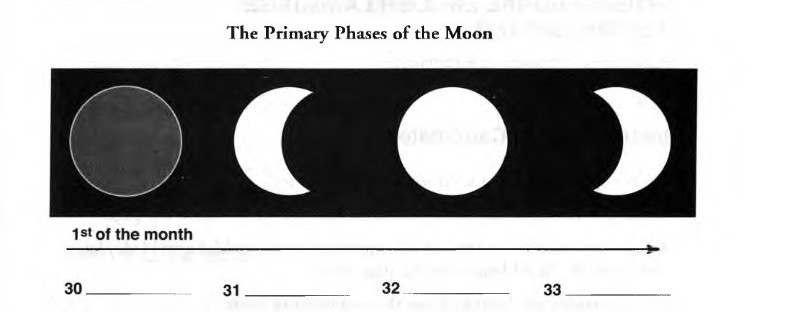
There are eight phases of the moon, each with a unique name that signifies how much of the moon is visible from Earth. In the early phases, the moon is said to be waxing, or gradually getting larger. The first phase is called new moon. In this phase, the moon is lined up between the Earth and the sun. The illuminated side of the moon is facing the sun, not the Earth, so from Earth, there appears to be no moon at all. As the moon begins to move slowly eastward away from the sun, it becomes slightly more visible.
After new moon, the waxing crescent phase begins. During this phase, the moon appears to be less than half illuminated. First quarter occurs when one-half of the moon is visible. It is called first quarter, not because of its size, but because it represents the end of the first quarter of the moon’s cycle. The next phase is called waxing gibbous and represents a moon that is larger than half a sphere, but not quite a whole. This phase is followed by full moon, which occurs when the moon's illuminated side is directly facing Earth.
As the moon begins to get smaller again, it is said to be waning. The phases in the second half of the cycle appear the same as the first, except that the opposite half of the near side of the moon is illuminated, thus the moon appears to be shrinking rather than growing. Waning gibbous is followed by last quarter, when one-half of the moon is visible, and finally waning crescent. In the Northern Hemisphere, when the moon is waxing, the light of the moon increases from right to left. The opposite occurs in the Southern Hemisphere.
Like the sun, the moon is an accurate tool for measuring time. A complete cycle of the moon is called a lunation. A full cycle of the moon typically lasts just under one calendar month, therefore, the phase of the moon that starts a month usually repeats just before the month is through. When two full moons occur in one calendar month the second one is called a blue moon. This phenomenon occurs about once every 2.7 years. Within one cycle, the moon’s “age” is calculated from the last day of the new moon. For example, the moon is approximately fifteen days old during the full moon phase.
The moon can also be used to calculate the time of day. Just like the sun, the moon rises and sets each day and is visible on the Earth’s horizon. At new moon, the moon and sun rise and set at almost the same time. As the moon begins to wax, or move farther in its orbit, it rises approximately one hour later each day. By full moon, the moon rises at about the same time the sun sets and sets when the sun rises. Therefore, the moon is out in the daytime as often as it is at night even though it is not always as easy to see in the daylight. The Islamic calendar is based on the phases of the moon. The beginning of each new month in the Islamic calendar begins when the waxing crescent first appears in the night sky.
The primary phases of the moon, which include new moon, first quarter, full moon, and last quarter are published in almanacs for each month. The phases can also be found on many calendars in the Western world. Despite the world’s fascination with the moon, its phases are not entirely unique. The planets Venus and Mercury have similar phases; however, unlike the moon, these planets can never be on the opposite side of the Earth from the sun. To see the equivalent of the “full moon” phase of these planets, we would need to have the capacity to see through the sun.
Questions
Questions 28–29 One Choice
Choose the correct letter, A, B, or C.
Questions 30–33 Diagram Labeling
Label the diagram below. Choose NO MORE THAN TWO WORDS from the reading passage for each answer.
Questions 34–40 Yes / No / Not Given
Do the following statements agree with the information given in the passage?
YES if the statement agrees with the information
NO if the statement contradicts the information
NOT GIVEN if there is no information on this
Answers & Explanations Summary
| # | Answer | Evidence | Explanation |
|---|---|---|---|
| Q28 | B | Traveling a distance of approximately 382,400 kilometers, the moon takes just over twenty-nine days to complete its orbit around the Earth | Excerpt/Passage Explanation: The passage explains that moving through a distance of about 382,400 kilometers takes the moon a little more than twenty-nine days as it travels around the Earth. Answer Explanation: The answer means that the moon travels a distance of about 382,400 kilometers in around twenty-nine days. Reason For Correctness: The correct answer is B because the passage clearly states that the moon takes just over twenty-nine days to travel a distance of approximately 382,400 kilometers. Option A is incorrect because the moon orbits the Earth, not the sun. Option C is incorrect because reaching full illumination happens around fifteen days into the cycle during the full moon phase, not twenty-nine days. |
| Q29 | C | However, because the moon and the Earth are in synchronous rotation, we can see only the near side of the moon. The side we do not see is called the far side, or the dark side, a term that is often misunderstood | Excerpt/Passage Explanation: The passage explains that people on Earth can only see one side of the moon, called the near side. The other side, which we cannot see, is called the far side or the dark side. Answer Explanation: The answer means that people living on Earth can never see the dark side of the moon. Reason For Correctness: The correct answer is C because the text clearly states that we can only see the near side of the moon from Earth. The other side that people cannot see is named the 'far side' or the 'dark side'. Therefore, this side is never visible from Earth. |
| Q30 | new moon | The first phase is called new moon | Excerpt/Passage Explanation: The passage clearly says that the first stage of the moon cycle is named 'new moon'. Answer Explanation: The answer is 'new moon', which is the name of the moon's very first stage. Reason For Correctness: The correct answer is 'new moon' because the text names 'new moon' as the very first phase in the moon's cycle. |
| Q31 | first quarter | First quarter occurs when one-half of the moon is visible | Excerpt/Passage Explanation: The passage explains that the phase called 'first quarter' happens when people can see half of the moon. Answer Explanation: The answer 'first quarter' refers to the moon phase where half of the visible side of the moon is lit up by sunlight. Reason For Correctness: The correct answer is 'first quarter' because the text explains that this specific moon phase happens when one-half of the moon is visible from Earth. |
| Q32 | full moon | This phase is followed by full moon, which occurs when the moon's illuminated side is directly facing Earth | Excerpt/Passage Explanation: The passage explains that the phase called 'full moon' happens when the side of the moon lit by sunlight directly faces the Earth. Answer Explanation: The answer refers to the 'full moon', which is the stage when the entire lit side of the moon can be seen from Earth. Reason For Correctness: The correct answer is 'full moon' because the text explains that this specific phase happens when the lit up or 'illuminated' side of the moon points right toward Earth. |
| Q33 | last quarter | Waning gibbous is followed by last quarter, when one-half of the moon is visible, and finally waning crescent | Excerpt/Passage Explanation: The passage explains that after the waning gibbous phase comes the last quarter phase, where half of the moon is visible, followed by the waning crescent. Answer Explanation: The answer is "last quarter", which is the moon phase where half of the moon is visible after it starts getting smaller. Reason For Correctness: The correct answer is "last quarter" because the text explains the order of the moon's phases when it is shrinking (waning). After the waning gibbous phase, the next stage is called the "last quarter", during which half of the moon can be seen from Earth. |
| Q34 | NO | A complete cycle of the moon is called a lunation. A full cycle of the moon typically lasts just under one calendar month, therefore, the phase of the moon that starts a month usually repeats just before the month is through | Excerpt/Passage Explanation: The passage explains that one full moon cycle is named a lunation, and it takes slightly less time than one calendar month to finish. Answer Explanation: The answer "NO" means that the statement is false according to the text. Reason For Correctness: The correct answer is NO because the statement says a lunation takes a little more than one month, but the text states that a lunation (a full cycle of the moon) usually lasts "just under one calendar month" (less than one month). Since the statement contradicts the text, the answer is NO. |
| Q35 | NO | When two full moons occur in one calendar month the second one is called a blue moon | Excerpt/Passage Explanation: The passage states that a blue moon is the second full moon that happens within one calendar month. Answer Explanation: The answer means that the given statement is false according to the text. Reason For Correctness: The correct answer is NO because the text explains that a 'blue moon' is the name given to the second full moon in a single month. It does not mean the moon actually changes color or turns blue at specific times of the year. |
| Q36 | YES | Within one cycle, the moon’s “age” is calculated from the last day of the new moon. For example, the moon is approximately fifteen days old during the full moon phase | Excerpt/Passage Explanation: The passage explains that counting the moon's age begins on the last day of the new moon, and when it reaches the full moon phase, it is about fifteen days old. Answer Explanation: The answer YES means that the statement matches the information provided in the passage. Reason For Correctness: The correct answer is YES because the text explains that the moon's age is counted starting from the last day of the new moon. By the time the moon reaches the full moon stage, it is about fifteen days old. This confirms that it takes around fifteen days to go from the new moon to the full moon. |
| Q37 | YES | At new moon, the moon and sun rise and set at almost the same time | Excerpt/Passage Explanation: The passage states that during the new moon phase, the moon and the sun come up and go down at practically the same time. Answer Explanation: The answer means that the statement is correct according to the text. Reason For Correctness: The correct answer is YES because the text explains that during the new moon phase, the moon and the sun go up into the sky (rise) at nearly the exact same time. This shows that at specific times in a month, both the moon and the sun rise together. |
| Q38 | NOT GIVEN | The Islamic calendar is based on the phases of the moon. The beginning of each new month in the Islamic calendar begins when the waxing crescent first appears in the night sky | Excerpt/Passage Explanation: The passage explains that the Islamic calendar follows the moon and tells us when a new month begins. However, it does not state how many months there are on this calendar. Answer Explanation: The answer NOT GIVEN means that the text does not say whether the Islamic calendar has twelve months or a different number of months. Reason For Correctness: The correct answer is NOT GIVEN because the text talks about the Islamic calendar and how a new month starts, but it never mentions how many total months are in an Islamic year. |
| Q39 | YES | The planets Venus and Mercury have similar phases | Excerpt/Passage Explanation: The passage explains that Venus and Mercury, which are planets, have phases like the moon. Answer Explanation: The answer YES means that the statement is true based on the information given in the text. Reason For Correctness: The correct answer is YES because the passage clearly states that the planets Venus and Mercury have phases similar to those of the moon. The keyword 'planets' refers to Venus and Mercury, and the phrase 'similar phases' directly matches the statement. |
| Q40 | NOT GIVEN | The planets Venus and Mercury have similar phases; however, unlike the moon, these planets can never be on the opposite side of the Earth from the sun | Excerpt/Passage Explanation: The passage discusses the planets Venus and Mercury themselves, but it does not provide any information about moons around these planets. Answer Explanation: The answer means that the provided text does not say anything about moons of Venus and Mercury being visible from Earth. Reason For Correctness: The correct answer is NOT GIVEN because the text only mentions the planets Venus and Mercury having phases similar to Earth's moon. It never mentions whether Venus and Mercury have moons of their own or if those moons can be seen from Earth. |