
The First Antigravity Machine? - IELTS Reading Answers & Explanations
From Achieve IELTS Practice Tests Academic Reading Test 4 · Part 3 · Questions 27–40
Reading Passage
You should spend about 20 minutes on Questions 27 – 40, which are based on Reading Passage 3.
The First Antigravity Machine?
It was one of the biggest science stories of the 1990s. Even now, the facts behind it remain hotly disputed. And small wonder, for if the claims made for the small disc, the focus of the controversy, are true, it may be possible to break through one of the great barriers in the scientific world and control the most potent of cosmic forces: gravity. Huge innovations in flight and space travel could arise from that.
The first gravity-blocking system to be taken seriously by scientists appeared in a laboratory in Tampere University of Technology, Finland. A Russian scientist named Dr Evgeny Podkletnov created a disc 275mm across, made from a substance which combined copper, barium and the ‘rare Earth metal’ called yttrium, which is known to be a high-temperature superconductor (a substance that conducts electricity without resistance). When chilled with liquid nitrogen at -196° C (a high temperature compared with other superconductors), this material loses all its electrical resistance, and can levitate (lift) in a magnetic field. That may seem amazing for a ceramic-like material – and it won a Nobel Prize for the scientists, Karl Müller and Johannes Bednorz, who first demonstrated it in the 1980s. But according to Podkletnov, the disc had another far more astounding property.
In 1992, while experimenting with rotating superconductors, Podkletnov noticed that pipe-smoke from a nearby researcher was drifting into a vertical column above the spinning disc. Intrigued by this phenomenon, he decided to devise an experiment to investigate further. A superconductive disc, surrounded by liquid nitrogen was magnetically levitated and rotated at high speed – up to 5,000 revolutions per minute (rpm) in a magnetic field. An object was suspended from a sensitive balance above the disc. It was enclosed in a glass tube to shield it from any effects of air currents. During the course of a series of tests, Podkletnov was able to observe that the object lost a variable amount of weight from less than 0.5 percent to 2 percent of its total weight. This effect was noted with a range of materials from ceramics to wood. The effect was slight, yet the implications were revolutionary: the disc appeared to be partly shielding the object from the gravitational pull of the Earth.
This was just the start, claimed Podkletnov. While far short of the 100 percent reduction in weight needed to send astronauts into space, for example, it was infinitely greater than the amount predicted by the best theory of gravity currently in existence: Einstein’s theory of general relativity (GR), published in 1905. According to Einstein, gravity is not some kind of ‘force field’, like magnetism, which can – in principle at least – be screened out. Instead, GR views gravity as a distortion in the very fabric of space and time, that permeates the whole cosmos. As such, any claim to have shielded objects from gravity is to defy Einstein himself.
Podkletnov’s claims were subjected to intense scrutiny when he submitted them for publication. The UK Institute of Physics had Podkletnov’s paper checked by three independent referees, but none could find a fatal flaw. His research was set to appear in the respected Journal of Physics D when events took an unexpected turn. The claims were leaked to the media, sparking world-wide coverage of his apparent breakthrough. Then Podkletnov suddenly withdrew the paper from publication and refused to talk to the press.
Rumours began to circulate of unknown backers demanding silence until the device had been fully patented. But for many scientists the strange events were all too familiar. Podkletnov was just the latest in a long line of people to have made claims about defying gravity. Most of these have come from madcap inventors, with bizarre devices – often with some kind of spinning disc. But occasionally, respectable academics have made such claims as well.
One instance of this occurred in the late 1980s when scientists at Tohoku University, Japan, made headlines with research suggesting that apparatus, known as a gyroscope, lost 0.01 percent of its weight when spinning at up to 13,000 rpm. Oddly the effect only appeared if the gyroscope was spinning anticlockwise – raising suspicions that some mechanical peculiarity was to blame. Attempts by scientists at the University of Colorado to replicate the effect failed.
Then Professor Giovanni Modanese, an Italian theoretical physicist, became interested. He had read an earlier paper by Podkletnov, hinting at a connection between superconductivity and gravity shielding. Modanese wondered if the magnetic fields surrounding the superconductive disc might somehow assimilate part of the gravitational field under it. He published some calculations based on his idea in 1995 – and soon discovered that taking ‘antigravity’ seriously was a career-limiting move.
The revelations about Podkletnov’s antigravity research led to reports of major corporations setting up their own studies. In 2000, the UK defence contractor BAE Systems was said to have launched ‘Project Greenglow’ to investigate Podkletnov’s gravity shield effect. Then it emerged that the US aircraft builder Boeing was also investigating, suggesting it too had an interest in the effect. Groups in other countries were also rumoured to be carrying out studies. Yet not one of the teams has reported confirmation of the original findings. Some projects have been wound up without producing results either way. So for the time being, it seems that the dream of controlling gravity will remain precisely that.
Questions
Questions 27–30 Diagram Labeling
Label the diagram below.
Choose NO MORE THAN THREE WORDS AND/OR A NUMBER from the passage for each answer.
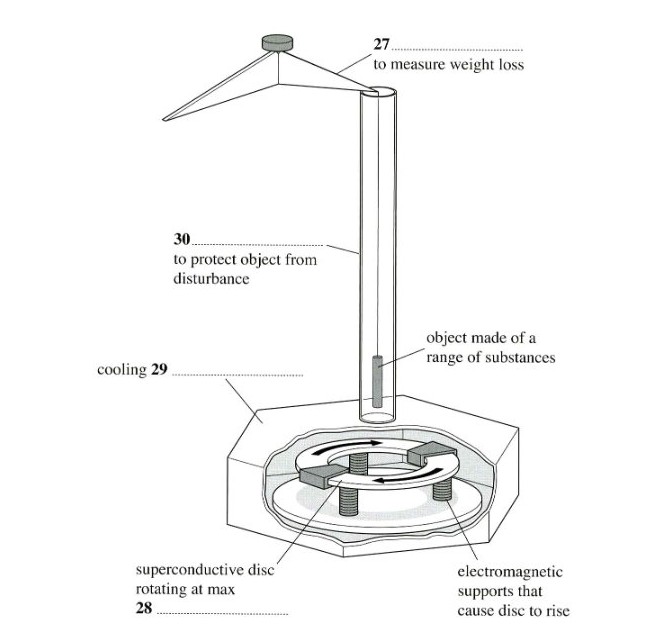
Questions 31–35 Matching Features
Classify the following findings as belonging to
A Podkletnov
B Tohoku University
C Modanese
Write the correct letter, A, B or C.
A. Podkletnov
B. Tohoku University
C. Modanese
Questions 36–40 True / False / Not Given
Do the following statements agree with information given in Reading Passage 3?
TRUE if the statement agrees with the information
FALSE if the statement contradicts the information
NOT GIVEN if there is no information on this.
Answers & Explanations Summary
| # | Answer | Evidence | Explanation |
|---|---|---|---|
| Q27 | a sensitive balance / a balance / sensitive balance / balance | An object was suspended from a sensitive balance above the disc | Excerpt/Passage Explanation: The passage means that an item was hung from a delicate scale located directly over the disc to measure its weight. Answer Explanation: The answer refers to a delicate weighing device or scale used to measure very small changes in weight. Reason For Correctness: The correct answer is "(sensitive) balance" because the passage explains the setup of Podkletnov's experiment. In paragraph 3, it states that an object was hung from a "sensitive balance" located above the spinning superconductive disc to measure any loss in weight. |
| Q28 | 5 000 rpm / 5,000 rpm / 5 000 revolutions per minute / 5,000 revolutions per minute | A superconductive disc, surrounded by liquid nitrogen was magnetically levitated and rotated at high speed – up to 5,000 revolutions per minute (rpm) in a magnetic field | Excerpt/Passage Explanation: The passage explains that the special disc floated in a magnetic field and spun very quickly, reaching up to 5,000 turns every minute. Answer Explanation: The answer refers to the maximum rotational speed of the disc, which is 5,000 revolutions per minute (rpm). Reason For Correctness: The correct answer is supported by paragraph 3, which details Dr. Podkletnov's experiment. The text states that the superconductive disc was spun at high speed, reaching "up to 5,000 revolutions per minute (rpm)". Therefore, "5,000 revolutions per minute" or "5,000 rpm" accurately describes the speed of the spinning disc. |
| Q29 | liquid nitrogen | A superconductive disc, surrounded by liquid nitrogen was magnetically levitated and rotated at high speed – up to 5,000 revolutions per minute (rpm) in a magnetic field | Excerpt/Passage Explanation: The passage explains that during the experiment, the special disc was encircled by liquid nitrogen and made to spin quickly in a magnetic field. Answer Explanation: The answer refers to the extremely cold liquid substance used in the experiment to surround and chill the superconductive disc. Reason For Correctness: The correct answer is supported by the text's description of Podkletnov's experimental setup. In paragraph 3, the passage explicitly states that the superconductive disc was 'surrounded by liquid nitrogen' while being levitated and rotated in a magnetic field. |
| Q30 | a glass tube / glass tube | It was enclosed in a glass tube to shield it from any effects of air currents | Excerpt/Passage Explanation: The passage explains that the object was put inside a tube made of glass so that air currents would not disturb the test. Answer Explanation: The answer "glass tube" refers to a hollow cylinder made of glass that was placed around the test object. Reason For Correctness: The correct answer is "glass tube" because paragraph 3 describes Dr Podkletnov's experimental setup. In this experiment, the object hanging above the spinning disc was placed inside a "glass tube" to protect or shield it from moving air. |
| Q31 | B | One instance of this occurred in the late 1980s when scientists at Tohoku University, Japan, made headlines with research suggesting that apparatus, known as a gyroscope, lost 0.01 percent of its weight when spinning at up to 13,000 rpm. Oddly the effect only appeared if the gyroscope was spinning anticlockwise – raising suspicions that some mechanical peculiarity was to blame | Excerpt/Passage Explanation: The passage explains that researchers at Tohoku University discovered that the device only lost weight when it was spinning in an anticlockwise direction. Answer Explanation: The answer B means that scientists at Tohoku University found that the experiment worked only when the machine was turning in one specific direction. Reason For Correctness: The correct answer is B because paragraph 7 talks about research done by scientists at Tohoku University, Japan. In their experiment with a spinning gyroscope, the weight loss effect only happened when the device was rotating in a specific direction ("anticlockwise"). Therefore, this finding belongs to Tohoku University. |
| Q32 | A | During the course of a series of tests, Podkletnov was able to observe that the object lost a variable amount of weight from less than 0.5 percent to 2 percent of its total weight | Excerpt/Passage Explanation: The passage explains that while doing several tests, Podkletnov saw that the object became lighter by changing amounts, between under 0.5% and 2% of its full weight. Answer Explanation: The answer "A" means that Dr. Evgeny Podkletnov is the researcher who found that objects lost different percentages of their weight during his experiments. Reason For Correctness: The correct answer is A because paragraph 3 describes Dr. Evgeny Podkletnov's experiments. In the text, it explicitly states that during his tests, "the object lost a variable amount of weight from less than 0.5 percent to 2 percent of its total weight." The phrase "a variable amount" directly matches "varying amounts" in the question. |
| Q33 | C | Modanese wondered if the magnetic fields surrounding the superconductive disc might somehow assimilate part of the gravitational field under it | Excerpt/Passage Explanation: The passage explains that Modanese questioned whether magnetic fields could take in or absorb some of the gravity under the disc. Answer Explanation: The answer "C" means that the idea of gravity being absorbed by a magnetic field belongs to Professor Giovanni Modanese. Reason For Correctness: The correct answer is C because paragraph 8 discusses the work of Professor Giovanni Modanese. It states that Modanese thought the magnetic fields around the disc might "assimilate" (which means absorb or take in) part of the "gravitational field" (gravity) beneath it. |
| Q34 | A | A superconductive disc, surrounded by liquid nitrogen was magnetically levitated and rotated at high speed – up to 5,000 revolutions per minute (rpm) in a magnetic field. An object was suspended from a sensitive balance above the disc. It was enclosed in a glass tube to shield it from any effects of air currents. During the course of a series of tests, Podkletnov was able to observe that the object lost a variable amount of weight from less than 0.5 percent to 2 percent of its total weight. This effect was noted with a range of materials from ceramics to wood. The effect was slight, yet the implications were revolutionary: the disc appeared to be partly shielding the object from the gravitational pull of the Earth | Excerpt/Passage Explanation: The passage explains that Podkletnov tested a spinning superconductive disc and saw that objects placed above it lost a small amount of weight, showing that the disc seemed to block some of Earth's gravity. Answer Explanation: The answer "A" means that Dr Evgeny Podkletnov was the scientist who found that a superconductive material appeared to protect or block an object from the pull of gravity. Reason For Correctness: The correct answer is A because the text describes how Dr Podkletnov carried out an experiment using a spinning "superconductive disc." During his tests, objects above the disc lost weight, leading to the conclusion that "the disc appeared to be partly shielding the object from the gravitational pull of the Earth." The word "shielding" matches "screen" in the question, and "superconductive disc" matches "superconductive material." |
| Q35 | B | One instance of this occurred in the late 1980s when scientists at Tohoku University, Japan, made headlines with research suggesting that apparatus, known as a gyroscope, lost 0.01 percent of its weight when spinning at up to 13,000 rpm | Excerpt/Passage Explanation: The passage explains that scientists at Tohoku University in Japan conducted research showing that a piece of equipment called a gyroscope lost a small amount of weight when it turned around at speeds reaching 13,000 revolutions per minute (rpm). Answer Explanation: The answer means that the finding about a device losing weight while spinning at speeds up to 13,000 rpm belongs to Tohoku University (choice B). Reason For Correctness: The correct answer is B because the passage clearly connects the specific speed of 'up to 13,000 rpm' and the loss of weight to researchers at Tohoku University in Japan. In paragraph 7, it explains that their equipment (a gyroscope) lost weight when it was spinning at this high rotation speed. |
| Q36 | FALSE | That may seem amazing for a ceramic-like material – and it won a Nobel Prize for the scientists, Karl Müller and Johannes Bednorz, who first demonstrated it in the 1980s | Excerpt/Passage Explanation: The passage explains that the scientists who won the Nobel Prize for showing how this material works were Karl Müller and Johannes Bednorz, not Podkletnov. Answer Explanation: The answer is FALSE because it was not Podkletnov who won a prize for the discovery of this superconductor property, but two other scientists named Karl Müller and Johannes Bednorz. Reason For Correctness: The correct answer is FALSE because the passage clearly states that the Nobel Prize for demonstrating the properties of this ceramic-like superconducting material went to Karl Müller and Johannes Bednorz in the 1980s, not to Dr Evgeny Podkletnov. |
| Q37 | TRUE | In 1992, while experimenting with rotating superconductors, Podkletnov noticed that pipe-smoke from a nearby researcher was drifting into a vertical column above the spinning disc. Intrigued by this phenomenon, he decided to devise an experiment to investigate further | Excerpt/Passage Explanation: The passage says that in 1992, Podkletnov saw smoke from a coworker's pipe rise straight up over a spinning disc by accident, and this strange event caused him to design a new experiment to study it. Answer Explanation: The answer "TRUE" means that the text confirms Dr. Podkletnov started his gravity-blocking experiments because he accidentally noticed something unusual. Reason For Correctness: The correct answer is TRUE because the third paragraph explains that Dr. Podkletnov accidentally saw pipe-smoke from another researcher rising in a straight column above a spinning disc. This unexpected sight ("chance observation") made him curious ("intrigued"), which directly motivated him to create and carry out experiments ("devise an experiment to investigate further") to test if gravity was being blocked. |
| Q38 | NOT GIVEN | According to Einstein, gravity is not some kind of ‘force field’, like magnetism, which can – in principle at least – be screened out. Instead, GR views gravity as a distortion in the very fabric of space and time, that permeates the whole cosmos. As such, any claim to have shielded objects from gravity is to defy Einstein himself | Excerpt/Passage Explanation: The passage explains what Einstein believed about gravity and how his theory contradicts ideas of blocking gravity, but it gives no information about Einstein personally challenging earlier experiments. Answer Explanation: The answer "NOT GIVEN" means that the text does not say whether Einstein ever argued against or challenged any previous antigravity experiments. Reason For Correctness: The correct answer is NOT GIVEN because the passage only explains Einstein's theory of general relativity and notes that claims of shielding gravity go against his theory. The text never states whether Einstein himself directly challenged or disputed any earlier experiments on antigravity. |
| Q39 | TRUE | He published some calculations based on his idea in 1995 – and soon discovered that taking ‘antigravity’ seriously was a career-limiting move | Excerpt/Passage Explanation: The passage explains that when Modanese published work based on antigravity theories in 1995, it harmed his job prospects and professional advancement. Answer Explanation: The answer "TRUE" means the passage confirms that Professor Giovanni Modanese experienced negative consequences for his career after studying and publishing work related to Podkletnov's ideas. Reason For Correctness: The correct answer is TRUE because the passage explicitly mentions that after Giovanni Modanese looked into Podkletnov's paper and published calculations related to the idea, he found out that taking antigravity seriously was a "career-limiting move." The phrase "career-limiting move" means something that damages or restricts a person's professional career, which directly matches the statement that he "suffered professionally." |
| Q40 | FALSE | Then it emerged that the US aircraft builder Boeing was also investigating, suggesting it too had an interest in the effect. Groups in other countries were also rumoured to be carrying out studies. Yet not one of the teams has reported confirmation of the original findings | Excerpt/Passage Explanation: The passage explains that although the airplane manufacturer Boeing was researching the gravity effect, not a single group or company was able to confirm the original experiment's results. Answer Explanation: The answer FALSE means the statement directly contradicts the information in the text because no aircraft company or research group ever confirmed or successfully repeated Dr. Podkletnov's results. Reason For Correctness: The correct answer is FALSE because the text mentions that the US aircraft builder Boeing investigated the antigravity claims, but clarifies that not a single team confirmed or replicated the original results. Key phrases to notice include "aircraft builder Boeing" and "not one of the teams has reported confirmation of the original findings", which directly contradict the claim that a company announced it had replicated the results. |