
Quiet Roads Ahead - IELTS Reading Answers & Explanations
From IELTS Practice Test Plus 2 Academic Reading Test 2 · Part 3 · Questions 27–40
Reading Passage
You should spend about 20 minutes on Questions 27-40, which are based on Reading Passage 3 below.
Quiet roads ahead
The roar of passing vehicles could soon be a thing of the past
A The noise produced by busy roads is a growing problem. While vehicle designers have worked hard to quieten engines, they have been less successful elsewhere. The sound created by the tyres on the surface of the road now accounts for more than half the noise that vehicles create, and as road building and car sales continue to boom - particularly in Asia and the US - this is turning into a global issue.
B According to the World Health Organization, exposure to noise from road traffic over long periods can lead to stress-related health problems. And where traffic noise exceeds a certain threshold, road builders have to spend money erecting sound barriers and installing double glazing in blighted homes. Houses become harder to sell where environmental noise is high, and people are not as efficient or productive at work.
C Already, researchers in the Netherlands - one of the most densely populated countries in the world - are working to develop techniques for silencing the roads. In the next five years the Dutch government aims to have reduced noise levels from the country's road surfaces by six decibels overall. Dutch mechanical engineer Ard Kuijpers has come up with one of the most promising, and radical, ideas. He set out to tackle the three most important factors: surface texture, hardness and ability to absorb sound.
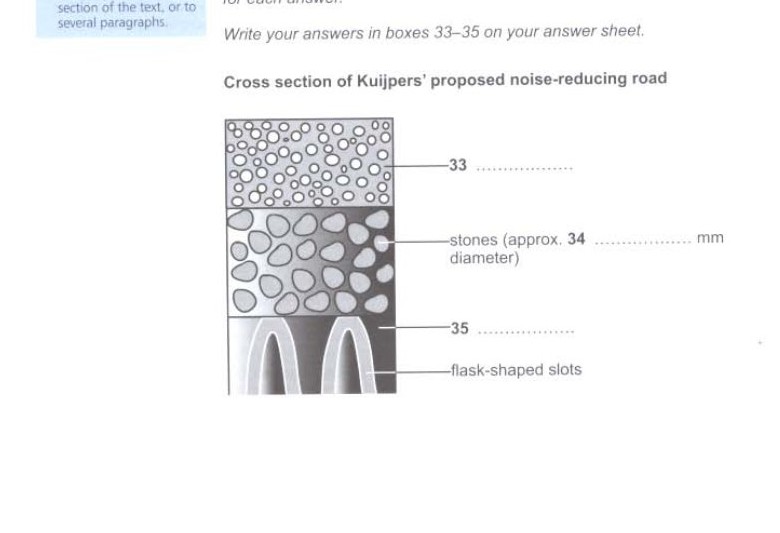
D The rougher the surface, the more likely it is that a tyre will vibrate and create noise. Road builders usually eliminate bumps on freshly laid asphalt with heavy rollers, but Kuijpers has developed a method of road building that he thinks can create the ultimate quiet road. His secret is a special mould 3 metres wide and 50 metres long. Hot asphalt, mixed with small stones, is spread into the mould by a rail-mounted machine which flattens the asphalt mix with a roller. When it sets, the 10-millimetre-thick sheet has a surface smoother than anything that can be achieved by conventional methods.
E To optimise the performance of his road surface - to make it hard wearing yet soft enough to snuff out vibrations - he then adds another layer below the asphalt. This consists of a 30-millimetre-thick layer of rubber, mixed with stones which are larger than those in the layer above. 'It's like a giant mouse mat, making the road softer,' says Kuijpers.
F The size of the stones used in the two layers is important, since they create pores of a specific size in the road surface. Those used in the top layer are just 4 or 5 millimetres across, while the ones below are approximately twice that size - about 9 millimetres. Kuijpers says the surface can absorb any air that is passing through a tyre's tread, damping oscillations that would otherwise create noise. And in addition they make it easier for the water to drain away, which can make the road safer in wet weather.
G Compared with the complex manufacturing process, laying the surface is quite simple. It emerges from the factory rolled, like a carpet, onto a drum 1.5 metres in diameter. On site, it is unrolled and stuck onto its foundation with bitumen. Even the white lines are applied in the factory.
H The foundation itself uses an even more sophisticated technique to reduce noise further. It consists of a sound-absorbing concrete base containing flask-shaped slots up to 10 millimetres wide and 30 millimetres deep that are open at the top and sealed at the lower end. These cavities act like Helmholtz resonators - when sound waves of specific frequencies enter the top of a flask, they set up resonances inside and the energy of the sound dissipates into the concrete as heat. The cavities play another important role: they help to drain water that seeps through from the upper surface. This flow will help flush out waste material and keep the pores in the outer layers clear.
I Kuijpers can even control the sounds that his resonators absorb, simply by altering their dimensions. This could prove especially useful since different vehicles produce noise at different frequencies. Car tyres peak at around 1000 hertz, for example, but trucks generate lower-frequency noise at around 600 hertz. By varying the size of the Kuijpers resonators, it is possible to control which frequencies the concrete absorbs. On large highways, trucks tend to use the inside lane, so resonators here could be tuned to absorb sounds at around 600 hertz while those in other lanes could deal with higher frequency noise from cars.
J Kuijpers believes he can cut noise by five decibels compared to the quietest of today's roads. He has already tested a 100-metre-long section of his road on a motorway near Apeldoorn, and Dutch construction company Heijmans is discussing the location of the next roll-out road with the country's government. The success of Kuijpers' design will depend on how much it eventually costs. But for those affected by traffic noise there is hope of quieter times ahead.
Questions
Questions 27–32 Matching Information
Reading Passage 3 has ten paragraphs labelled A-J.
Which paragraph contains the following information?
Write the correct letter A-J.
Questions 33–35 Diagram Labeling
Label the diagram below.
Choose NO MORE THAN ONE WORD AND/OR A NUMBER from the passage
for each answer.
Questions 36–40 Table Completion
Complete the table below using the list of words (A-K) from the box below.
Write the correct letters.
A frequencies B the engine C rubbish
D resonators E air flow F dissipation
G sound energy H pores I lanes
J drainage K sources
| Layer | Component | Function |
|---|---|---|
| upper and lower | stones |
|
| foundation | slots |
|
Answers & Explanations Summary
| # | Answer | Evidence | Explanation |
|---|---|---|---|
| Q27 | G | It emerges from the factory rolled, like a carpet, onto a drum 1.5 metres in diameter | Excerpt/Passage Explanation: The passage says the road surface comes out of the factory 'rolled, like a carpet, onto a drum'. This means it is rolled up into a big roll, similar to how a carpet is rolled, and put onto a large cylinder, ready to be taken to its location. Answer Explanation: The answer is paragraph G. Reason For Correctness: The correct answer is G because this paragraph explains how the special road surface is packaged and moved from the factory to the place where it will be used. It describes the 'form' of the road surface when it is ready for transport, using words like 'rolled' and 'drum'. |
| Q28 | D | Kuijpers has developed a method of road building that he thinks can create the ultimate quiet road. His secret is a special mould 3 metres wide and 50 metres long. Hot asphalt, mixed with small stones, is spread into the mould by a rail-mounted machine which flattens the asphalt mix with a roller. When it sets, the 10-millimetre-thick sheet has a surface smoother than anything that can be achieved by conventional methods | Excerpt/Passage Explanation: The passage says that Kuijpers has a new way to build roads quietly. His special trick is a 'mould' (a shape) that is 3 meters wide and 50 meters long. He puts hot asphalt (the road material) with small stones into this mould. A machine with wheels and a roller flattens it. After it dries, the road piece is very thin (10 millimeters) and has a surface that is much 'smoother' than roads made in the usual way. Answer Explanation: The answer is D. This paragraph tells us how Kuijpers makes the road surface very smooth. Reason For Correctness: The correct answer is D because paragraph D explains Kuijpers' special method for creating a 'smoother' road surface. It describes using a 'special mould' and a 'rail-mounted machine' with a 'roller' to flatten the asphalt mix. This process results in a surface that is 'smoother than anything that can be achieved by conventional methods', which is the core of the question about how he makes a smooth road surface. |
| Q29 | J | The success of Kuijpers' design will depend on how much it eventually costs | Excerpt/Passage Explanation: The passage says that if people want to know if Kuijpers' new road idea will work and be used a lot, they need to know how much money it will cost to make it. Answer Explanation: The answer is J. This paragraph talks about something very important to think about when deciding if Kuijpers' idea is good. Reason For Correctness: The correct answer is J because paragraph J clearly states that the 'success' of Kuijpers' idea, meaning whether it will be used widely, will 'depend on how much it eventually costs'. This cost is a crucial factor to 'consider when evaluating' his proposal, as it determines if the solution is practical and affordable for widespread use. |
| Q30 | B | And where traffic noise exceeds a certain threshold, road builders have to spend money erecting sound barriers and installing double glazing in blighted homes. Houses become harder to sell where environmental noise is high, and people are not as efficient or productive at work | Excerpt/Passage Explanation: The passage says that if traffic noise is too loud, road builders must 'spend money' to put up sound barriers and install special windows in affected homes. It also mentions that it becomes 'harder to sell' houses in noisy areas, and people cannot work as well or be as 'productive' in their jobs. These points explain the financial and work-related reasons to lower road noise. Answer Explanation: The answer is paragraph B. Reason For Correctness: The correct answer is paragraph B because it describes several ways road noise costs money and affects people's jobs and homes. It explains that companies have to 'spend money' on things like sound barriers. It also states that 'Houses become harder to sell' and people are not as 'efficient or productive at work' when there's a lot of noise. These are all financial or economic reasons why reducing road noise is important. |
| Q31 | I | On large highways, trucks tend to use the inside lane, so resonators here could be tuned to absorb sounds at around 600 hertz while those in other lanes could deal with higher frequency noise from cars | Excerpt/Passage Explanation: The passage states that on big roads, trucks often drive in the lane closest to the middle, while cars drive in the other lanes. This shows a common way vehicles are used on major roads. Answer Explanation: The answer is paragraph I. This paragraph talks about how different types of vehicles usually drive on big roads. Reason For Correctness: The correct answer is paragraph I because it provides a general statement about how different vehicles, specifically 'trucks', tend to 'use the inside lane' on 'large highways', while 'cars' use 'other lanes'. This describes a common practice or 'pattern of use' for vehicles on important roads. |
| Q32 | C | He set out to tackle the three most important factors: surface texture, hardness and ability to absorb sound | Excerpt/Passage Explanation: The passage says that a person named Ard Kuijpers wanted to deal with the three main things that make roads noisy: how the road's top feels (surface texture), how firm or soft it is (hardness), and if it can soak up sound (ability to absorb sound). These are the different reasons why roads are noisy. Answer Explanation: The answer is paragraph C. Reason For Correctness: The correct answer is C because this paragraph introduces the main things that cause road noise, which a researcher named Ard Kuijpers wanted to fix. The passage states that Kuijpers 'set out to tackle the three most important factors: surface texture, hardness and ability to absorb sound.' These 'factors' are the different things affecting how much noise roads make. The paragraphs after C then explain how he addresses each of these factors. |
| Q33 | asphalt / asphalte | Hot asphalt, mixed with small stones, is spread into the mould by a rail-mounted machine which flattens the asphalt mix with a roller. When it sets, the 10-millimetre-thick sheet has a surface smoother than anything that can be achieved by conventional methods | Excerpt/Passage Explanation: The passage says that a mix of hot 'asphalt' and small rocks is put into a special shape. A machine flattens it with a roller. When it becomes solid, this 'sheet' is 10 millimeters thick and very smooth. This shows that the top layer is made of asphalt. Answer Explanation: The answer is 'asphalt'. This is the material used for the top part of the road that cars drive on. Reason For Correctness: The correct answer is 'asphalt' because the passage explains that the top layer of Ard Kuijpers' special road surface is made from this material. Paragraph D describes how 'Hot asphalt, mixed with small stones, is spread into the mould' to create a '10-millimetre-thick sheet' which forms the smooth surface. |
| Q34 | 9 / nine | Those used in the top layer are just 4 or 5 millimetres across, while the ones below are approximately twice that size - about 9 millimetres | Excerpt/Passage Explanation: The passage explains that the stones in the road's top part are 4 or 5 millimeters wide. It then says that the stones in the layer just below that are about twice as big, which is around 9 millimeters. Answer Explanation: The answer is 9. This number tells us the size of the stones in the layer of the road that is underneath the very top surface. These stones are 9 millimeters big. Reason For Correctness: The correct answer is 9 because the passage describes the different layers of the special road surface and the size of the stones used in each. It clearly states that the stones in the 'top layer' are 4 or 5 millimetres across, while 'the ones below' (referring to the layer underneath) are 'approximately twice that size - about 9 millimetres'. Therefore, 9 millimetres is the size of the stones in the lower layer. |
| Q35 | concrete | It consists of a sound-absorbing concrete base containing flask-shaped slots up to 10 millimetres wide and 30 millimetres deep that are open at the top and sealed at the lower end | Excerpt/Passage Explanation: The passage says that the road's bottom part, called the foundation, is a special 'concrete base'. This concrete base can soak up sound and has small holes inside it that look like tiny bottles. Answer Explanation: The answer is 'concrete'. This is a very strong building material made from mixing cement, sand, small stones, and water. It is used to make roads, buildings, and other solid structures. Reason For Correctness: The correct answer is 'concrete' because the passage explains what the 'foundation' of the road is made of. The text mentions that the road's base is 'a sound-absorbing concrete base'. This shows that the main material for the foundation is concrete. |
| Q36 | E | Kuijpers says the surface can absorb any air that is passing through a tyre's tread, damping oscillations that would otherwise create noise | Excerpt/Passage Explanation: The passage explains that the road's surface can soak up air that moves through a car tire's pattern. This stops the small, quick movements (oscillations) that would normally make noise. Answer Explanation: The answer is 'E', which means the movement of air. Reason For Correctness: The correct answer is E because the passage states that the special road surface, with its specific stone sizes, is designed to absorb the 'air that is passing through a tyre's tread'. This action helps in 'damping oscillations' that would otherwise make noise. Therefore, the oscillations are caused by this 'air flow'. |
| Q37 | J | The cavities play another important role: they help to drain water that seeps through from the upper surface | Excerpt/Passage Explanation: The passage says that the small spaces (cavities/slots) in the road's base have a key job: they move water away that goes into the road from the top layer. This act of moving water away is called 'drainage'. Answer Explanation: The answer, 'J', means that the special holes (slots) in the road's base help water flow away. Reason For Correctness: The correct answer is 'J' (drainage) because the passage explains that the slots in the road's foundation play a role in water removal. In paragraph H, it states that these 'cavities' (which are the slots) 'help to drain water that seeps through from the upper surface'. The word 'drainage' refers to the process of water flowing away. |
| Q38 | G | These cavities act like Helmholtz resonators - when sound waves of specific frequencies enter the top of a flask, they set up resonances inside and the energy of the sound dissipates into the concrete as heat | Excerpt/Passage Explanation: The passage says that the special slots in the road's bottom part are like 'Helmholtz resonators'. When sound waves, which are sounds that move, go into these slots, the 'energy of the sound' changes into 'heat'. This means the sound's power turns into warmth within the concrete, which helps to make the road quieter. Answer Explanation: The answer is 'sound energy'. This means that the slots in the road's foundation change the energy from sounds into heat. Reason For Correctness: The correct answer is 'G' because the passage explains that the slots in the road's foundation work like special devices called Helmholtz resonators. When sound waves go into these slots, the 'energy of the sound' changes into heat, which helps to reduce noise. The table asks what is converted to heat, and 'sound energy' directly matches the 'energy of the sound' mentioned in the text. |
| Q39 | C | The cavities play another important role: they help to drain water that seeps through from the upper surface. This flow will help flush out waste material and keep the pores in the outer layers clear | Excerpt/Passage Explanation: The passage says that the small spaces (cavities/slots) in the road's base layer help water leave the road. This moving water then helps to remove 'waste material' from the tiny holes (pores) in the road's surface, which means it helps clear away dirt or 'rubbish'. Answer Explanation: The answer 'C' means 'rubbish'. It refers to unwanted things or waste. Reason For Correctness: The correct answer is 'C' because the passage explains that the slots (cavities) in the foundation have two main functions. One function is to convert sound energy to heat. The other important role is to help water drain away, and this flow of water helps to 'flush out waste material'. 'Waste material' is another name for 'rubbish', which fits the context of removing unwanted things from the road's pores. |
| Q40 | A | Kuijpers can even control the sounds that his resonators absorb, simply by altering their dimensions. This could prove especially useful since different vehicles produce noise at different frequencies. Car tyres peak at around 1000 hertz, for example, but trucks generate lower-frequency noise at around 600 hertz. By varying the size of the Kuijpers resonators, it is possible to control which frequencies the concrete absorbs | Excerpt/Passage Explanation: The passage states that the inventor can 'control the sounds that his resonators absorb' by changing their size. It explains that 'different vehicles produce noise at different frequencies' (meaning different sound pitches). So, by making the 'resonators' different sizes, they can 'control which frequencies the concrete absorbs' – meaning they can choose which specific sound pitches the road will quiet down. Answer Explanation: The answer, 'frequencies', means different pitches or types of sound waves. Imagine sounds like a high whistle or a deep rumble; these are different frequencies. Reason For Correctness: The correct answer is 'A' (frequencies) because the passage explains that the slots in the foundation of the road are special parts called 'resonators'. The inventor, Kuijpers, can change the size of these resonators to control which specific 'frequencies' (different sound pitches) the concrete will absorb. This is useful because different vehicles, like cars and trucks, make noise at different frequencies. |