
Raining Ice - IELTS Reading Answers & Explanations
From Collins Practice Tests For IELTS 1 Academic Reading Test 4 · Part 1 · Questions 1–16
Reading Passage
You should spend about 20 minutes on Questions 1-16, which are based on Reading Passage 1 below.
Raining Ice
In May 2012, disaster struck a mountainous region of China's Gansu province. 40 people were killed and 29,300 people evacuated when a brief but extremely violent hailstone storm swept across Min County. Houses collapsed, roads were blocked and crops were destroyed. The extreme weather also affected the power supply and communications in the region. When you consider that hailstones can reach sizeable proportions, the damage they can cause is understandable. The world's largest hailstone was found after a storm in South Dakota and measured 20.5 cm in diameter with a 47 cm circumference - this was after melting caused it to lose 5 cm from its original size. Apart from China and the US, other parts of the world that frequently suffer from hailstorm damage include Russia, India and northern Italy.
Hail is a form of solid precipitation created within cumulonimbus clouds. Cumulonimbus clouds are caused by heating from below and cooling from above. As the earth is heated during the day by the sun, air close to the ground becomes warmer. Hot air is less dense than cold air and therefore lighter so it rises and, as it does so, it becomes cooler. The warm air reaches a cold point called the condensation level where the water vapor condenses and turns back to a liquid form. As the warm air rises to the condensation level, it becomes less able to keep its moisture and condenses into large clouds, which are often called thunderheads. The process of condensation releases heat into the surrounding air making the air rise even faster and release more moisture. These huge clouds are complex systems in their own right, containing large amounts of energy resulting in updrafts and downdrafts - vertical winds that can reach speeds over 176 km per hour and help in the formation of hail.
Hail grows in the thunderhead's main updraft where most of the cloud is 'supercooled' water: water that is still liquid even though its temperature is below 0°C. This water will stay in liquid form until it encounters something on which to freeze. There are other particles within the cloud - small frozen raindrops or soft ice particles - called graupel. When the supercooled water hits the graupel, it freezes around it, creating a hailstone. However, this is just the start of the hailstone's journey. A hailstone's eventual size depends upon the intensity of the storm in which it is born. To form a golf ball-sized hailstone requires over ten billion supercooled drops of water and a time span of between five and 10 minutes. This accumulation of additional ice is a process called accretion and takes place in areas of the cloud rich in supercooled water. Accretion takes place in two ways, resulting in two distinguishable kinds of hailstone. In the first process, strong updrafts, which lift the top of the cloud into part of the atmosphere known as the troposphere, take the hailstone through the supercooled layer where it accretes ice, making it heavy enough to fall back through the cloud. On falling, it encounters other strong updrafts, which take it back though the supercooled layer where it grows and falls again. An updraft of 35-55 km per hour will form small hailstones; hailstones that are 5 cm in diameter require updrafts of 88 kph and hailstones that are 12 cm in diameter need updrafts of 160 kph to grow. The other process involves the hailstone falling slowly through a layer of the cloud rich in supercooled water.
The first process results in hailstones with concentric layers usually alternating between clear and cloudy ice, indicating how it was produced. The opaque layer forms when supercooled water drops freeze quickly onto the growing hailstone and trap tiny air bubbles inside the ice giving it a milky appearance. The next layer - the transparent layer - forms when larger drops of supercooled liquid water hit the hailstone. Here the freezing process is slower, allowing air bubbles to escape and clear ice to form. Hailstones showing little of this layering may have been subject to the second process of formation. Instead of being pushed up through the cumulonimbus by updrafts and pulled back through by gravity several times, these hailstones simply fall slowly through the cloud gathering mass as they drop.
The interior of a cumulonimbus cloud is a place of extreme violence. As the hailstones rise and fall, they collide with each other. The result of this can be their breaking up or the formation of large irregular shaped hailstones. Hailstones are categorised according to their size. The Tornado and Storm Research Organisation classifies hailstones according to their destructive power, ranging from H0 - hard hail composed of hailstones of 5 mm in diameter, which do not cause damage - through H5 storms, destructive enough to damage glass, roofs and injure people, to the most severe - H10 or 'super hailstorms', which cause extensive structural damage and can fatally injure people caught out in the open.
The rate at which they fall varies but can be faster than 160 kph for larger hailstones as they become too heavy for the updraft to support or if a downdraft catches them and blows them violently back to earth. It is estimated that between 40 and 70% of hailstones never reach the earth, melting instead inside the cloud, colliding with and smashing into smaller pieces on their way through the air, or melting in the atmosphere to fall as rain.
Questions
Questions 1–8 True / False / Not Given
Do the following statements agree with the information given in Reading Passage 1?
Write
TRUE if the statement agrees with the information
FALSE if the statement contradicts the information
NOT GIVEN if there is no information on this
Questions 9–16 Diagram Labeling
Label the diagram below using words from the box.
Write the correct letter, A-H, in spaces 9-16.
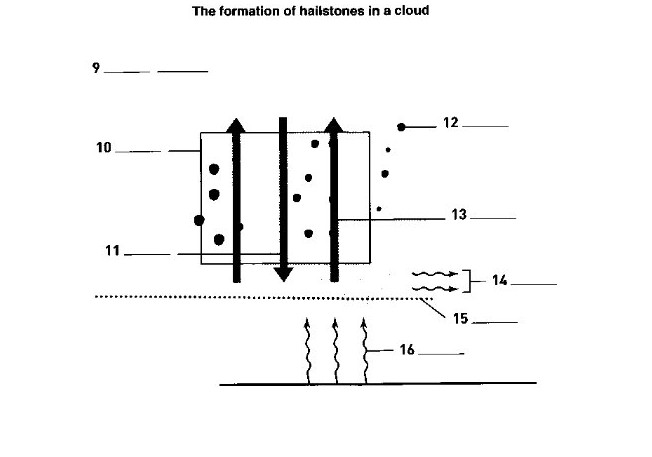
A. graupel | B. updraft | C. condensation level
D. accretion | E. heat released into atmosphere | F. downdraft
G. warm air | H. supercooled area
Answers & Explanations Summary
| # | Answer | Evidence | Explanation |
|---|---|---|---|
| Q1 | FALSE | 40 people were killed and 29,300 people evacuated when a brief but extremely violent hailstone storm swept across Min County | Excerpt/Passage Explanation: The passage says the storm was brief, which means it was short. Even though it was violent and caused damage, it did not last a long time. Answer Explanation: The answer is FALSE because the passage explains that these storms do not last for a long time. Reason For Correctness: The correct answer is FALSE because the passage describes a major hailstone storm as brief, which means it lasted only a short time. This contradicts the statement's claim that these storms last a long time. While the passage agrees that the storms cause considerable damage (by mentioning deaths and destroyed houses), the word brief makes the statement incorrect. |
| Q2 | TRUE | The world's largest hailstone was found after a storm in South Dakota and measured 20.5 cm in diameter with a 47 cm circumference - this was after melting caused it to lose 5 cm from its original size | Excerpt/Passage Explanation: The passage states that the biggest hailstone was measured after a storm, but it had already melted and lost 5 cm of its size compared to how big it was at first. Answer Explanation: The answer is TRUE because the biggest hailstone ever discovered had already become smaller by the time it was measured. Reason For Correctness: The correct answer is TRUE because the passage describes the world's largest hailstone found in South Dakota. It notes that while it was measured at a certain size, this was only 'after' it had already melted and lost 5 cm from its 'original size.' This confirms that the hailstone had indeed decreased in volume (size) before it was recorded. |
| Q3 | TRUE | These huge clouds are complex systems in their own right, containing large amounts of energy resulting in updrafts and downdrafts — vertical winds that can reach speeds over 176 km per hour and help in the formation of hail | Excerpt/Passage Explanation: The passage states that these very large clouds are complicated systems that hold high levels of energy, which creates very fast winds moving up and down. Answer Explanation: The answer is TRUE because the text clearly states that these specific clouds have a lot of energy inside them. Reason For Correctness: The correct answer is TRUE because the passage explicitly describes cumulonimbus clouds as systems 'containing large amounts of energy.' In the question, the phrase 'significant quantities' is a synonym for 'large amounts.' This energy is what drives the powerful 'updrafts and downdrafts' (vertical winds) mentioned later in the sentence. |
| Q4 | NOT GIVEN | As the warm air rises to the condensation level, it becomes less able to keep its moisture and condenses into large clouds, which are often called thunderheads | Excerpt/Passage Explanation: The passage says that these big clouds are named thunderheads, but it does not explain the reason why they are named that way. Answer Explanation: The answer is NOT GIVEN because the text does not tell us why the clouds have that name. Reason For Correctness: The correct answer is NOT GIVEN because while the text says big clouds are called 'thunderheads', it does not say if this is because they make thunder or lightning. The text does not give a reason for the name. Whenever a specific reason (like 'because of...') is missing from the text, you must choose NOT GIVEN. |
| Q5 | FALSE | Hail grows in the thunderhead's main updraft where most of the cloud is 'supercooled' water: water that is still liquid even though its temperature is below 0°C | Excerpt/Passage Explanation: The passage states that there is a kind of water called 'supercooled' water, which stays as a liquid even when the temperature is lower than 0°C. Answer Explanation: The answer means it is not true that water always turns into ice when the temperature is below 0°C. Reason For Correctness: The correct answer is FALSE because the passage describes a state called 'supercooled' water. This is water that remains in a liquid form even when its temperature has dropped below 0°C, which is the normal freezing point. It only turns into ice if it hits another object, such as a particle of dust or ice. Because the statement says water 'always' turns to ice at this temperature, and the passage provides a specific example where it does not, the statement is incorrect. You should look for the term 'supercooled' and the description of it being 'still liquid'. |
| Q6 | TRUE | The next layer - the transparent layer - forms when larger drops of supercooled liquid water hit the hailstone. Here the freezing process is slower, allowing air bubbles to escape and clear ice to form | Excerpt/Passage Explanation: The passage says that the clear or see-through part of the hailstone is made when the water freezes more slowly. This slow speed lets air bubbles leave the ice, making it clear. Answer Explanation: The answer is true because the text confirms that ice becomes clear when it freezes at a speed that is not fast. Reason For Correctness: The correct answer is TRUE because the passage explains the difference between cloudy ice and clear ice. Cloudy ice happens when water freezes quickly, which traps air. In contrast, clear (transparent) ice happens when the freezing happens slowly. At a slower speed, the air bubbles can get out of the ice, which makes it clear. |
| Q7 | FALSE | Hailstones are categorised according to their size | Excerpt/Passage Explanation: The passage says that hailstones are put into different groups depending on how big they are. Answer Explanation: The answer means that the statement is not true because it goes against the facts provided in the text. Reason For Correctness: The correct answer is FALSE because the text first explains that hailstones are sorted into groups based on how big they are (their size). While it mentions that one specific group uses destructive power for sorting, the general fact provided is that size is the main way they are labeled or categorized. |
| Q8 | TRUE | It is estimated that between 40 and 70% of hailstones never reach the earth, melting instead inside the cloud, colliding with and smashing into smaller pieces on their way through the air, or melting in the atmosphere to fall as rain | Excerpt/Passage Explanation: The passage states that a very high number of hailstones—nearly half to even more than half—do not actually land on the ground because they melt or break apart first. Answer Explanation: The answer is TRUE because the text confirms that a large portion of hailstones never hit the ground. Reason For Correctness: The correct answer is TRUE because the passage provides a specific estimate showing that between 40 and 70% of hailstones never reach the earth. Instead, they vanish before landing because they melt inside the cloud, break into smaller pieces, or turn into rain while falling. Therefore, the statement that 'many hailstones' do not reach the ground is supported by the text's data. |
| Q9 | H | Hail grows in the thunderhead's main updraft where most of the cloud is 'supercooled' water: water that is still liquid even though its temperature is below 0°C | Excerpt/Passage Explanation: The passage states that inside the storm cloud, there is a large area where the water is 'supercooled.' This means the water is still liquid even though it is colder than the normal freezing temperature (0°C). This is the part of the cloud where hailstones increase in size. Answer Explanation: The answer is 'H,' which stands for 'supercooled area.' This is a part of the storm cloud where the water is very cold but stays as a liquid instead of turning into ice. Reason For Correctness: The correct answer is 'H' because the text explains that hailstones grow in a large part of the cloud described as 'supercooled.' This is a region where the water has a temperature below 0°C but is still a liquid. When a small ice particle or soft ice (called graupel) is in this 'supercooled layer,' the liquid water freezes onto it, helping it grow into a larger hailstone. The passage highlights this area as essential for the process where ice builds up on the stone. |
| Q10 | D | This accumulation of additional ice is a process called accretion and takes place in areas of the cloud rich in supercooled water | Excerpt/Passage Explanation: The passage explains that when more ice is added to a hailstone, this growth process is known as 'accretion.' This happens in parts of the cloud where there is a lot of extremely cold water that is ready to freeze onto the stone. Answer Explanation: The answer is 'D', which stands for 'accretion'. This is the scientific name for the way a hailstone grows larger by collecting more layers of ice as it moves through a cloud. Reason For Correctness: The correct answer is 'D' because the passage identifies 'accretion' as the specific name for the 'process' of a hailstone getting bigger. As the hailstone travels through parts of the cloud that are full of 'supercooled water' (water that is cold but still liquid), it builds up or 'accumulates' more ice. This building-up action is exactly what 'accretion' describes. |
| Q11 | F | These huge clouds are complex systems in their own right, containing large amounts of energy resulting in updrafts and downdrafts - vertical winds that can reach speeds over 176 km per hour and help in the formation of hail | Excerpt/Passage Explanation: The passage explains that very big clouds have a lot of energy. This energy creates winds that move straight up and down. A "downdraft" is one of these winds, and it can travel very fast. Answer Explanation: The answer is "downdraft," which is a strong wind that blows downward from a cloud. Reason For Correctness: The correct answer is "downdraft" (option F) because the passage describes these as vertical winds that occur within storm clouds. While "updrafts" blow air upward, "downdrafts" can catch hailstones and push them quickly down toward the ground. |
| Q12 | A | There are other particles within the cloud - small frozen raindrops or soft ice particles - called graupel. When the supercooled water hits the graupel, it freezes around it, creating a hailstone | Excerpt/Passage Explanation: The passage states that there are tiny ice pieces or frozen rain in clouds called graupel. When very cold water touches these pieces, it turns into ice around them to make a hailstone. Answer Explanation: The answer "A" refers to graupel, which are small pieces of frozen rain or ice that serve as the center around which a hailstone grows. Reason For Correctness: The correct answer is "A" because the passage identifies graupel as the specific particles—such as frozen raindrops or soft ice—that exist inside the cloud. It explains that a hailstone begins to form when supercooled water (water that is colder than freezing but still liquid) touches the graupel and freezes onto its surface. |
| Q13 | B | These huge clouds are complex systems in their own right, containing large amounts of energy resulting in updrafts and downdrafts - vertical winds that can reach speeds over 176 km per hour and help in the formation of hail | Excerpt/Passage Explanation: The passage explains that big clouds have a lot of energy that creates vertical winds moving up and down. These very fast winds, called updrafts and downdrafts, are part of what allows hailstones to form. Answer Explanation: The answer B corresponds to 'updraft', which refers to air or wind that blows straight up inside a storm cloud. Reason For Correctness: The correct answer is 'updraft' because the text describes how large storm clouds contain powerful vertical winds. These winds that move upward are called updrafts, and they are essential for the formation of hail because they carry water and ice to the cold parts of the cloud. |
| Q14 | E | The process of condensation releases heat into the surrounding air making the air rise even faster and release more moisture | Excerpt/Passage Explanation: The passage explains that when gas turns into liquid water in the cloud, it gives off heat. This heat helps the air climb higher and faster into the sky. Answer Explanation: The answer is the process where heat moves out into the air as clouds are forming. Reason For Correctness: The correct answer is E because the text explains that when water vapor turns into water (a process called condensation), it sends out heat. This heat goes into the air nearby, which causes that air to move upward at a higher speed. Important words to remember are 'releases heat' and 'surrounding air,' which is another way to say the 'atmosphere.' |
| Q15 | C | The warm air reaches a cold point called the condensation level where the water vapor condenses and turns back to a liquid form | Excerpt/Passage Explanation: The passage explains that when air that is warm rises up, it reaches a cold area. At this point, the water in the air changes into liquid water. This area is named the condensation level. Answer Explanation: The answer is 'condensation level', which refers to the specific height or area in the sky where rising air becomes cold enough for water gas to turn into liquid water. Reason For Correctness: The correct answer is C because the passage describes the specific step in cloud and hail formation where rising warm air cools down and changes state. The author identifies this 'cold point' as the condensation level. This is the place where water vapor (gas) becomes liquid, leading to the creation of large clouds known as thunderheads. In a diagram about how storms formed, this term would identify the boundary where moisture starts to turn into clouds. |
| Q16 | G | As the earth is heated during the day by the sun, air close to the ground becomes warmer. Hot air is less dense than cold air and therefore lighter so it rises and, as it does so, it becomes cooler | Excerpt/Passage Explanation: The passage explains that sunlight makes the earth hot, which then makes the air near the ground warm. This warm air then moves up into the sky because it is not as heavy as cold air. Answer Explanation: The answer is the air that has been heated by the sun and begins to move upwards from the earth's surface. Reason For Correctness: The correct answer is 'warm air' because the passage describes the initial stage of hail formation as a process where the sun heats the ground. This heat is transferred to the air near the surface, making it 'warmer'. Because this air is 'hot' and 'lighter' than cold air, it begins to 'rise', which is the movement typically shown at the beginning of a diagram about cloud formation. |