
Raising The Mary Rose - IELTS Reading Answers & Explanations
From Cambridge IELTS 11 Academic Reading Test 2 · Part 1 · Questions 1–13
Reading Passage
Raising the Mary Rose
How a sixteenth-century warship was recovered from the seabed
On 19 July 1545, English and French fleets were engaged in a sea battle off the coast of southern England in the area of water called the Solent, between Portsmouth and the Isle of Wight. Among the English vessels was a warship by the name of Mary Rose. Built in Portsmouth some 35 years earlier, she had had a long and successful fighting career, and was a favourite of King Henry VIII. Accounts of what happened to the ship vary: while witnesses agree that she was not hit by the French, some maintain that she was outdated, overladen and sailing too low in the water, others that she was mishandled by undisciplined crew. What is undisputed, however, is that the Mary Rose sank into the Solent that day, taking at least 500 men with her. After the battle, attempts were made to recover the ship, but these failed.
The Mary Rose came to rest on the seabed, lying on her starboard (right) side at an angle of approximately 60 degrees. The hull (the body of the ship) acted as a trap for the sand and mud carried by Solent currents. As a result, the starboard side filled rapidly, leaving the exposed port (left) side to be eroded by marine organisms and mechanical degradation. Because of the way the ship sank, nearly all of the starboard half survived intact. During the seventeenth and eighteenth centuries, the entire site became covered with a layer of hard grey clay, which minimised further erosion.
Then, on 16 June 1836, some fishermen in the Solent found that their equipment was caught on an underwater obstruction, which turned out to be the Mary Rose. Diver John Deane happened to be exploring another sunken ship nearby, and the fishermen approached him, asking him to free their gear. Deane dived down, and found the equipment caught on a timber protruding slightly from the seabed. Exploring further, he uncovered several other timbers and a bronze gun. Deane continued diving on the site intermittently until 1840, recovering several more guns, two bows, various timbers, part of a pump and various other small finds.
The Mary Rose then faded into obscurity for another hundred years. But in 1965, military historian and amateur diver Alexander McKee, in conjunction with the British Sub-Aqua Club, initiated a project called ‘Solent Ships’. While on paper this was a plan to examine a number of known wrecks in the Solent, what McKee really hoped for was to find the Mary Rose. Ordinary search techniques proved unsatisfactory, so McKee entered into collaboration with Harold E. Edgerton, professor of electrical engineering at the Massachusetts Institute of Technology. In 1967, Edgerton’s side-scan sonar systems revealed a large, unusually shaped object, which McKee believed was the Mary Rose.
Further excavations revealed stray pieces of timber and an iron gun. But the climax to the operation came when, on 5 May 1971, part of the ship’s frame was uncovered. McKee and his team now knew for certain that they had found the wreck, but were as yet unaware that it also housed a treasure trove of beautifully preserved artefacts. Interest ^ in the project grew, and in 1979, The Mary Rose Trust was formed, with Prince Charles as its President and Dr Margaret Rule its Archaeological Director. The decision whether or not to salvage the wreck was not an easy one, although an excavation in 1978 had shown that it might be possible to raise the hull. While the original aim was to raise the hull if at all feasible, the operation was not given the go-ahead until January 1982, when all the necessary information was available.
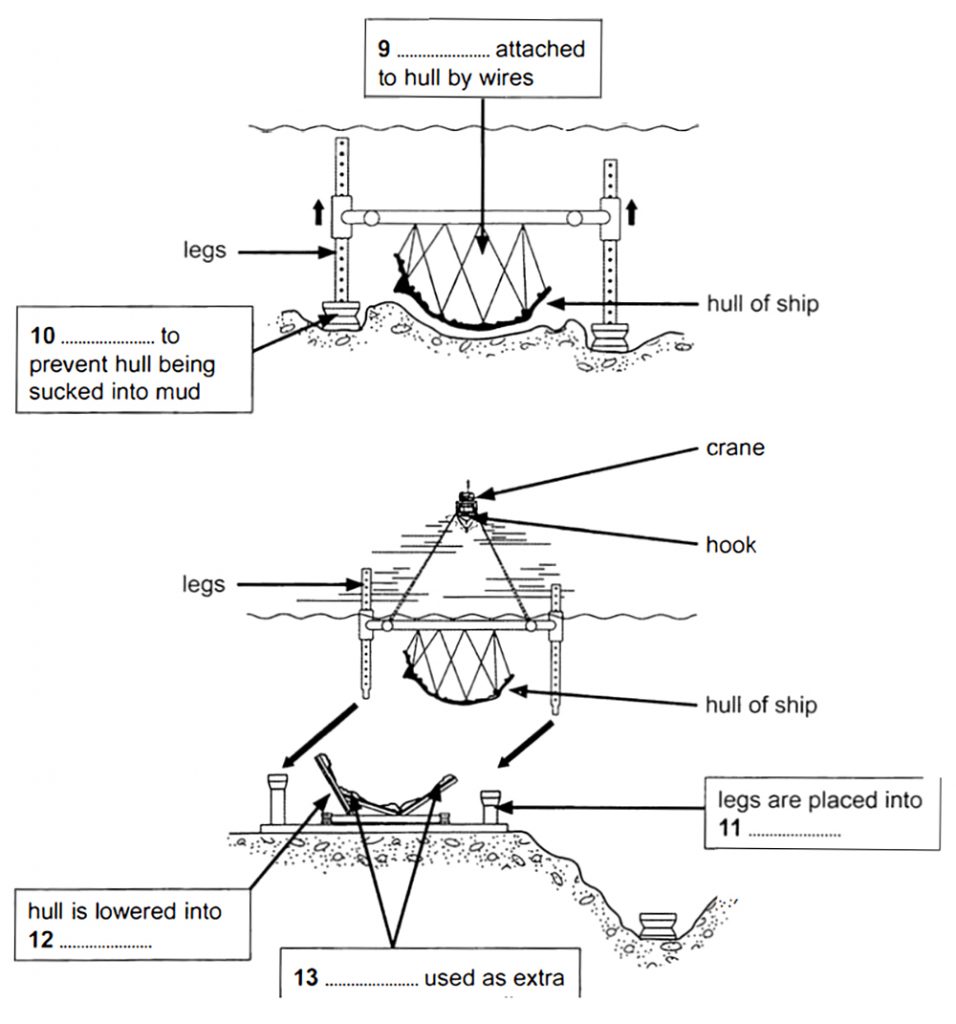
An important factor in trying to salvage the Mary Rose was that the remaining hull was an open shell. This led to an important decision being taken: namely to carry out the lifting operation in three very distinct stages. The hull was attached to a lifting frame via a network of bolts and lifting wires. The problem of the hull being sucked back downwards into the mud was overcome by using 12 hydraulic jacks. These raised it a few centimetres over a period of several days, as the lifting frame rose slowly up its four legs. It was only when the hull was hanging freely from the lifting frame, clear of the seabed and the suction effect of the surrounding mud, that the salvage operation progressed to the second stage. In this stage, the lifting frame was fixed to a hook attached to a crane, and the hull was lifted completely clear of the seabed and transferred underwater into the lifting cradle. This required precise positioning to locate the legs into the stabbing guides’ of the lifting cradle. The lifting cradle was designed to fit the hull using archaeological survey drawings, and was fitted with air bags to provide additional cushioning for the hull’s delicate timber framework. The third and final stage was to lift the entire structure into the air, by which time the hull was also supported from below. Finally, on 11 October 1982, millions of people around the world held their breath as the timber skeleton of the Mary Rose was lifted clear of the water, ready to be returned home to Portsmouth.
Questions
Questions 1–4 True / False / Not Given
Do the following statements agree with the information given in the Reading Passage?
In boxes on your answer sheet, write
TRUE if the statement agrees with the information
FALSE if the statement contradicts the information
NOT GIVEN if there is no information on this
Questions 5–8 Matching Features
Look at the following statements and the list of dates below.
Match each statement with the correct date, A-G.
Write the correct letter, A-G, in boxes on your answer sheet.
List of Dates
A 1836 E 1971
B 1840 F 1979
C 1965 G 1982
D 1967
Questions 9–13 Diagram Labeling
Label the diagram below.
Choose NO MORE THAN TWO WORDS from the passage for each answer.
Write your answers in boxes on your answer sheet.
Raising the hull of the Mary Rose: Stages one and two
Answers & Explanations Summary
| # | Answer | Evidence | Explanation |
|---|---|---|---|
| Q1 | TRUE | Accounts of what happened to the ship vary: while witnesses agree that she was not hit by the French, some maintain that she was outdated, overladen and sailing too low in the water, others that she was mishandled by undisciplined crew. | Excerpt/Passage Explanation: The passage talks about different accounts of what might have caused the Mary Rose to sink. There are differing opinions on whether the ship was outdated, overladen, sailing too low in the water, or mishandled by the crew. Answer Explanation: The answer indicates that there is doubt about what caused the Mary Rose to sink. Reason For Correctness: The correct answer is TRUE because the passage mentions varying accounts of what could have led to the sinking of the Mary Rose, showing that there is indeed doubt about the exact cause. |
| Q2 | NOT GIVEN | Among the English vessels was a warship by the name of Mary Rose. | Excerpt/Passage Explanation: The passage mentions a warship named Mary Rose among the English vessels. Answer Explanation: The answer means that the passage does not provide information about whether the Mary Rose was the only ship to sink in the battle of 19 July 1545. Reason For Correctness: The correct answer is 'NOT GIVEN' because the passage does not specifically mention whether the Mary Rose was the only ship to sink in the battle of 19 July 1545. It only introduces the existence of the warship Mary Rose among the English vessels. |
| Q3 | TRUE | Because of the way the ship sank, nearly all of the starboard half survived intact. | Excerpt/Passage Explanation: The passage says that because of how the ship sank, almost all of one side (starboard half) remained undamaged. Answer Explanation: The answer indicates that most of one side of the Mary Rose was undamaged under the sea. Reason For Correctness: The correct answer is TRUE because it aligns with the information in the excerpt where it is stated that nearly all of the starboard half of the ship survived intact, implying that most of one side of the Mary Rose laid undamaged under the sea. |
| Q4 | FALSE | McKee and his team now knew for certain that they had found the wreck, but were as yet unaware that it also housed a treasure trove of beautifully preserved artefacts. | Excerpt/Passage Explanation: The passage talks about how McKee and his team found a wreck but they didn't know at that time that it contained valuable objects. Answer Explanation: The answer says it's FALSE, which means that the statement mentioning McKee knowing about the valuable historical objects is incorrect. Reason For Correctness: The correct answer is FALSE because the passage clearly states that McKee and his team were unaware that the wreck contained valuable artefacts. Therefore, the statement that McKee knew about the valuable historical objects is not true according to the information provided in the passage. |
| Q5 | C | But in 1965, military historian and amateur diver Alexander McKee, in conjunction with the British Sub-Aqua Club, initiated a project called ‘Solent Ships’. While on paper this was a plan to examine a number of known wrecks in the Solent, what McKee really hoped for was to find the Mary Rose. | Excerpt/Passage Explanation: The passage talks about how in 1965, a historian and diver named Alexander McKee started a project with a diving club called 'Solent Ships'. Although officially the project was about exploring shipwrecks, McKee was secretly wishing to discover the Mary Rose. Answer Explanation: The answer indicates that the search for the Mary Rose was initiated in the year 1965. Reason For Correctness: The correct answer is 'C' because the passage states that in 1965, Alexander McKee, along with the British Sub-Aqua Club, began a project with the underlying intention of finding the Mary Rose shipwreck, aligning perfectly with the event described in the excerpt. |
| Q6 | B | Deane continued diving on the site intermittently until 1840, recovering several more guns, two bows, various timbers, part of a pump and various other small finds. | Excerpt/Passage Explanation: The passage talks about a person diving at the Mary Rose site until 1840 and finding various items like guns, bows, timbers, and other small objects. Answer Explanation: The answer indicates that the person's exploration of the Mary Rose site stopped in 1840. Reason For Correctness: The correct answer is 'B' because the excerpt mentions that Deane continued diving on the site until 1840, which matches the statement that someone's exploration of the Mary Rose site stopped in 1840. |
| Q7 | G | While the original aim was to raise the hull if at all feasible, the operation was not given the go-ahead until January 1982, when all the necessary information was available. | Excerpt/Passage Explanation: The passage talks about a plan to raise the hull of a ship called the Mary Rose. However, despite the initial aim to do so, the operation did not get approval until January 1982 when all the necessary information was ready. Answer Explanation: The answer 'G' corresponds to the year 1982, which is when the operation to raise the hull of the Mary Rose was finally approved. Reason For Correctness: The correct answer is 'G' because in the excerpt, it clearly states that the operation to raise the hull was not given the go-ahead until January 1982, which matches date 'G' in the list provided. |
| Q8 | A | Then, on 16 June 1836, some fishermen in the Solent found that their equipment was caught on an underwater obstruction, which turned out to be the Mary Rose. | Excerpt/Passage Explanation: The passage describes how some fishermen discovered the Mary Rose by accident while fishing in the Solent on June 16, 1836. Answer Explanation: The answer option 'A' corresponds to the statement that mentions the year 1836. Reason For Correctness: The correct answer is 'A' because the excerpt specifically states that the fishermen found the Mary Rose in 1836, matching the provided date list where 'A' represents the year 1836. |
| Q9 | frame / lifting frame | The hull was attached to a lifting frame via a network of bolts and lifting wires. | Excerpt/Passage Explanation: The passage talks about how the hull of the Mary Rose ship was connected to a lifting frame using bolts and wires. Answer Explanation: The answer refers to the structure used to lift the hull of the Mary Rose, which is a frame specifically designed for this lifting process. Reason For Correctness: The correct answer is 'frame' and 'lifting frame' because they directly describe the structure used in the process of raising the hull of the Mary Rose, as mentioned in the excerpt. |
| Q10 | hydraulic jacks | The problem of the hull being sucked back downwards into the mud was overcome by using 12 hydraulic jacks. | Excerpt/Passage Explanation: The passage mentions that a solution to the problem of the hull sinking back into the mud was found using 12 hydraulic jacks. Answer Explanation: The answer refers to a tool or mechanism called hydraulic jacks. Reason For Correctness: The correct answer 'hydraulic jacks' matches with the description in the excerpt, which specifies that hydraulic jacks were employed to raise the hull of the Mary Rose and prevent it from sinking back into the mud. |
| Q11 | stabbing guides | This required precise positioning to locate the legs into the stabbing guides’ of the lifting cradle. | Excerpt/Passage Explanation: The passage talks about how the hull of the Mary Rose was lifted, and it mentions that the legs needed to be placed in a specific location called the 'stabbing guides.' Answer Explanation: The answer refers to guides that help with positioning or inserting something accurately. Reason For Correctness: The correct answer is 'stabbing guides' because they are the specific guides mentioned in the excerpt that were used to position the legs correctly for the lifting process of the Mary Rose's hull. |
| Q12 | cradle / lifting cradle | the hull was lifted completely clear of the seabed and transferred underwater into the lifting cradle. | Excerpt/Passage Explanation: The passage describes how the hull (the bottom part) of a ship called the Mary Rose was lifted completely above the ocean floor and moved underwater into a lifting cradle (a kind of support structure). Answer Explanation: The answer refers to two key stages of the process: 'lifting cradle' indicates the structure used for raising the hull, and 'cradle' implies the equipment for supporting the hull during the lift. Reason For Correctness: The correct answer is accurate because it mentions the lifting equipment ('lifting cradle') and the type of support structure ('cradle') essential in the process of raising the hull of the Mary Rose, as described in the provided excerpt. |
| Q13 | air bags | and was fitted with air bags to provide additional cushioning for the hull’s delicate timber framework. | Excerpt/Passage Explanation: The passage talks about using air bags to protect the delicate timber frame of the hull. Answer Explanation: The answer refers to bags filled with air that are used for cushioning and support. Reason For Correctness: The correct answer is 'air bags' because it directly matches the description in the passage where air bags were mentioned as part of the process to raise the hull of the Mary Rose and protect its delicate timber framing. |