
Seed Vault Guards Resources For The Future - IELTS Reading Answers & Explanations
From IELTS Trainer 1 Academic Reading Test 3 · Part 1 · Questions 1–13
Reading Passage
You should spend about 20 minutes on Questions 1-13, which are based on Reading Passage 1 below.
Seed vault guards resources for the future
About 1,000 km from the North Pole, Svalbard is one of the most remote places on earth. For this reason, it is the site of a vault that will safeguard a priceless component of our common heritage - the seeds of our staple crops. Here, seeds from the world's most vital food crops will be locked away for hundreds or even thousands of years. If something goes wrong in the world, the vault will provide the means to restore farming. We, or our descendants, will not have to retread thousands of years of agriculture from scratch.
Deep in the vault at the end of a long tunnel, are three storage vaults which are lined with insulated panels to help maintain the cold temperatures. Electronic transmitters linked to a satellite system monitor temperature, etc. and pass the information back to the appropriate authorities at Longyearbyen and the Nordic Gene Bank which provide the technical information for managing the seed vaults. The seeds are placed in sealed boxes and stored on shelves in the vaults. The minimal moisture level and low temperature ensure low metabolic activity. The remote location, as well as the rugged structure, provide unparalleled security for the world's agricultural heritage.
The three vaults are buried deep in the hillside. To reach them, it is necessary to proceed down a long and surprisingly large corridor. At 93.3 metres in length, it connects the 26-metre long entrance building to the three vaults, each of which extends a further 27 metres into the mountain. Towards the end of this tunnel, after about 80 metres, there are several small rooms on the right-hand side. One is a transformer room to which only the power company officials have access - this houses the equipment needed to transform the incoming electrical current down to 220 volts. A second is an electrical room housing controls for the compressor and other equipment. The other room is an office which can be heated to provide comfortable working conditions for those who will make an inventory of the samples in and out of the vault.
Anyone seeking access to the seeds has to pass through four locked doors: the heavy steel entrance doors, a second door approximately 90 metres down the tunnel and finally the two keyed doors separated by an airlock, from which it is possible to proceed directly into the seed vaults. Keys are coded to allow access to different levels of the facility.
A work of art will make the vault visible for miles around. The vault entrance is filled with highly reflective sheets of steel and mirrors which form an installation acting as a beacon. It reflects polar light in the summer months, while in the winter, a network of 200 fibre-optic cables will give the piece a muted greenish-turquoise and white light.
Cary Fowler, the mastermind behind the vault, stands inside the echoing cavern. For him, this is the culmination of nearly 30 years of work. 'It's an insurance policy,' he explains, 'a very cheap insurance policy when you consider what we're insuring - the earth's biological diversity.'
Seeds are being brought here from all over the world, from seed banks created by governments, universities and private institutions. Soon, there will be seed varieties from at least 100 crops in the Svalbard vault - extending to examples of all of the 1.5 million known crop seed varieties in the world. If any more are unearthed, either in the wild or found in obscure collections, they can be added, too - the vault has room for at least 4.5 million samples.
Inside the entrance area it is more than 10° C below freezing, but in the chambers where the seeds are kept, refrigerators push down the temperature even further, to -18° C. At this temperature, which will be kept constant to stop the seeds germinating or rotting, the wheat seeds will remain viable for an estimated 1,700 years, the barley for 2,000 years and the sorghum for 20,000 years.
Svalbard's Arctic conditions will keep the seeds cold. In order to maintain the temperature at a constant -10° C to -20° C, the cold Arctic air will be drawn into the vault during the winter, automatically and without human intervention. The surrounding rock will maintain the temperature requirements during the extremely cold season and, during warmer periods, refrigeration equipment will engage. Looking out across the snow-covered mountains of Svalbard, it is hard not to feel respect for the 2,300 or so people who live here, mainly in Longyearbyen, a village a few miles away. There are three months without light in winter.
Svalbard is intended as the seed bank of last resort. Each sample is made up of a few hundred seeds, sealed inside a watertight package which will never be tampered with while it is in the vault. The packages of seeds remain the property of the collections they have come from. Svalbard will disburse samples 'only if all the other seeds in other collections around the world are gone,' explains Fowler. If seeds do have to be given out, those who receive them are expected to germinate them and generate new samples, to be returned to the vault.
Questions
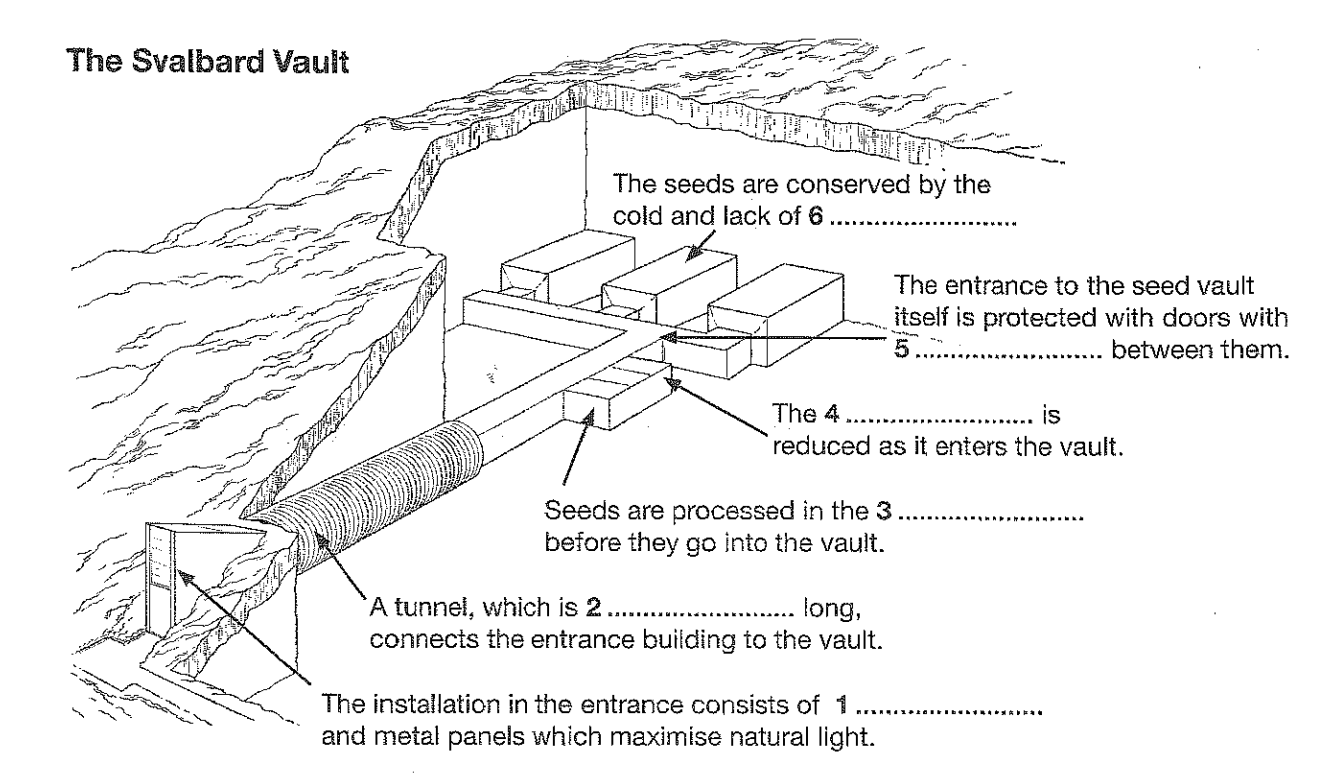
Questions 1–6 Diagram Labeling
Label the diagram below.
Choose NO MORE THAN TWO WORDS OR A NUMBER from the passage for each answer.
Questions 7–13 True / False / Not Given
Do the following statements agree with the information given in Reading Passage 1?
TRUE if the statement agrees with the information
FALSE if the statement contradicts the information
NOT GIVEN if there is no information on this
Answers & Explanations Summary
| # | Answer | Evidence | Explanation |
|---|---|---|---|
| Q1 | mirrors | The vault entrance is filled with highly reflective sheets of steel and mirrors which form an installation acting as a beacon | Excerpt/Passage Explanation: The passage states that the front door of the building has shiny metal and mirrors that create a very bright light so people can see the building from far away. Answer Explanation: The answer means smooth, shiny surfaces that show an image or reflect light back. Reason For Correctness: The correct answer is found in the description of the building's entrance. The passage says there is an art piece that makes the building easy to see from miles away. It says this art is made of reflective steel and mirrors. These parts together act like a beacon, which is a bright light used for signaling. |
| Q2 | 93.3 metres / 93.3 meters | At 93.3 metres in length, it connects the 26-metre long entrance building to the three vaults, each of which extends a further 27 metres into the mountain | Excerpt/Passage Explanation: The passage explains that there is a long hallway. This hallway is 93.3 metres long and it joins the front part of the building to the three storage rooms built into the side of the mountain. Answer Explanation: The answer is the specific length of the long hallway inside the seed vault building. Reason For Correctness: The correct answer is "93.3 metres" because the text describes a long walkway or "corridor" that visitors must walk through. This corridor connects the entrance of the building to the three vaults where the seeds are kept. The passage explicitly states that this hallway is "93.3 metres in length." |
| Q3 | office | The other room is an office which can be heated to provide comfortable working conditions for those who will make an inventory of the samples in and out of the vault | Excerpt/Passage Explanation: The passage explains that there is a room called an office. This room is kept warm so that workers can stay comfortable while they make a list of the seed samples being stored. Answer Explanation: The answer is the word for a room where people do work, such as writing or keeping records. Reason For Correctness: The correct answer is found by looking at the description of the rooms inside the tunnel. The text mentions several small rooms located on the right side of the corridor. It describes a 'transformer room', an 'electrical room', and a third room called an 'office' where people can work in a warm environment while they keep track of the seeds. The word 'inventory' means to make a list or record items, which is a common task in an office. |
| Q4 | electrical current / current | One is a transformer room to which only the power company officials have access - this houses the equipment needed to transform the incoming electrical current down to 220 volts | Excerpt/Passage Explanation: The passage explains that there is a specific room for power equipment. Inside this room, the machines change the power of the incoming electricity (the electrical current) so it reaches 220 volts. Answer Explanation: The answer refers to 'electrical current,' which is simply the flow of electricity that comes into the building. Reason For Correctness: The correct answer is chosen because the passage describes several small rooms near the end of the long tunnel. One of these rooms is the 'transformer room.' Inside this room, there is special equipment used to change or 'transform' the incoming flow of electricity, referred to as the 'electrical current,' to a lower level of 220 volts. |
| Q5 | an airlock | finally the two keyed doors separated by an airlock, from which it is possible to proceed directly into the seed vaults | Excerpt/Passage Explanation: The passage says that the last two doors are divided by a space called an airlock. Once you go through this area, you enter the place where the seeds are kept. Answer Explanation: The answer is a small room or area located between two doors that helps keep the air inside the vault stable and separate from the air outside. Reason For Correctness: The correct answer is found in the section of the text that describes how people get into the vault. It explains that to reach the seeds, a person must go through several doors. Specifically, the last stage involves passing through two doors that have a space called 'an airlock' sitting between them. |
| Q6 | moisture | The minimal moisture level and low temperature ensure low metabolic activity | Excerpt/Passage Explanation: The passage explains that keeping the amount of water in the air very low and the temperature very cold makes sure that the seeds do not start the inner processes required for growth. Answer Explanation: The answer refers to the very small amount of water or dampness found in the air where the seeds are kept. Reason For Correctness: The correct answer is found in the section describing how the seeds are kept alive for a long time. The passage mentions that a 'minimal moisture level' is a key condition, alongside low temperatures, to stop the seeds from being active or growing. This ensures the seeds remain in a 'sleeping' state (low metabolic activity) so they do not die or rot over hundreds of years. |
| Q7 | TRUE | If any more are unearthed, either in the wild or found in obscure collections, they can be added, too - the vault has room for at least 4.5 million samples | Excerpt/Passage Explanation: The passage says that if new types of seeds are discovered later in nature or in hidden collections, they can be put inside because the vault has enough space for 4.5 million different samples. Answer Explanation: The answer means that the storage building is big enough to hold new seeds that might be discovered in the future. Reason For Correctness: The correct answer is TRUE because the passage explains that even if more seeds are found (unearthed) later, they can be placed in the building. It states that there is extra space (room) for at least 4.5 million samples, which is much more than the 1.5 million known crop varieties currently in existence. The word 'unearthed' is used as a synonym for discovered or found, confirming that the vault can handle seeds that are not yet part of the collection. |
| Q8 | FALSE | Inside the entrance area it is more than 10° C below freezing, but in the chambers where the seeds are kept, refrigerators push down the temperature even further, to -18° C. At this temperature, which will be kept constant to stop the seeds germinating or rotting, the wheat seeds will remain viable for an estimated 1,700 years, the barley for 2,000 years and the sorghum for 20,000 years | Excerpt/Passage Explanation: The passage explains that in the rooms where seeds are stored, machines keep the temperature at -18° C. This temperature stays the same for all the different types of crop seeds mentioned. Answer Explanation: The answer is FALSE because the statement is not true. All the seeds in the storage rooms are kept at the same cold temperature. Reason For Correctness: The correct answer is FALSE because the text says that all the seeds are kept at a single constant temperature of -18° C. It mentions that different seeds (like wheat, barley, and sorghum) stay good for different lengths of time at this one temperature. It does not say that the vault uses different levels of coldness for different types of seeds. |
| Q9 | FALSE | In order to maintain the temperature at a constant -10° C to -20° C, the cold Arctic air will be drawn into the vault during the winter, automatically and without human intervention | Excerpt/Passage Explanation: The passage explains that during the winter season, cold air from outside is pulled into the vault to keep it freezing. This happens using a machine or system that works on its own, so people (human intervention) do not need to do anything to make it work. Answer Explanation: The answer is FALSE because staff members do not have to watch or control the air entering the vault; it happens by itself. Reason For Correctness: The correct answer is FALSE because the passage explicitly states that the process of drawing cold Arctic air into the vault during winter occurs 'automatically and without human intervention.' This statement contradicts the idea that workers or staff are needed to regularly monitor or manage the flow of air. |
| Q10 | NOT GIVEN | In order to maintain the temperature at a constant -10° C to -20° C, the cold Arctic air will be drawn into the vault during the winter, automatically and without human intervention. The surrounding rock will maintain the temperature requirements during the extremely cold season and, during warmer periods, refrigeration equipment will engage | Excerpt/Passage Explanation: The passage explains that natural cold air and cooling machines are used to keep the seeds at the right temperature. It describes how the normal system works but does not mention anything about a backup system. Answer Explanation: The answer means that the text does not tell us if there is a second cooling machine ready to start if the first one stops working. Reason For Correctness: The correct answer is NOT GIVEN because while the passage explains how the vault is kept cold using natural air, the surrounding rock, and refrigeration equipment, it never mentions a backup or emergency system for when things go wrong. We know how the temperature is maintained, but the author does not provide information about a spare system being ready for a failure. |
| Q11 | NOT GIVEN | Looking out across the snow-covered mountains of Svalbard, it is hard not to feel respect for the 2,300 or so people who live here, mainly in Longyearbyen, a village a few miles away | Excerpt/Passage Explanation: The passage mentions that a small number of people live in a village near the vault, but it does not say if these people are the ones who work at the seed vault facility. Answer Explanation: The answer means that the passage does not provide enough information to know if the staff members at the vault are from the local area or from somewhere else. Reason For Correctness: The correct answer is NOT GIVEN because, while the text mentions that around 2,300 people live in a nearby village called Longyearbyen, it never states that the employees of the seed vault are chosen from this local population. It mentions that an office exists for people to work in and that certain organizations manage the facility, but it remains silent on the origins or home towns of the actual workers. |
| Q12 | TRUE | Each sample is made up of a few hundred seeds, sealed inside a watertight package which will never be tampered with while it is in the vault | Excerpt/Passage Explanation: The passage explains that every group of seeds is kept inside a special waterproof bag that stays closed and is not touched while it is in the storage room. Answer Explanation: The answer means that once a bag of seeds is placed inside the storage area, it is not opened. Reason For Correctness: The correct answer is TRUE because the text says that the seed samples are kept in closed, waterproof packages. It clearly states that these packages are never disturbed or touched ("never be tampered with") as long as they are kept inside the vault. The vault is a place of last resort, meaning the seeds are only used if all other seeds in the world are lost. |
| Q13 | TRUE | If seeds do have to be given out, those who receive them are expected to germinate them and generate new samples, to be returned to the vault | Excerpt/Passage Explanation: The passage explains that if the vault has to give seeds to people, those people must grow the seeds to make more and then send the new seeds back to the vault. Answer Explanation: The answer means that if a person or organization receives seeds from the Svalbard vault, they are required to grow those seeds and return new ones to the storage facility. Reason For Correctness: The correct answer is TRUE because the passage explicitly states that if seeds are distributed from the vault, the recipients have a responsibility. They are expected to grow the seeds and create new samples to be sent back. This confirms there is an obligation (a duty or requirement) to provide replacements. Key words to look for are 'expected to' (which implies a duty/obligation), 'generate new samples' (to produce more seeds), and 'returned' (to send something back). |