
The Development Of Travel Under The Ocean - IELTS Reading Answers & Explanations
From IELTS Simulation Tests Academic Reading Test 05 · Part 1 · Questions 1–13
Reading Passage
You should spend about 20 minutes on Questions 1–13, which are based on Reading Passage 1 below.
The development of travel under the ocean
For millennia humans have been intrigued by what lies beneath the sea, and although sub-marine travel was attempted from time to time, it did not become commonplace until the middle of last century. Several clever and innovative people had experimented with designs for submersible boats before then, but there was much loss of life and little success.
There had long been use of a primitive diving bell for explorative purposes but it was as a war machine that the submarine came into its own. The first development in the history of American submarines was a small submersible with a hand-cranked screw-like oar and a crew of one. It was built before the American Revolutionary War (1775–1783) but was adapted for use against the British during this war. Although its pilot twice failed to fasten explosive devices to British ships before losing control of his vessel, he escaped harm.
In 1800, an American inventor, Robert Fulton, designed an underwater machine that he called the Nautilus. His version brought in features that can still be found in some modern submarines, notably adjustable diving planes for better underwater manoeuvring, dual systems of propulsion, and a compressed air system that allowed it to stay down for about four hours without surfacing.
Development of submersible vessels lagged a long way behind the continued progress in the design of surface ships until the American Civil War (1861–1865) when both sides tried out various designs. One of those, called the Hunley—named after its financier rather than its inventor—sank twice during training missions with 11 crew members losing their lives including Hunley himself. Notwithstanding these failures, it was commissioned again in 1864 to attack a ship in Charleston Harbor. A torpedo was used to strike and scuttle the ship—a first in naval history—but the submarine never reappeared and once again the whole crew perished. Its potential had been recognised but there still remained the challenge of operating safely under the water.
The US Navy could appreciate the strategic benefits of having submarines in its fleet and held a competition to encourage design and construction of these underwater craft. The inventor, John Holland, won the competition and it was his sixth prototype, the Holland, that the navy bought and added to its fleet in 1900. This submarine was quite different from previous designs. It was propelled by a gasoline engine that turned a propeller while the vessel was on the surface. When it submerged, the engine ran a generator to charge batteries to operate an electric motor. The improved propulsion methods were, unfortunately, highly dangerous. Not only is gasoline flammable and unstable, using it in the restricted environment of a submarine posed quite a hazard for the crewmen. There was another problem too: the batteries were not only heavy, cumbersome and inefficient but they were also extremely volatile.
During the same period as Holland's efforts were being trialled, a German scientist by the name of Rudolf Diesel, created an engine which used a fuel less explosive than gasoline and which could consequently be stored safely. Another advantage was that there was no necessity for an electric spark to ignite the fuel. These safety improvements combined with better fuel economy allowed Diesel engines to power a submarine for longer on the surface; however, batteries were still needed to supply energy for underwater operation.
Although diesel-powered submarines were successful and used by the US Navy for almost 50 years, the search for a single power source carried on. It wasn't long before the concept of nuclear power was realised in Germany and taken up by an American physicist, Ross Gunn, who could envisage its potential in submersibles. A research team was put together to adapt the concept of nuclear power for use in submarines. In effect, modern nuclear submarines have on board a small nuclear power plant which produces a great amount of energy. This is used to heat water and create steam which drives a huge turbine which turns the propeller.
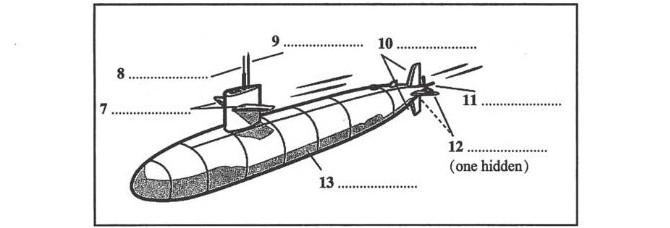
There have been many adaptations and technological improvements made to submarines over the years but the shape is basically the same. Obviously, it is a totally enclosed craft, cigar-shaped with narrowed ends. The outer hull is the largest part of the boat and forms the body. The inner hull is designed to resist the considerable water pressure and insulates the crew from the cold. This is where the crew works, eats and sleeps. It also contains the engine room and the apparatus that makes clean air and clean water. Between the hulls are the ballast tanks for controlling buoyancy. There is a tall fin-shaped sail that comes up out of the hull. Inside the sail is the conning tower and extending from this, to the fore, there is a periscope (through which the captain can see the sea and sky when the submarine is near the surface of the water). Sonar is used for navigation deep below the surface. The other projection from the conning tower is the radio antenna.
Underwater, there are two controls for steering the submarine. The rudder (like a tail fin) controls side-to-side movement and diving planes influence rise and descent. There are two sets of diving planes: the forward sail planes and the stern planes, which are located at the back with the rudder and propeller.
Advancing technology will undoubtedly result in different shapes and modes of operation and it is quite possible that, in the future, submarines will be manned by robots or computer technology that communicates information to land bases via satellite.
Questions
Questions 1–6 Short Answers
Answer the questions below.
Choose NO MORE THAN THREE WORDS OR A NUMBER from the text for each answer.
Questions 7–13 Diagram Labeling
Label the diagram below.
Choose NO MORE THAN TWO WORDS from the text for each answer.
Answers & Explanations Summary
| # | Answer | Evidence | Explanation |
|---|---|---|---|
| Q1 | primitive diving bell / diving bell / a diving bell | There had long been use of a primitive diving bell for explorative purposes but it was as a war machine that the submarine came into its own | Excerpt/Passage Explanation: The passage explains that people used a basic diving bell for a long time to explore underwater before submarines were developed into war vessels. Answer Explanation: The answer refers to an early, simple underwater device shaped like a bell, called a "primitive diving bell" (or "diving bell"). Reason For Correctness: The correct answer is supported by the text in the second paragraph, which states that a "primitive diving bell" was used for "explorative purposes." In the question, "investigate the ocean" matches the passage's idea of "explorative purposes," and "underwater device" corresponds to the "primitive diving bell." |
| Q2 | fasten explosive devices | Although its pilot twice failed to fasten explosive devices to British ships before losing control of his vessel, he escaped harm | Excerpt/Passage Explanation: The passage explains that the driver of the submarine tried two times to attach explosive weapons onto British ships, but he was not successful before losing control of his underwater boat. Answer Explanation: The answer means attaching bombs or explosives to enemy ships. Reason For Correctness: The correct answer is supported by the text, which discusses the first American submarine operated by a single person ("a crew of one"). During his mission against British ships, the pilot attempted two times to attach bombs to the ships before he lost control of the craft. Key words in the question like "crewman" and "first American-built submarine" correspond to "crew of one", "pilot", and "The first development in the history of American submarines". |
| Q3 | compressed air system / compressed air | a compressed air system that allowed it to stay down for about four hours without surfacing | Excerpt/Passage Explanation: The passage states that the Nautilus had an air system with compressed air that let it stay underwater for about four hours without coming up to the surface. Answer Explanation: The answer means a system using stored, tightly squeezed air (compressed air system). Reason For Correctness: The correct answer is supported by the third paragraph of the text. The passage explains that Robert Fulton designed a submarine called the Nautilus. It had a "compressed air system" which enabled the vessel to "stay down for about four hours without surfacing" (meaning it could remain submerged for a long period of time). Therefore, the system that gave it this ability was the "compressed air (system)". |
| Q4 | 1864 | Notwithstanding these failures, it was commissioned again in 1864 to attack a ship in Charleston Harbor. A torpedo was used to strike and scuttle the ship—a first in naval history—but the submarine never reappeared and once again the whole crew perished | Excerpt/Passage Explanation: The passage explains that in the year 1864, a submarine was sent out to attack a boat. It successfully hit and sank the ship, which had never been done before in naval history. Answer Explanation: The answer means the year 1864. Reason For Correctness: The correct answer is 1864 because the passage mentions that in 1864, the submarine *Hunley* attacked a ship in Charleston Harbor. It used a torpedo to "strike and scuttle the ship," which means to hit and sink the ship, marking "a first in naval history." Therefore, 1864 is the year an underwater craft was first used to sink an enemy ship. |
| Q5 | a gasoline engine / gasoline engine / a gasolene engine / gasolene engine / gasoline / gasolene | It was propelled by a gasoline engine that turned a propeller while the vessel was on the surface | Excerpt/Passage Explanation: The passage explains that while floating on the water's surface, the submarine was powered and moved forward by a motor that ran on gasoline. Answer Explanation: The answer refers to the machine or fuel—specifically a gasoline engine or gasoline—used to move the Holland submarine when it was floating on the water's surface. Reason For Correctness: The correct answer is supported by the text where it discusses John Holland's submarine prototype named the Holland. The passage explicitly states that when the boat was on the surface (meaning on top of the water), it was pushed forward or propelled by a gasoline engine. |
| Q6 | less explosive / less volatile | Rudolf Diesel, created an engine which used a fuel less explosive than gasoline and which could consequently be stored safely | Excerpt/Passage Explanation: The passage explains that Rudolf Diesel made an engine running on a type of fuel that was less likely to blow up than gasoline, making it safer to keep on the submarine. Answer Explanation: The answer means that the fuel used in Diesel's engine was not as likely to burst into flames or blow up as gasoline. Reason For Correctness: The correct answer is supported by paragraph 6, which directly compares Diesel's engine with Holland's gasoline-powered design. The text explains that Rudolf Diesel designed an engine using a fuel that was "less explosive than gasoline," meaning it did not catch fire or blow up as easily, and was therefore much safer to store. |
| Q7 | sail planes | There are two sets of diving planes: the forward sail planes and the stern planes, which are located at the back with the rudder and propeller | Excerpt/Passage Explanation: The passage states that submarines have two pairs of diving wings: the front ones called sail planes, and the rear ones called stern planes. Answer Explanation: The answer "sail planes" refers to the front set of wing-like diving planes attached to a submarine's sail (tower) that help control going up and down in the water. Reason For Correctness: The correct answer is confirmed in the ninth paragraph, which describes the submarine's controls. It explains that there are two sets of diving planes used to go up and down underwater: the "sail planes" (located forward on the sail) and the "stern planes" (located at the back). |
| Q8 | a periscope / periscope | Inside the sail is the conning tower and extending from this, to the fore, there is a periscope (through which the captain can see the sea and sky when the submarine is near the surface of the water) | Excerpt/Passage Explanation: The passage explains that sticking out from the front of the conning tower is a periscope, which lets the captain look at the sea and the sky when the submarine is close to the surface. Answer Explanation: The answer refers to a "periscope", which is a long tube-like device with mirrors or lenses that allows someone inside a submarine to look above the water. Reason For Correctness: The correct answer is "periscope" because the text describes the structure on top of the submarine's conning tower. It explicitly mentions that extending forward from the conning tower is a periscope, which enables the captain to see above the surface of the water. |
| Q9 | radio antenna | The other projection from the conning tower is the radio antenna | Excerpt/Passage Explanation: The passage explains that another part sticking out from the top tower of the submarine is the radio antenna. Answer Explanation: The answer "radio antenna" refers to a metal rod or wire on the submarine used for sending and receiving radio signals and communication. Reason For Correctness: The correct answer is "radio antenna" because the text describes the parts extending from the top section of the submarine. In paragraph 8, it mentions the conning tower inside the sail, noting that extending to the front is a periscope, and "the other projection from the conning tower is the radio antenna." Therefore, "radio antenna" correctly identifies this feature in the submarine diagram. |
| Q10 | the rudder / rudder | The rudder (like a tail fin) controls side-to-side movement and diving planes influence rise and descent | Excerpt/Passage Explanation: The passage explains that the rudder acts like a tail fin to guide the submarine left and right, while diving planes help it go up and down. Answer Explanation: The answer "rudder" refers to a flat part shaped like a tail fin located at the rear of a submarine, used for steering it from side to side. Reason For Correctness: The correct answer is "rudder" because the passage describes the different parts used to steer a submarine. It states that underwater, the "rudder (like a tail fin)" is responsible for controlling side-to-side movement, while diving planes control moving up and down. Important keywords to look for include "controls", "steering", and "rudder". |
| Q11 | the propeller / propeller | There are two sets of diving planes: the forward sail planes and the stern planes, which are located at the back with the rudder and propeller | Excerpt/Passage Explanation: The passage explains that the back part of the submarine contains the stern diving planes, the rudder, and the propeller. Answer Explanation: The answer refers to the "propeller", which is the spinning blade at the back of a submarine that pushes it forward through the water. Reason For Correctness: The correct answer is supported by the text's description of the submarine's parts. The passage explains that at the very back (stern) of the submarine, along with the rudder and stern planes, is the "propeller" that turns to move the vessel. |
| Q12 | stern planes | There are two sets of diving planes: the forward sail planes and the stern planes, which are located at the back with the rudder and propeller | Excerpt/Passage Explanation: The passage explains that there are two pairs of diving planes on the submarine. The pair positioned at the back end, near the rudder and propeller, is called the stern planes. Answer Explanation: The answer means "stern planes," which are wing-like parts located at the back of the submarine that help it move up and down in the water. Reason For Correctness: The correct answer is "stern planes" because the text explains the parts used for steering underwater. It mentions that diving planes control rising and descending, and identifies the set "located at the back with the rudder and propeller" specifically as the "stern planes." |
| Q13 | outer hull | The outer hull is the largest part of the boat and forms the body | Excerpt/Passage Explanation: The passage explains that the outside layer or shell, called the outer hull, is the biggest part of the submarine and creates its main structure. Answer Explanation: The answer "outer hull" refers to the outside shell or main exterior structure that forms the body of the submarine. Reason For Correctness: The correct answer is confirmed in the eighth paragraph, where the text describes the parts of a submarine. It states that the "outer hull" is the biggest part of the vessel and makes up its external body. |