
The Rainmaker - IELTS Reading Answers & Explanations
From IELTS Recent Actual Test 2 Academic Reading Test 6 · Part 3 · Questions 27–40
Reading Passage
You should spend about 20 minutes on Questions 27-40 which are based on Reading Passage 3 below.
The Rainmaker
Sometimes ideas just pop up out of the blue. Or in Charlie Paton's case, out of the rain. "I was in a bus in Morocco travelling through the desert," he remembers. "It had been raining and the bus was full of hot, wet people. The windows steamed up and I went to sleep with a towel against the glass. When I woke, the thing was soaking wet. I had to wring it out. And it set me thinking. Why was it so wet?"
The answer, of course, was condensation. Back home in London, a physicist friend, Philip Davies, explained that the glass, chilled by the rain outside, had cooled the hot humid air inside the bus below its dew point, causing droplets of water to form on the inside of the window. Intrigued, Paton — a lighting engineer by profession — started rigging up his own equipment. "I made my own solar stills. It occurred to me that you might be able to produce water in this way in the desert, simply by cooling the air. I wondered whether you could make enough to irrigate fields and grow crops."
Today, a decade on, his dream has taken shape as a giant greenhouse on a desert island off Abu Dhabi in the Persian Gulf — the first commercially viable version of his "seawater greenhouse". Local scientists, working with Paton under a licence from his company Light Works, are watering the desert and growing vegetables in what is basically a giant dew-making machine that produces fresh water and cool air from sun and seawater. In awarding Paton first prize in a design competition two years ago, Marco Goldschmied, president of the Royal Institute of British Architects, called it "a truly original idea which has the potential to impact on the lives of millions of people living in coastal water-starved areas around the world".
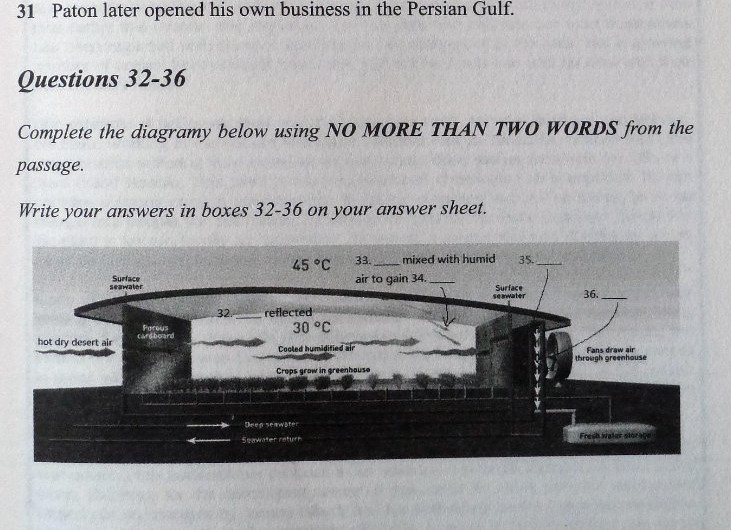
The design has three main parts (see Graphic). The greenhouse faces into the prevailing wind so that hot, dry desert air blows in through the front wall of perforated cardboard, kept wet and cool by a constant trickle of seawater pumped up from the nearby shoreline. The evaporating seawater cools and moistens the air. Last June, for example, when the temperature outside the Abu Dhabi greenhouse was 46 °C, it was in the low 30s inside. While the air outside was dry, the humidity in the greenhouse was 90 per cent. The cool, moist air allows the plants to grow faster, and because much less water evaporates from the leaves their demand for moisture drops dramatically. Paton's crops thrived on a single litre of water per square metre per day, compared to 8 litres if they were growing outside.
The second feature also cools the air for the plants. Paton has constructed a double-layered roof with an outer layer of clear polythene and an inner, coated layer that reflects infrared light. Visible light can stream through to maximise photosynthesis, while heat from the infrared radiation is trapped in the space between the layers, away from the plants.
At the back of the greenhouse sits the third element, the main water-production unit. Just before entering this unit, the humid air of the greenhouse mixes with the hot, dry air from between the two layers of the roof. This means the air can absorb more moisture as it passes through a second moist cardboard wall. Finally, the hot saturated air hits a condenser. This is a metal surface kept cool by still more seawater — the equivalent of the window on Paton's Moroccan bus. Drops of pure distilled water form on the condenser and flow into a tank for irrigating the crops.
The greenhouse more or less runs itself. Sensors switch everything on when the sun rises and alter flows of air and seawater through the day in response to changes in temperature, humidity and sunlight. On windless days, fans ensure a constant flow of air through the greenhouse. "Once it is tuned to the local environment, you don't need anyone there for it to work," says Paton. "We can run the entire operation off one 13-amp plug, and in future we could make it entirely independent of the grid, powered from a few solar panels."
The net effect is to evaporate seawater into hot desert air, then recondense the moisture as fresh water. At the same time, cool moist air flows through the greenhouse to provide ideal conditions for the crops. The key to the seawater greenhouse's potential is its unique combination of desalination and air conditioning. By tapping the power of the sun it can cool as efficiently as a 500-kilowatt air conditioner while using less than 3 kilowatts of electricity. In practice, it evaporates 3000 litres of seawater a day and turns it into about 800 litres of fresh water — just enough to irrigate the plants. The rest is lost as water vapour.
Critics point out that construction costs of £25 per square metre mean the water is twice as expensive as water from a conventional desalination plant. But the comparison is misleading, says Paton. The natural air conditioning in the greenhouse massively increases the value of that water. Because the plants need only an eighth of the water used by those grown conventionally, the effective cost is only a quarter that of water from a standard desalinator. And costs should plummet when mass production begins, he adds.
Best of all, the greenhouses should be environmentally friendly. "I suppose there might be aesthetic objections to large structures on coastal sites," says Harris, "but it is a clean technology and doesn't produce pollution or even large quantities of hot water."
Questions
Questions 27–31 True / False / Not Given
Do the following statements agree with the information given in Reading Passage 3?
Write
TRUE if the statement agrees with the information
FALSE if the statement contradicts the information
NOT GIVEN if there is no information on this
Questions 32–36 Diagram Labeling
Complete the diagram below using NO MORE THAN TWO WORDS from the passage.
Questions 37–40 Summary Completion
Complete the summary below using NO MORE THAN TWO WORDS from the passage.
The greenhouse Paton built is installed with 37 to keep the air flowing if the wind stands still, and it is expected in the future to rely on electricity provided solely by 38. Despite the high construction costs compared to desalination plant, the plants grown in Paton's greenhouse need much less water, and if produced in large quantities the 39 could be reduced remarkably. In addition to all these advantages, it is also 40, because it is clean and pollution free.
Answers & Explanations Summary
| # | Answer | Evidence | Explanation |
|---|---|---|---|
| Q27 | TRUE | Sometimes ideas just pop up out of the blue. Or in Charlie Paton's case, out of the rain. "I was in a bus in Morocco travelling through the desert," he remembers. "It had been raining and the bus was full of hot, wet people. The windows steamed up and I went to sleep with a towel against the glass. When I woke, the thing was soaking wet. I had to wring it out. And it set me thinking. Why was it so wet?" | Excerpt/Passage Explanation: The passage says that ideas can happen suddenly and without a plan, like they come 'out of the blue'. For Charlie Paton, the idea happened while he was on a bus. He fell asleep with a towel against the window, and when he woke up, the towel was very wet. This accidental event made him think about why it happened, which gave him his new idea. Answer Explanation: The answer is TRUE. This means the statement that Paton's idea was an accident is correct. Reason For Correctness: The correct answer is TRUE. The passage starts by saying that sometimes ideas 'just pop up out of the blue', which means they appear unexpectedly or by accident. It then describes how Paton got his idea while on a bus in a desert. A towel he used got soaked with water from the bus window. This accidental event made him think and led to his invention. He was not trying to invent something at that moment; the idea came to him by chance. |
| Q28 | NOT GIVEN | "I was in a bus in Morocco travelling through the desert," he remembers. "It had been raining and the bus was full of hot, wet people. The windows steamed up and I went to sleep with a towel against the glass. When I woke, the thing was soaking wet." | Excerpt/Passage Explanation: The passage says that the bus was crowded with "hot, wet people" after it had been raining. This caused the windows to "steam up," or get foggy with water. The text describes the situation on the bus but it does not give a reason, like broken fans, for why it was so hot and wet inside. Answer Explanation: The answer means the story does not say if the fans on the bus were broken or not. Reason For Correctness: The correct answer is NOT GIVEN because the passage describes the conditions inside the bus—it was hot, full of people, and the windows were foggy. However, it does not say *why* the bus was hot or had poor ventilation. The passage does not mention fans on the bus, so we cannot know if they were broken. |
| Q29 | TRUE | When I woke, the thing was soaking wet | Excerpt/Passage Explanation: The passage says that after Paton woke up from his sleep, the object ('the thing') he had against the window was very wet. The story had just mentioned his towel, so 'the thing' is the towel. 'Soaking wet' means completely full of water. Answer Explanation: The answer is TRUE. This means it is correct that when Paton woke up, he found his towel was very wet. Reason For Correctness: The correct answer is TRUE because the first paragraph tells the story of how Paton got his idea. It says he was on a bus and went to sleep with a towel next to the window. The passage states that when he woke up, the towel ('the thing') was 'soaking wet.' 'Soaking wet' means very wet. Therefore, the statement accurately describes what happened. |
| Q30 | FALSE | Intrigued, Paton — a lighting engineer by profession — started rigging up his own equipment. "I made my own solar stills. It occurred to me that you might be able to produce water in this way in the desert, simply by cooling the air. I wondered whether you could make enough to irrigate fields and grow crops." Today, a decade on, his dream has taken shape as a giant greenhouse on a desert island off Abu Dhabi in the Persian Gulf — the first commercially viable version of his "seawater greenhouse" |
Excerpt/Passage Explanation: The passage first says that Paton started by building his own small equipment ('solar stills') to test his idea. Then, it says that 'a decade on', which means ten years later, his dream became a 'giant greenhouse'. This proves he did not start the big project immediately; there was a ten-year gap. Answer Explanation: The answer is FALSE. This means the statement that Paton began his greenhouse project right after talking to his friend is not true. Reason For Correctness: The correct answer is FALSE because the passage shows that there was a long time between Paton's first small experiments and the final big greenhouse. After talking to his friend, he started making his own small equipment, called 'solar stills'. The large greenhouse project mentioned in the text was built 'a decade on', which means ten years later. |
| Q31 | TRUE | Local scientists, working with Paton under a licence from his company Light Works, are watering the desert and growing vegetables in what is basically a giant dew-making machine that produces fresh water and cool air from sun and seawater | Excerpt/Passage Explanation: The passage says that scientists are working with Mr. Paton. They have a 'licence', which is a type of permission, from 'his company Light Works'. This shows that Paton has a company and it is involved in the project in the Persian Gulf. Answer Explanation: The answer means that the statement is correct. The passage shows that Paton started a business that operates in the Persian Gulf. Reason For Correctness: The correct answer is TRUE because the passage mentions a greenhouse project in Abu Dhabi, which is in the Persian Gulf. It says local scientists are working there with Paton, using a license from 'his company Light Works'. This confirms that his company is doing business in that region. |
| Q32 | Infrared light / infra-red light | Paton has constructed a double-layered roof with an outer layer of clear polythene and an inner, coated layer that reflects infrared light | Excerpt/Passage Explanation: The passage says that the greenhouse has a special roof made of two sheets of plastic. The inner sheet has a special surface that is designed to bounce back 'infrared light', which is a part of sunlight that carries heat. Answer Explanation: The answer, 'Infrared light', is a type of light from the sun that we cannot see, but we can feel it as heat. Reason For Correctness: The correct answer is 'Infrared light' because the passage describes the special roof of the greenhouse. It says the roof has two layers, and the inner layer has a coating that 'reflects infrared light'. This means it bounces this type of light away, which helps to keep the heat out and the plants inside cool. The diagram you are completing likely shows this part of the greenhouse roof. |
| Q33 | Hot dry air | The greenhouse faces into the prevailing wind so that hot, dry desert air blows in through the front wall of perforated cardboard, kept wet and cool by a constant trickle of seawater pumped up from the nearby shoreline | Excerpt/Passage Explanation: The passage says the greenhouse is positioned so that the wind from the desert, which is hot and dry, blows into it through the front wall. Answer Explanation: The answer means the air from outside the greenhouse is warm and has very little water in it. Reason For Correctness: The correct answer is 'Hot dry air' because the passage describes how the greenhouse works. It starts by explaining that air from the desert enters the building. The passage calls this air 'hot, dry desert air', which is exactly what the answer says. |
| Q34 | moisture | This means the air can absorb more moisture as it passes through a second moist cardboard wall | Excerpt/Passage Explanation: The passage says that the air takes in more water, which is called 'moisture', when it goes through a second wet cardboard wall. Answer Explanation: The answer 'moisture' means the wetness or water that is in the air. Reason For Correctness: The correct answer is 'moisture' because the passage explains the steps of how the greenhouse makes fresh water. In one step, the air passes through a second wet wall just before the water production unit. The text says that doing this allows the air to 'absorb more moisture'. This means 'moisture' is what the air takes in at this stage, which is part of the process shown in the diagram. |
| Q35 | Condenser | Finally, the hot saturated air hits a condenser. This is a metal surface kept cool by still more seawater — the equivalent of the window on Paton's Moroccan bus. Drops of pure distilled water form on the condenser and flow into a tank for irrigating the crops | Excerpt/Passage Explanation: The passage says that at the end of the process, the very wet air touches a cold metal part called a 'condenser'. This makes clean water drops appear on the condenser, which are then collected in a tank to water the plants. Answer Explanation: The answer is 'Condenser'. A condenser is a part of a machine that cools down hot, wet air (steam or vapor) to turn it back into liquid water. Reason For Correctness: The correct answer is 'Condenser' because the passage describes the three main parts of the greenhouse. The last part mentioned is the 'main water-production unit'. The text explicitly states that in this unit, the hot, wet air 'hits a condenser' where 'drops of pure distilled water form'. This identifies the condenser as the specific component where water is collected. |
| Q36 | Pure distilled water | Drops of pure distilled water form on the condenser and flow into a tank for irrigating the crops | Excerpt/Passage Explanation: The passage says that small drops of very clean water appear on the condenser. This water then moves into a tank to be used for watering the plants grown in the greenhouse. Answer Explanation: The answer means very clean water that has no salt or other things in it. "Pure" means it is not mixed with anything. "Distilled" means it has been purified by being turned into a gas and then back into a liquid. Reason For Correctness: The correct answer is explained in the paragraph describing the third part of the greenhouse, where water is produced. The passage states that hot, wet air hits a cool metal surface called a condenser. This process makes water droplets form, which the text identifies specifically as 'pure distilled water' that is then collected to water the crops. |
| Q37 | fans | On windless days, fans ensure a constant flow of air through the greenhouse | Excerpt/Passage Explanation: The passage says that when there is no wind ('On windless days'), machines called 'fans' make sure that the air keeps moving ('ensure a constant flow of air') through the special building. Answer Explanation: The answer is 'fans'. Fans are machines with blades that spin to move the air. Reason For Correctness: The correct answer is 'fans' because the summary asks what is used to keep the air moving when the wind is not blowing. The passage says that on 'windless days', which means days with no wind, 'fans' are used to make sure there is a 'constant flow of air' inside the greenhouse. |
| Q38 | solar panels | We can run the entire operation off one 13-amp plug, and in future we could make it entirely independent of the grid, powered from a few solar panels | Excerpt/Passage Explanation: The passage says that in the future, the greenhouse will not need to be connected to the main electricity system. Instead, it can get all the power it needs from a few solar panels. Answer Explanation: The answer means special flat pieces of equipment that use sunlight to create electricity. Reason For Correctness: The correct answer is 'solar panels' because the summary asks what future power source the greenhouse will use. The passage explains that 'in future', the greenhouse could become 'entirely independent of the grid', which means it would not need the main electricity supply. Instead, it would be 'powered from a few solar panels'. This shows that solar panels are the expected future source of electricity. |
| Q39 | costs | And costs should plummet when mass production begins, he adds | Excerpt/Passage Explanation: The passage says that the price or amount of money needed to build the greenhouses ('costs') will go down a lot ('should plummet') when many of them are made at the same time ('when mass production begins'). Answer Explanation: The answer is 'costs'. This means the price or the amount of money needed to build the greenhouse will become lower. Reason For Correctness: The correct answer is 'costs' because the summary sentence says that if the greenhouses are 'produced in large quantities', something 'could be reduced remarkably'. The passage discusses this idea, stating that 'costs should plummet when mass production begins'. 'Mass production' is another way of saying 'produced in large quantities', and 'plummet' means to reduce very quickly or remarkably. Therefore, the 'costs' are what will be reduced. |
| Q40 | environmentally friendly | Best of all, the greenhouses should be environmentally friendly. "I suppose there might be aesthetic objections to large structures on coastal sites," says Harris, "but it is a clean technology and doesn't produce pollution or even large quantities of hot water." | Excerpt/Passage Explanation: The passage says that the best thing about the greenhouses is that they are good for the environment. This is because they use a technology that is clean and does not make any pollution or a lot of hot water. Answer Explanation: The answer 'environmentally friendly' means that something is good for nature and does not harm our planet. Reason For Correctness: The correct answer is 'environmentally friendly' because the sentence in the summary needs a term to describe the greenhouse, explaining that it is 'clean and pollution free'. The last paragraph of the text says that a great advantage of the greenhouses is that they are 'environmentally friendly' and gives the reason why: 'it is a clean technology and doesn't produce pollution'. |