
WALK FOR CHARITY & The Week’s Best - IELTS Reading Answers & Explanations
From Cambridge IELTS 05 General Training Reading Test 2 · Part 1 · Questions 1–14
Reading Passage
Read the information below and answer Questions 1-7.
WALK FOR CHARITY
Dear Friend,
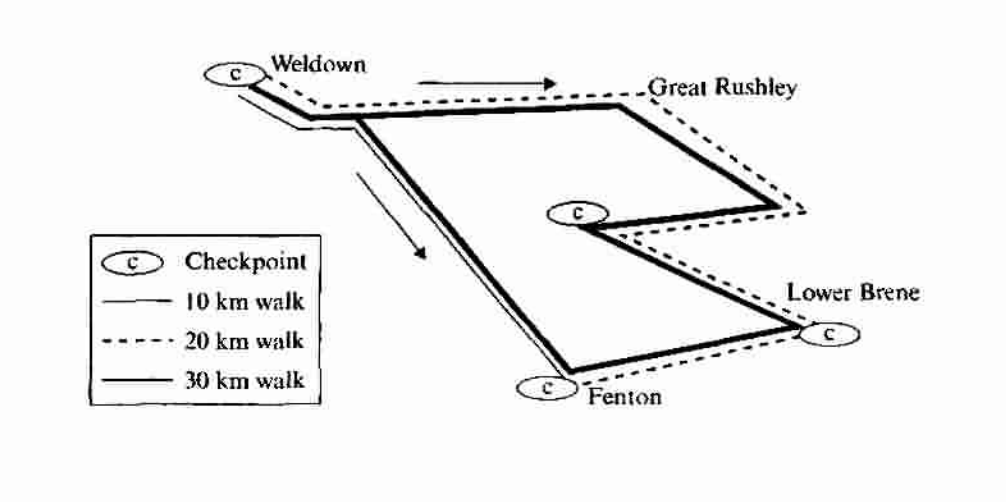
Please join us for our annual Walk for Charity. Starting in Weldown, you and your friends can choose a delightful 10, 20 or 30 kilometre route.
The money raised will provide support to help people all over the world. Start collecting your sponsors now and then simply come along on the day. Please read the instructions below carefully, especially if you require transport to and from Weldown.
See you on Sunday 14 May,
V Jessop
Walk Co-ordinator
P.S. Well done to last year's walkers for helping to raise a grand total of £21,000. The money has already been used to build a children's playground.
START TIMES:
30 km: 8 – 10 am
20 km: 8 – 10.30 am
10 km: 8 – 11.30 am
The organisers reserve the right to refuse late-comers.
CLOTHING should be suitable for the weather. If rain is forecast, bring some protection and be prepared for all eventualities. It is better to wear shoes that have been worn in, rather than ones that are new.
ROUTE MAPS will be available from the registration point. The route will be sign-posted and marshalled. Where the route runs along the road, walkers should keep to one side in single file, facing oncoming traffic at all times. If you need help along the route, please inform one of the marshals.
Free car parking available in car parks and on streets in Weldown.
BUSES
For the 10 and 20 km routes, a bus will be waiting at Fenton to take walkers back to Weldown. The bus will leave every half-hour starting at midday. The service is free and there is no need to book.
______________
Read the information below and answer Questions 8-14.
The Week's Best
A
Wild Rose
(Tuesday 19.00)
This TV drama is about a young private detective employed by a team of New York businessmen who send her to Brazil to look into a series of hotel robberies. When she gets there, she discovers that the hotels, which are owned by the businessmen, have been empty for the last two years and the local authorities have no record of any robberies.
B
Animal Planet
(Wednesday 23.00)
This is a classic black-and-white film from the forties in which astronaut Charlie Huston crash-lands on a planet ruled entirely by animals. It is a first-class suspense adventure which also looks at the human condition, although this is not always a successful part of the film.
C
Strange Encounter
(Saturday 21.00)
Suspense is skilfully built up in this clever, small-scale supernatural story. A young couple view a deserted old house that they are interested in buying. They meet a strange old lady who tells them of the mystical powers of the house and how previous owners have been able to travel back through the centuries to meet their ancestors.
D
The Longest Walk
(Tuesday 21.30)
Ffyona Campbell is nearly there. All she has to do now is walk the length of France and Britain and she has succeeded in walking around the world. Tonight she drinks coffee in a tent and tells her story to Janet Street-Porter before she sets off for the Pyrenees mountains.
E
Rubicon 5
(Thursday 20.30)
This is a TV film being used to launch a new science fiction series. It has impressive special effects and a strong, believable cast of characters who travel to the twenty-third century. The action takes place in underground cities where the environment is controlled by computers.
F
New Science
(Friday 19.30)
This popular half-hour science magazine continues into its twenty-ninth year, proving itself to be a hardy survivor in the television world. Tonight it is presented by Carol Vorderman who introduces five reports, which include computer-driven cars and in-flight ten-pin bowling.
G
There and Back Again
(Sunday 22.00)
Paul Theroux's account of his recent journey from London to Japan and back makes ideal material for this evening's travel slot. Based on his own novel, the progress of his journey on the railways of Europe and Asia (Victoria station, Paris, Istanbul...) acts as a fascinating travelogue as the inhabitants gradually shift from the West to the East.
Questions
Questions 1–7 Short Answers
Look at the information about a walk for charity.
Answer the questions below using NO MORE THAN THREE WORDS AND/OR A NUMBER from the text for each answer.
Questions 8–14 Matching Features
Look at the seven television programmes A–G.
For which programme are the following statements true?
NB You may use any letter more than once.
Answers & Explanations Summary
| # | Answer | Evidence | Explanation |
|---|---|---|---|
| Q1 | Weldown | Starting in Weldown, you and your friends can choose a delightful 10, 20 or 30 kilometre route | Excerpt/Passage Explanation: The passage says that no matter which distance you choose (10, 20, or 30 km), the walk begins in the town of Weldown. Answer Explanation: The answer is the name of the town where the charity walk begins. Reason For Correctness: The correct answer is Weldown because the text states that participants will start their walk in this town. It mentions that you can choose between three different lengths (10, 20, or 30 kilometers), but all of them begin in the same place. The word 'starting' refers to the first point of the route. |
| Q2 | 10.30 am / 10.30 / 10:30 am / 10:30 | 20 km: 8 – 10.30 am | Excerpt/Passage Explanation: The passage shows that for the 20 km distance, walkers must start their journey sometime between 8:00 and 10:30 in the morning. Answer Explanation: The answer means the last possible time you can begin the 20-kilometer walk is 10:30 in the morning. Reason For Correctness: The correct answer is located in the 'START TIMES' section of the text. This section lists specific time windows for each walking distance. For the 20 km route, the time range given is from 8 to 10.30 am, making 10.30 am the latest possible start. |
| Q3 | new shoes | It is better to wear shoes that have been worn in, rather than ones that are new | Excerpt/Passage Explanation: The passage explains that it is a good idea to wear shoes you have used many times before, but it is not a good idea to wear brand new shoes. Answer Explanation: The answer means you should not wear shoes that are brand new and have not been used before. Reason For Correctness: The correct answer is found in the 'CLOTHING' section of the text. This section gives advice on what to wear for the charity walk. It states that it is better to wear shoes that have been 'worn in' (shoes you have already used enough to be comfortable) instead of using 'ones that are new.' Therefore, the text is warning walkers against using new shoes for the event. |
| Q4 | the marshals / marshals | If you need help along the route, please inform one of the marshals | Excerpt/Passage Explanation: The passage says that if a walker has a problem or needs aid while walking the path, they should tell a person called a marshal. Answer Explanation: The answer is the people whose job is to help and watch the walkers during the event. Reason For Correctness: The correct answer is 'marshals' because the text says they are the people working on the route to aid the participants. It mentions that the route is 'marshalled' and specifically tells walkers to talk to one of the 'marshals' if they need 'help'. |
| Q5 | Fenton | For the 10 and 20 km routes, a bus will be waiting at Fenton to take walkers back to Weldown | Excerpt/Passage Explanation: The passage says that for walkers doing the 10 or 20 km paths, there is a bus at Fenton to bring them back home. This means they finish their walk in Fenton. Answer Explanation: The answer is the name of the place where people finish the 20 km walk. Reason For Correctness: The correct answer is Fenton because it is the place where the 10 and 20 km routes end. The text explains that people who finish these walks can get on a bus at Fenton to go back to Weldown, which was the starting point. |
| Q6 | every half hour / every half-hour | The bus will leave every half-hour starting at midday | Excerpt/Passage Explanation: The passage states that the bus departs once during every 30-minute period. Answer Explanation: The answer describes how often the bus travels from the town of Fenton back to Weldown. Reason For Correctness: The correct answer is located in the 'BUSES' section of the text. This section explains that for certain walking routes, a bus service is provided to return people to the start. It specifically states that it departs 'every half-hour'. Frequency refers to the time between events, and 'every half-hour' tells the reader exactly how often the bus comes. |
| Q7 | 10 kilometre walk / 10 kilometre / 10 kilometer walk / 10 kilometer / 10 km walk / 10 km | Starting in Weldown, you and your friends can choose a delightful 10, 20 or 30 kilometre route | Excerpt/Passage Explanation: The passage explains that there are three separate paths of different lengths available for the walk, with 10 kilometres being the shortest of these choices. Answer Explanation: The answer is the 10 kilometre route. Reason For Correctness: The correct answer is the 10 kilometre walk. The text states that participants have three different route lengths to choose from: 10, 20, or 30 kilometres. Because the 10 km route is the shortest option, it covers the least distance and is the only one that does not extend far enough to pass through the location mentioned in the question (Lower Brene). |
| Q8 | D | Tonight she drinks coffee in a tent and tells her story to Janet Street-Porter before she sets off for the Pyrenees mountains | Excerpt/Passage Explanation: The passage says that Ffyona Campbell sits with Janet Street-Porter to share her experiences, which is what happens during an interview. Answer Explanation: The answer is TV programme D, titled The Longest Walk. Reason For Correctness: The correct answer is D because the description of the programme mentions Ffyona Campbell talking to another person, Janet Street-Porter, about her life and journey. When someone "tells her story" to another person in a media setting, it describes the format of a personal interview. |
| Q9 | F | This popular half-hour science magazine continues into its twenty-ninth year, proving itself to be a hardy survivor in the television world. Tonight it is presented by Carol Vorderman who introduces five reports, which include computer-driven cars and in-flight ten-pin bowling | Excerpt/Passage Explanation: The passage explains that this show is a 'science magazine' and that it includes reports on things like 'computer-driven cars,' which are examples of new technology. Answer Explanation: The answer 'F' refers to the television programme titled 'New Science'. Reason For Correctness: The correct answer is 'F' because 'New Science' is described as a 'science magazine' program that presents reports on new inventions and topics. The description mentions 'computer-driven cars,' which is a specific example of 'technological developments' (new and advanced machines). Since a television magazine program provides factual information about a topic, it fits the definition of a documentary. |
| Q10 | C E / C,E / E C / E,C / C and E / E and C | They meet a strange old lady who tells them of the mystical powers of the house and how previous owners have been able to travel back through the centuries to meet their ancestors It has impressive special effects and a strong, believable cast of characters who travel to the twenty-third century |
Excerpt/Passage Explanation: The passage states that in program C, people have used a house's power to go back in time to meet family members from hundreds of years ago. It also says that in program E, the characters move through time to live in a future century. Answer Explanation: The answer identifies that programs C and E are the ones that involve people moving through different periods of history or into the future. Reason For Correctness: The correct answer is programs C and E because both descriptions explicitly mention movement through time. Program C, 'Strange Encounter', describes people who 'travel back through the centuries' to visit the past. Program E, 'Rubicon 5', describes characters who 'travel to the twenty-third century', which is a journey into the future. The other programs focus on current-day mysteries, outer space, physical walking, modern science, or travel across geography rather than time. |
| Q11 | G | Based on his own novel, the progress of his journey on the railways of Europe and Asia (Victoria station, Paris, Istanbul ) acts as a fascinating travelogue as the inhabitants gradually shift from the West to the East |
Excerpt/Passage Explanation: The passage explains that the television show is made using a 'novel' (a book) as the main source of the story. Answer Explanation: The answer G refers to the television programme titled 'There and Back Again'. Reason For Correctness: The correct answer is G because the passage states that this specific programme is 'Based on his own novel'. A 'novel' is a type of book that tells a story. This confirms that the content of the programme comes from a book written by Paul Theroux. |
| Q12 | E | This is a TV film being used to launch a new science fiction series | Excerpt/Passage Explanation: The passage explains that this particular film is intended to start, or introduce, a group of television programs. Answer Explanation: The answer is choice E because it refers to the television program named Rubicon 5. Reason For Correctness: The correct answer is E because the text describes Rubicon 5 as a movie made specifically to begin a new science fiction series. The word 'launch' used in the text means to start or introduce something, and a TV 'series' is a set of programs that follow the same story or theme. |
| Q13 | D G / D,G / G D / G,D / D and G / G and D | Ffyona Campbell is nearly there. All she has to do now is walk the length of France and Britain and she has succeeded in walking around the world Paul Theroux's account of his recent journey from London to Japan and back makes ideal material for this evening's travel slot |
Excerpt/Passage Explanation: The passage shows that Ffyona Campbell is in the middle of a very long walk across different countries and Paul Theroux just finished a trip through Europe and Asia. Answer Explanation: The answer identifies programs D and G as the ones that describe people traveling in the modern world. Reason For Correctness: The correct answer is programs D and G because they both focus on real people making journeys in the present day. Program D features Ffyona Campbell, who is currently "walking around the world." Program G features Paul Theroux and his "recent journey" from London to Japan. Unlike the other options, which involve science fiction, historical films, or imaginary drama, these two focus on contemporary travel across real countries. Key phrases to notice include "walking around the world" and "recent journey," which signify modern-day travel. |
| Q14 | A | This TV drama is about a young private detective employed by a team of New York businessmen who send her to Brazil to look into a series of hotel robberies | Excerpt/Passage Explanation: The passage explains that this show is about a detective who goes to Brazil to find information about many reported hotel robberies. Answer Explanation: The answer means that the TV show 'Wild Rose' (Program A) tells a story about someone trying to find the truth about a possible crime. Reason For Correctness: The correct answer is A because the description for 'Wild Rose' says the main character is a 'private detective'. A detective is a person whose job is to investigate or find out about crimes. The text also says she was sent to 'look into' a series of 'hotel robberies'. The phrase 'look into' is a synonym for 'investigate', and 'robberies' are a type of crime. |