The Cambridge IELTS Academic series uses authentic past papers from the official exam creators, making it the most reliable way to practice. Because the material closely matches the real Academic exam in format, logic, and difficulty, it is the best category to start with if you want a true exam experience.
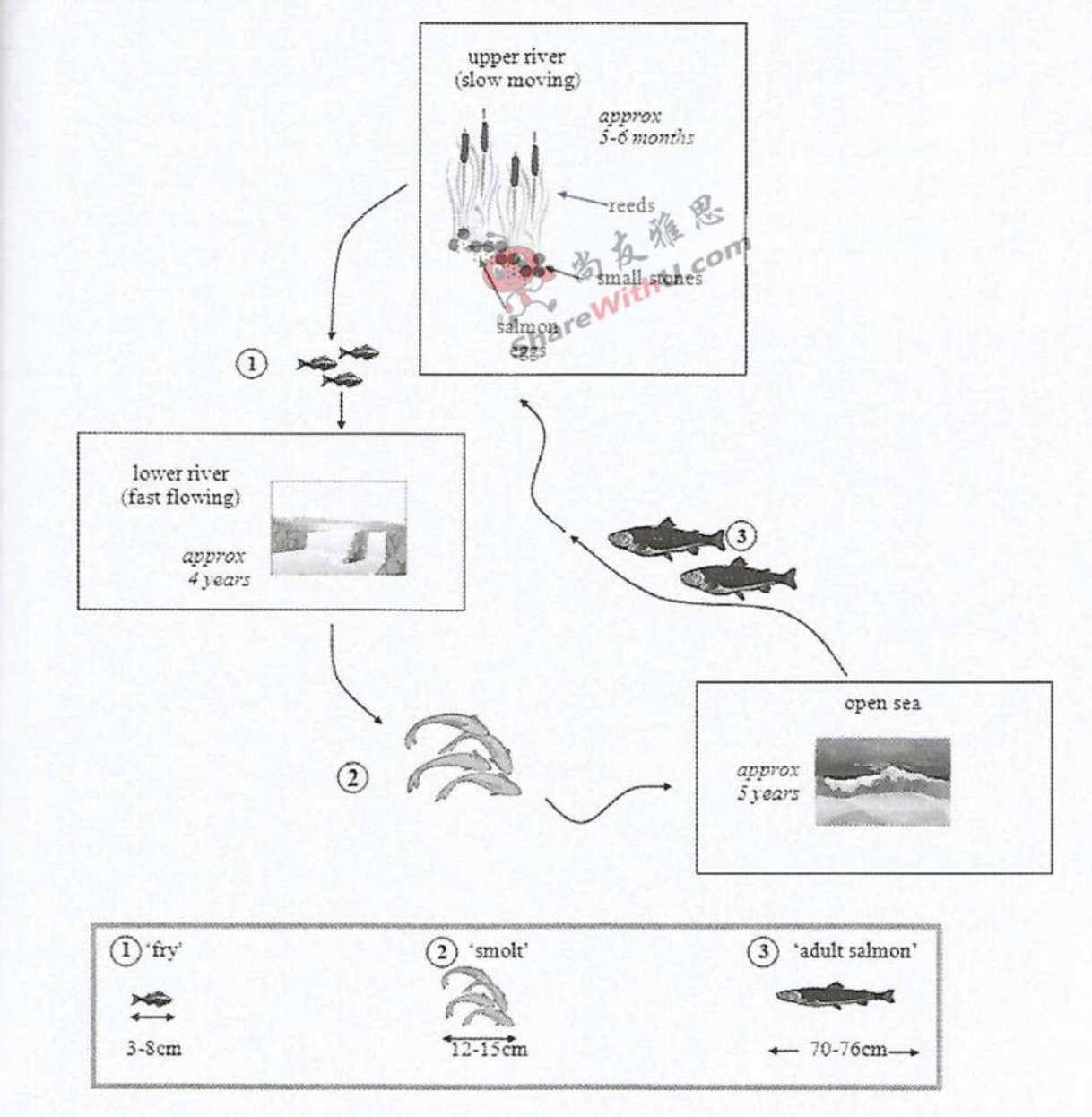
The two diagrams illustrate the life cycle of a species of large fish known as the salmon.
Overall, the life cycle of salmon consists of three stages before the ultimate maturation of the fish. Firstly, eggs are laid in slow-moving rivers, then salmon are generated. Next, they live in the lower river with faster flowing water, subsequently going to the open sea. By the end of the cycle, salmon reach maturity and restart the process again.
Initially, the cycle begins with salmon laying eggs in reeds that lie in small stones, where they spend approximately 5-6 months. Afterward, due to the hatching of eggs, a fry appears, which lives in the lower river, adapting to faster flowing water and spending an estimated duration of four years. Then, fry turn into smolt, which prefer to spend their existence in the open sea for 5 years. Finally, smolt achieve maturation and become adult salmon, consequently recreating the life cycle of salmon again.
The diagram illustrates the developmental stages of the salmon, a large species of fish, tracing its journey from an egg to a fully-grown adult.
The life cycle is a cyclical process that takes approximately 9 to 10 years to complete. It involves three distinct stages of physical growth and habitat changes: starting in the slow-moving upper river, moving to the fast-flowing lower river, and finally maturing in the open sea before returning to their birthplace to spawn.
The cycle begins in the upper river, where the water moves slowly. Eggs are laid among reeds and small stones and remain there for 5 to 6 months before hatching. Once hatched, the fish are known as ”fry,” measuring between 3 and 8 cm in length.
The fry migrate to the lower river, where the current is fast-flowing. They live in this environment for 4 years, growing significantly into “smolt,” which reach a length of 12 to 15 cm. The final stage occurs in the open sea, where the smolt spend approximately 5 years.
During this period, they grow into adult salmon, reaching their full size of 70 to 76cm. After reaching maturity, these adults travel back to the same upper river areas to lay eggs, thereby restarting the entire cycle.
7.0
The graphics show the life cycle of salmon, beginning from unhatched eggs to mature fish across different environments.
Overall, each stages involves this kind of fish how the length changes and what the transitions of the survival places, from the silent upper river to the dynamic lower river and salty expansive sea.
In the first stage, adult salmon hatches salmon eggs in the upper river, surrounding with small stones and reeds. These eggs stay in the slow-moving water, approximate 5-6 months. When the eggs are crashed, the 3-8 cm little fish, called “fry”, appear in the upper river. In next stage, these fries flood to the lower river. They live in the fast-flowing water and stay here around 4 years. After a time period, the fry grow up to 12-15 cm length, termed “smolt”. These smolts move to the open sea as a new live environment. In the third stage, the smolts wait for about 5 years and then become full-mature, which is called “adult salmon”, measuring 70-76cm. Finally, these mature salmon swim back to the upper river and find somewhere to lay egg for hatching.
This diagram illustrates the life cycle of large fish called by salmon.
Overall,it clearly shows that there three type of fish.This shows three stage of fish where they are living.
first fish type is called by fry.salmon eggs got layed by near small stones and reeds.it take 5 to 6 six months to hatch the eggs.after they born they known as fry. they are growing up to 3-8 cms.its also layed on upper rivers beacuse water is slowly moving thats why salmon layed eggs on that side.
After the egg hatch they will come towrd to lower river.they called by smolt.their length is 12-15 cm.they are bigger than frys.smolt will live their approximtly 4 years.They will leave river and smolt will go to open sea.
Finally they will grown adults.adult salmon length will be 70-76 cms.they will live in sea like approximtly 5 years.After that adults salmon find their partner and go back to upper river and they will layed the eggs near stones.
my band was like 4
what should i do to improve my band score?should i attention to my grammar.
The diagrams illustrate the various stages of the life cycle of a salmon, which is a species of large fish.
Overall, this is a natural process consisting of three stages, following a cyclical sequence, beginning with young fish called fry, and reaching adult salmon of larger size before continuing the next life cycle again.
In initial stage, the young fish of size 3-8 cm are produced from eggs in slow-moving water, after 5-6 months of laying eggs. This tiny fish then moves towards the lower river where water flows with fast speed, and spends approximately 4 years. When their size reaches 12-15 cm, they migrate toward the open sea, and they become adults after spending around 5 years and reaching a size of 70-76 cm.
After reaching adulthood, the salmons become able to give eggs and continue the cycle. For this, they travel toward the upper river where water speed is slow, better for egg protection. They give eggs in small stones and reeds and incubate for approximately 5-6 months, before young fish hatch.
7 band
The diagram illustrates the stages of development that a salmon fish passes through during its lifetime.
Overall, salmon go through three main stages during their life cycle, beginning as fry in rivers, growing into smolt as they migrate downstream, and eventually becoming adult salmon after spending several years in the open sea.
In the first stage, salmon eggs are laid among reeds and small stones in the upper river, where the water is slow-moving. After around five to six months, the eggs hatch, producing small fry that measure between 3 and 8 centimeters in length. These young salmon then migrate to the lower river, a fast-flowing environment, where they continue to grow for approximately four years until they reach a size of 12 to 15 centimeters and develop into smolt.
Once they have become smolt, the fish move into the open sea, where they remain for about five years. During this period, they grow substantially, reaching an adult size of 70 to 76 centimeters. After maturing in the marine environment, the adult salmon return to the upper river to spawn, completing the life cycle.
Band 8.5
The diagram illustrates the life cycle of the salmon, a species of fish, which consists of three distinct stages.
In the first stage, salmon begin their life in the slow-moving upper river as eggs, which eventually hatch into small fry. This process takes approximately five to six months, and the fry typically measure between 3 and 8 cm in length.
During the second stage of their life cycle, these fry migrate to the faster-flowing lower river. They remain there for about four years, growing into smolts that reach a length of 12 to 13 cm.
In the final stage of the cycle, smolts migrate to the open sea, where they spend around five years. At this stage, adult salmon usually measure between 70 and 76 cm in length. Eventually, they either continue their journey to spawn, or lay eggs, thus initiating the life cycle all over again.
In summary, the salmon life cycle consists of three main stages: fry, smolt, and adult salmon, with the entire process taking approximately 12 to 13 years.
The given picture illustrates the life cycle of the salmon, a large fish.
Overall, there are three main life cycle stages of this species, starting with a salmon egg and ending with an adult salmon. Throughout the cycle, they change their shape three times.
The cycle begins in the upper river area, where the water moves slowly. Adult salmon deposit their eggs next to small stones and reeds. The eggs should stay there for approximately 5 to 6 months. The hatched eggs become fry and grow from 3 to 8 cm long. After becoming fry, they move from the upper river to the lower river, where the water flows faster. The fry live there for nearly 4 years.
After completing 4 years, they become what is called smolt, with a width of 12 to 15 cm. As smolt, they relocate to the open sea and spend 5 years there. After 5 years, they transform from smolt to adult salmon, with a length of 70 to 76 cm. Next, the cycle starts again with salmon eggs, and the same process happens again.
The diagrams outline various stages of the life cycle of salmon, a common large fish species, from birth to maturity.
Overall, it can be seen that salmon have an average lifespan of nine years and their life cycle consists of four main stages: egg, fry, smolt and adult. While the first three stages occur in freshwater, the last stage takes place in saltwater.
The life cycle begins with salmon laying eggs at the base of reeds, generally in upper rivers where water flow moves slowly. After approximately 5 to 6 months, fry appear and they are usually 3-8 centimeters long. The fry move to lower rivers with faster water current and they grow into smolt which are usually 12-15 centimeters long.
In the following stage, smolt move to the open ocean and after spending approximately five years in saltwater, they finally turn into adult salmon whose length is usually between 70 and 76 centimeters. Then the process commences again.
The given diagram displays information about the life cycle of the most famous species of large fish, namely the salmon.
In the picture, it shows the first development of this fish; in this stage it is called ‘fry’. It measures 3–4 centimeters and lives in fast-flowing water, particularly in lower rivers, for 4 years. The following 5 years, it grows into 12-15 centimeters and lives in the open sea, labeled as ‘smolt’. 12
Moreover, the adult salmon stays in the same habitat for the same duration and grows more to 70–76 centimeters. Finally, the adult salmon produces its eggs, and lays them in small tones under the reeds located in the upper river, for 5–6 months.
In conclusion, the diagram shows the amazing life cycle, lifespan (approximately 10 years), size changes, and habitats of the most beneficial creatures in the world.
You will need a Premium plan to perform your action!
Note: If you already have a premium account, please log in to access our services as usual.
Plans & Pricing
Our mission is to make quality education accessible for everyone. However, to keep our hardworking team running and this service alive, we genuinely need your support! By opting for a premium plan, not only do you sustain us in achieving the mission, but you also unlock advanced features to enrich your learning experience.
For those serious about advancing their English proficiency, and for IELTS candidates aspiring to boost their band score by 1-2 points (especially in writing & speaking) in just 30 days or less
What's included on Premium
Save Your IELTS Test Progress
Unlock All Courses & IELTS Tests
Unlimited AI Conversations
Unlimited AI Writing Enhancement Exercises
Unlimited IELTS Writing Task 1 & 2 Evaluation
Unlimited IELTS Speaking Part 1, 2, & 3 Evaluation
Due to the nature of our service and the provided free trials, payments are non-refundable.
Nếu bạn là người Việt Nam và không có hoặc không muốn trả bằng credit/debit cards, bạn có thể thanh toán bằng phương thức chuyển khoản:
Chọn gói:
419,000₫277,000 ₫ cho gói 1 tháng(chỉ 9,233₫/ngày)
1,239,000₫597,000 ₫ cho gói 3 tháng(chỉ 6,633₫/ngày)
2,469,000₫1,027,000 ₫ cho gói 6 tháng(chỉ 5,706₫/ngày)
4,929,000₫1,417,000 ₫ cho gói 12 tháng(chỉ 3,936₫/ngày)
Sau khi chuyển khoản, vui lòng đợi trình duyệt tự động điều hướng bạn trở lại Engnovate và bạn sẽ ngay lập tức nhận được mã kích hoạt tài khoản premium.


8.5 example
The two diagrams illustrate the life cycle of a species of large fish known as the salmon.
Overall, the life cycle of salmon consists of three stages before the ultimate maturation of the fish. Firstly, eggs are laid in slow-moving rivers, then salmon are generated. Next, they live in the lower river with faster flowing water, subsequently going to the open sea. By the end of the cycle, salmon reach maturity and restart the process again.
Initially, the cycle begins with salmon laying eggs in reeds that lie in small stones, where they spend approximately 5-6 months. Afterward, due to the hatching of eggs, a fry appears, which lives in the lower river, adapting to faster flowing water and spending an estimated duration of four years. Then, fry turn into smolt, which prefer to spend their existence in the open sea for 5 years. Finally, smolt achieve maturation and become adult salmon, consequently recreating the life cycle of salmon again.
The diagram illustrates the developmental stages of the salmon, a large species of fish, tracing its journey from an egg to a fully-grown adult.
The life cycle is a cyclical process that takes approximately 9 to 10 years to complete. It involves three distinct stages of physical growth and habitat changes: starting in the slow-moving upper river, moving to the fast-flowing lower river, and finally maturing in the open sea before returning to their birthplace to spawn.
The cycle begins in the upper river, where the water moves slowly. Eggs are laid among reeds and small stones and remain there for 5 to 6 months before hatching. Once hatched, the fish are known as ”fry,” measuring between 3 and 8 cm in length.
The fry migrate to the lower river, where the current is fast-flowing. They live in this environment for 4 years, growing significantly into “smolt,” which reach a length of 12 to 15 cm. The final stage occurs in the open sea, where the smolt spend approximately 5 years.
During this period, they grow into adult salmon, reaching their full size of 70 to 76cm. After reaching maturity, these adults travel back to the same upper river areas to lay eggs, thereby restarting the entire cycle.
8.0
7.0
The graphics show the life cycle of salmon, beginning from unhatched eggs to mature fish across different environments.
Overall, each stages involves this kind of fish how the length changes and what the transitions of the survival places, from the silent upper river to the dynamic lower river and salty expansive sea.
In the first stage, adult salmon hatches salmon eggs in the upper river, surrounding with small stones and reeds. These eggs stay in the slow-moving water, approximate 5-6 months. When the eggs are crashed, the 3-8 cm little fish, called “fry”, appear in the upper river. In next stage, these fries flood to the lower river. They live in the fast-flowing water and stay here around 4 years. After a time period, the fry grow up to 12-15 cm length, termed “smolt”. These smolts move to the open sea as a new live environment. In the third stage, the smolts wait for about 5 years and then become full-mature, which is called “adult salmon”, measuring 70-76cm. Finally, these mature salmon swim back to the upper river and find somewhere to lay egg for hatching.
This diagram illustrates the life cycle of large fish called by salmon.
Overall,it clearly shows that there three type of fish.This shows three stage of fish where they are living.
first fish type is called by fry.salmon eggs got layed by near small stones and reeds.it take 5 to 6 six months to hatch the eggs.after they born they known as fry. they are growing up to 3-8 cms.its also layed on upper rivers beacuse water is slowly moving thats why salmon layed eggs on that side.
After the egg hatch they will come towrd to lower river.they called by smolt.their length is 12-15 cm.they are bigger than frys.smolt will live their approximtly 4 years.They will leave river and smolt will go to open sea.
Finally they will grown adults.adult salmon length will be 70-76 cms.they will live in sea like approximtly 5 years.After that adults salmon find their partner and go back to upper river and they will layed the eggs near stones.
my band was like 4
what should i do to improve my band score?should i attention to my grammar.
The diagrams illustrate the various stages of the life cycle of a salmon, which is a species of large fish.
Overall, this is a natural process consisting of three stages, following a cyclical sequence, beginning with young fish called fry, and reaching adult salmon of larger size before continuing the next life cycle again.
In initial stage, the young fish of size 3-8 cm are produced from eggs in slow-moving water, after 5-6 months of laying eggs. This tiny fish then moves towards the lower river where water flows with fast speed, and spends approximately 4 years. When their size reaches 12-15 cm, they migrate toward the open sea, and they become adults after spending around 5 years and reaching a size of 70-76 cm.
After reaching adulthood, the salmons become able to give eggs and continue the cycle. For this, they travel toward the upper river where water speed is slow, better for egg protection. They give eggs in small stones and reeds and incubate for approximately 5-6 months, before young fish hatch.
7 band
The diagram illustrates the stages of development that a salmon fish passes through during its lifetime.
Overall, salmon go through three main stages during their life cycle, beginning as fry in rivers, growing into smolt as they migrate downstream, and eventually becoming adult salmon after spending several years in the open sea.
In the first stage, salmon eggs are laid among reeds and small stones in the upper river, where the water is slow-moving. After around five to six months, the eggs hatch, producing small fry that measure between 3 and 8 centimeters in length. These young salmon then migrate to the lower river, a fast-flowing environment, where they continue to grow for approximately four years until they reach a size of 12 to 15 centimeters and develop into smolt.
Once they have become smolt, the fish move into the open sea, where they remain for about five years. During this period, they grow substantially, reaching an adult size of 70 to 76 centimeters. After maturing in the marine environment, the adult salmon return to the upper river to spawn, completing the life cycle.
Band 8.5
The diagram illustrates the life cycle of the salmon, a species of fish, which consists of three distinct stages.
In the first stage, salmon begin their life in the slow-moving upper river as eggs, which eventually hatch into small fry. This process takes approximately five to six months, and the fry typically measure between 3 and 8 cm in length.
During the second stage of their life cycle, these fry migrate to the faster-flowing lower river. They remain there for about four years, growing into smolts that reach a length of 12 to 13 cm.
In the final stage of the cycle, smolts migrate to the open sea, where they spend around five years. At this stage, adult salmon usually measure between 70 and 76 cm in length. Eventually, they either continue their journey to spawn, or lay eggs, thus initiating the life cycle all over again.
In summary, the salmon life cycle consists of three main stages: fry, smolt, and adult salmon, with the entire process taking approximately 12 to 13 years.
The given picture illustrates the life cycle of the salmon, a large fish.
Overall, there are three main life cycle stages of this species, starting with a salmon egg and ending with an adult salmon. Throughout the cycle, they change their shape three times.
The cycle begins in the upper river area, where the water moves slowly. Adult salmon deposit their eggs next to small stones and reeds. The eggs should stay there for approximately 5 to 6 months. The hatched eggs become fry and grow from 3 to 8 cm long. After becoming fry, they move from the upper river to the lower river, where the water flows faster. The fry live there for nearly 4 years.
After completing 4 years, they become what is called smolt, with a width of 12 to 15 cm. As smolt, they relocate to the open sea and spend 5 years there. After 5 years, they transform from smolt to adult salmon, with a length of 70 to 76 cm. Next, the cycle starts again with salmon eggs, and the same process happens again.
Band 8
The diagrams outline various stages of the life cycle of salmon, a common large fish species, from birth to maturity.
Overall, it can be seen that salmon have an average lifespan of nine years and their life cycle consists of four main stages: egg, fry, smolt and adult. While the first three stages occur in freshwater, the last stage takes place in saltwater.
The life cycle begins with salmon laying eggs at the base of reeds, generally in upper rivers where water flow moves slowly. After approximately 5 to 6 months, fry appear and they are usually 3-8 centimeters long. The fry move to lower rivers with faster water current and they grow into smolt which are usually 12-15 centimeters long.
In the following stage, smolt move to the open ocean and after spending approximately five years in saltwater, they finally turn into adult salmon whose length is usually between 70 and 76 centimeters. Then the process commences again.
The given diagram displays information about the life cycle of the most famous species of large fish, namely the salmon.
In the picture, it shows the first development of this fish; in this stage it is called ‘fry’. It measures 3–4 centimeters and lives in fast-flowing water, particularly in lower rivers, for 4 years. The following 5 years, it grows into 12-15 centimeters and lives in the open sea, labeled as ‘smolt’. 12
Moreover, the adult salmon stays in the same habitat for the same duration and grows more to 70–76 centimeters. Finally, the adult salmon produces its eggs, and lays them in small tones under the reeds located in the upper river, for 5–6 months.
In conclusion, the diagram shows the amazing life cycle, lifespan (approximately 10 years), size changes, and habitats of the most beneficial creatures in the world.