Our system will evaluate the answer based on this AI-generated description.
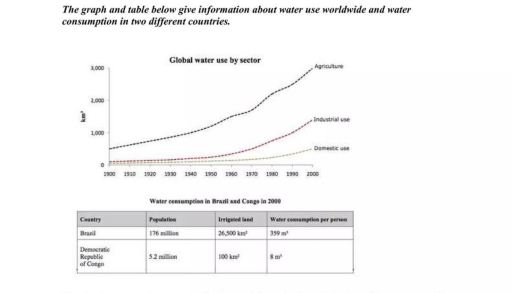
The image presents a line graph titled "Global water use by sector" and a table for "Water consumption in Brazil and Congo in 2000". The graph, with a y-axis in km³ and an x-axis from 1900 to 2000, shows water use for three sectors. Agriculture water use (km³) was approximately: 1900-500, 1910-600, 1920-700, 1930-800, 1940-1000, 1950-1200, 1960-1500, 1970-1800, 1980-2200, 1990-2600, 2000-3000. Industrial use (km³): 1900-50, 1910-60, 1920-80, 1930-100, 1940-150, 1950-200, 1960-400, 1970-600, 1980-800, 1990-1100, 2000-1400. Domestic use (km³): 1900-20, 1910-30, 1920-40, 1930-50, 1940-60, 1950-100, 1960-150, 1970-200, 1980-250, 1990-350, 2000-500. The table for the year 2000 shows for Brazil: a population of 176 million, 26,500 km² of irrigated land, and 359 m³ water consumption per person. For the Democratic Republic of Congo: a population of 5.2 million, 100 km² of irrigated land, and 8 m³ water consumption per person.
Given the complexity of the image, the above description may not be entirely accurate.
Skyrocket your IELTS band score by 1-2 points in under a month with our premium plan!
Note: Both the topic and the answer were created by one of our users.
The graph and the table represent findings about both use of water around the globe and its consumption in Brazil and Congo.
Overall, it is evident that significant amounts of water were used in the agriculture sector. In contrast, the domestic sector experienced the lowest water use. In addition, Brazil outpaced Congo in water consumption, showing the highest results in 2020.
To begin with, the agriculture sector underwent a crucial growth in water consumption, from approximately 500 square kilometers in 1900 to more than 1000 square kilometers in 2020. Both the industrial and the domestic sectors remained unchanged for a prolonged period of time (about 60 years). Nonetheless, in 1960-ishs the industrial sector increased significantly and reached around 1000 square kilometers of water use by 2000, while the domestic sector peaked at around 500 square kilometers.
Brazil population in comparison to Congo’s was 176 million people, while in Congo there were 5.2 million people. Subsequently, irrigated lands in Brazil were composed of 26.500 square kilometers versus 100 square kilometers in Congo. Consequently, water use was significantly higher in Brazil rather than in Congo, and reached 359 cubic meters and 8 cubic meters respectively.
Word Count: 193
