Our system will evaluate the answer based on this AI-generated description.
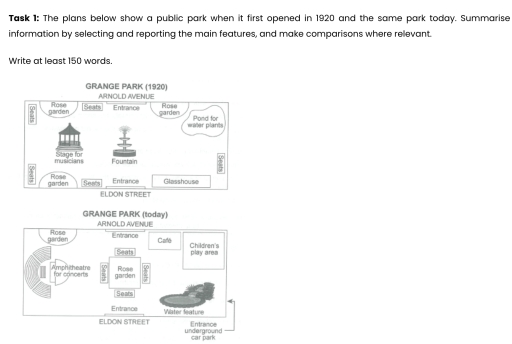
The image displays two plans of Grange Park, one from 1920 and another from the present day. The 1920 plan features entrances on both Eldon Street and Arnold Avenue, a central fountain, a stage for musicians positioned on the west side, a glasshouse located in the southeast corner, rose gardens flanking the stage area and to the north of the fountain, seats along the northern and southern sides, and a pond dedicated to water plants in the northeast sector. The current plan maintains the two main entrances but adds a new entrance from an underground car park, replaces the stage with an amphitheater for concerts, substitutes the glasshouse with a water feature, introduces a cafe northwest of the Eldon Street entrance, and removes the pond entirely, replacing it with a children's play area. Seating areas persist, albeit differently arranged, while the original arrangement of rose gardens remains additional components have been integrated into the park’s layout.
Given the complexity of the image, the above description may not be entirely accurate.
Skyrocket your IELTS band score by 1-2 points in under a month with our premium plan!
Note: Both the topic and the answer were created by one of our users.
The provided plans illustrate the transformation of Grange Park from the year 1920 to the present day.
Overall, the park has undergone notable enhancements, including the replacement of a rose garden and the introduction of a new amphitheater for concerts, while certain features have remained unchanged, such as the entrances.
In 1920, Grange Park was characterized by a single fountain which was placed in the center of the park. Furthermore, the east side consisted of many special places, such as a pond for water plants and a glasshouse; moreover, this area also had seats for individuals and a rose garden. In addition, the west side had two rose gardens and a stage for musicians, plus seats for viewers.
At present, the east side has experienced essential development; for instance, the rose garden was replaced with a new café, and the pond was removed, then the empty area has been transformed into a children’s play area. Likewise, in the center area, the fountain was substituted with a rose garden which is surrounded by seats. Additionally, on the west side, the stage was transformed into an amphitheater for concerts, and all the old seats had been removed.
Word Count: 195
