Our system will evaluate the answer based on this AI-generated description.
The image presents a bar chart comparing the number of houses built per year in two cities, Derby and Nottingham, from 2000 to 2009. In 2000, Derby had about 100 houses built, while Nottingham had about 50. In 2001, the number of houses built in Derby was just over 50, and Nottingham also built about 50 houses. Derby's numbers increased to almost 100 in 2002, whereas Nottingham's construction dropped below 50. 2003 shows a rise for both cities, with Derby reaching 150 houses and Nottingham surpassing 50. From 2004 to 2006, Derby's construction fluctuated around 150 houses annually, while Nottingham steadily increased from about 50 to nearly 150. In 2007, Derby built about 175 houses, Nottingham slightly fewer than 150. The year 2008 exhibited a significant increase in construction activity, Derby reaching about 200 houses, and Nottingham seeing an impressive jump to approximately 350 houses. The final year, 2009, Derby maintained around 200 houses, while Nottingham slightly decreased its construction to around 300 houses.
Given the complexity of the image, the above description may not be entirely accurate.
Skyrocket your IELTS band score by 1-2 points in under a month with our premium plan!
Note: Both the topic and the answer were created by one of our users.
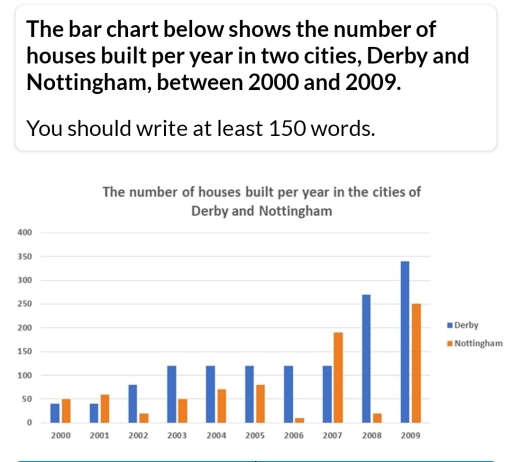
The graph illustrates the amounts of houses built per year in two UK cities (Derby, Nottingham) from 2000 to 2009.
Overall, it can be seen that the rate for both cities saw an upward trend over the period. While the number of houses in Derby almost stayed the same, there was greater fluctuations in Nottingham.
In 2000, the number of newly built houses in Derby was just under 50 and steadily increased overtime to reach over 100 houses in 2003. This figure then stayed constant for 4 years, between 2003 and 2007, until it dramatically increased to over 250 houses in 2008 and reached it’s peak of nearly 350 houses by the end of the period.
However, the figures for houses built in Nottingham followed rather a different pattern. Between 2000 and 2005 the rate fluctuated around 50 houses, before dropping to almost 0 in 2006. A large increase of approximately 200 houses can be seen in 2007, until it dropped again to around 0 in 2008. However, the figure then surged to 250 houses in 2009.
Word Count: 177
