Our system will evaluate the answer based on this AI-generated description.
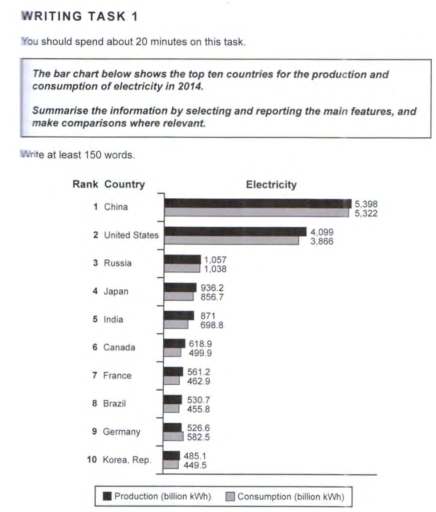
The image presents a bar chart with the top ten countries for production and consumption of electricity in 2014, ranking from 1 to 10. The chart has two different types of bars representing production (billion kWh) and consumption (billion kWh) for each country. For China, production is at 5,398 and consumption is at 5,322. For the United States, production is at 4,089 and consumption is at 3,866. Russia's production is at 1,057 and consumption is at 1,038. Japan has a production of 936.2 and a consumption of 856.7. India's production is at 871 and consumption is at 818.8. Canada has a production of 618.9 and consumption of 499.9. France's production is at 562.2 and consumption is at 461.9. Brazil has a production of 530.7 and consumption of 455.8. Germany's production is at 526.6 and consumption is at 582.5. Lastly, the Republic of Korea has a production of 485.1 and consumption of 449.5.
Given the complexity of the image, the above description may not be entirely accurate.
Skyrocket your IELTS band score by 1-2 points in under a month with our premium plan!
Note: Both the topic and the answer were created by one of our users.
The bar chart presents data on the top ten countries for electricity production and consumption in 2014, measured in billion kilowatt-hours (kWh). Overall, production and consumption levels are closely matched in most countries, with China and the United States leading significantly.
China was the largest producer and consumer, generating approximately 5,398 billion kWh and consuming slightly less at 5,322 billion kWh. The United States ranked second, with production and consumption figures around 4,099 billion kWh and 3,866 billion kWh, respectively. Other countries, such as India, Russia, and Japan, followed, with figures significantly lower but still notable, ranging between 1,000 and 1,500 billion kWh for both production and consumption.
In contrast, countries like Germany and South Korea had more balanced levels, with minor differences between their electricity production and consumption. Notably, Brazil and Canada also exhibited similar trends but at lower volumes compared to the top-ranking nations.
In summary, the chart highlights China’s and the United States’ dominance in electricity generation and usage, while other nations show relatively lower but balanced figures.
Word Count: 171
