Our system will evaluate the answer based on this AI-generated description.
The image shows a bar chart titled "People who ate five portions of fruit and vegetables per day" with three categories: Men, Women, and Children, represented over the years 2001 to 2008. The percentage of men who ate five portions ranged from just over 20% in 2001, dipping to just below 20% in 2002, rising to about 25% in 2003, falling slightly in 2004, then increasing steadily to just over 25% in 2005, just under 30% in 2006, just over 30% in 2007, and reaching almost 35% in 2008. The percentage of women was consistently the highest, starting at just under 30% in 2001, rising to just over 30% in 2002, increasing sharply to nearly 35% in 2003, dropping slightly in 2004, then jumping to almost 40% in 2005, falling back to just over 35% in 2006, rising to nearly 40% again in 2007, and reaching 40% in 2008. The percentage of children eating five portions started at just over 10% in 2001, increased to about 15% in 2002, remained stable in 2003, rose to just over 20% in 2004, dropped back to just under 20% in 2005, increased to about 25% in 2006, remained stable in 2007, and rose to just under 30% in 2008.
Given the complexity of the image, the above description may not be entirely accurate.
Skyrocket your IELTS band score by 1-2 points in under a month with our premium plan!
Note: Both the topic and the answer were created by one of our users.
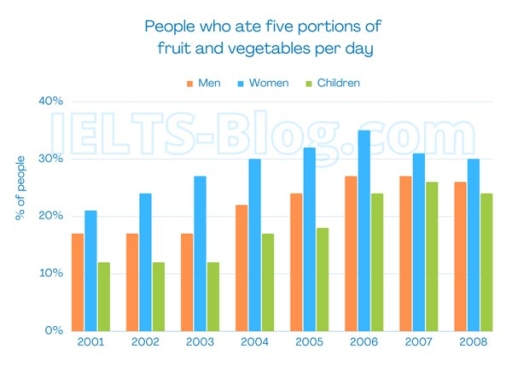
The provided bar chart illustrates the proportion of individuals consuming five particular portions of fruits and vegetables on a daily basis in the United Kingdom over the interval of 8 years since 2001.
From an overall perspective, it is evident that the most significant of the figure for people having five sections of fruits and vegetables can be seen in women over the survey time while there was the fewest in children in 3 years period from 2001 to 2003. In addition, the biggest difference was witnessed in the ratio of men, women, kids consuming in 2003
To be more specific, the percentage of men and children eating 5 sections of fruits and vegetables experienced exactly equal rates at roughly 18% and 12% meanwhile women grew slightly from about 21% to 27% from 2001 to 2003. However, in 3 years period since 2004, there was a minimal rise from 22% to 27% and 17% to 24% in men and youths rates respectively and a moderate rocket to over 36% in women rate.
It is worth noticing that there was a marginal ascend to 27% in kids rate in 2007 followed by a slight decline at 24% in 2008. Moreover, men and women rates exhibited a marked drop to 27% and 30% respectively at the end of the surveyed time.
Word Count: 219
