Our system will evaluate the answer based on this AI-generated description.
The image presents two line graphs; the first graph shows the number of whales killed from 1950 to 1985 with categories: blue whales (1950: 8000, 1955: 6000, 1960: 5000, 1965: 4000, 1970: 3000, 1975: 0, 1980: 0, 1985: 0), fin whales (1950: 24000, 1955: 30000, 1960: 34000, 1965: 10000, 1970: 20000, 1975: 10000, 1980: 2000, 1985: 0), sperm whales (1950: 10000, 1955: 17000, 1960: 20000, 1965: 30000, 1970: 20000, 1975: 10000, 1980: 1000, 1985: 0), sei whales (1950: 3000, 1955: 4000, 1960: 10000, 1965: 9000, 1970: 12000, 1975: 10000, 1980: 3000, 1985: 0); the second graph details the number of seals killed from 1950 to 1985 with categories: harp seals (1950: 100000, 1955: 80000, 1960: 50000, 1965: 30000, 1970: 40000, 1975: 30000, 1980: 20000, 1985: 10000), hooded seals (1950: 50000, 1955: 30000, 1960: 20000, 1965: 10000, 1970: 20000, 1975: 10000, 1980: 50000).
Given the complexity of the image, the above description may not be entirely accurate.
Skyrocket your IELTS band score by 1-2 points in under a month with our premium plan!
Note: Both the topic and the answer were created by one of our users.
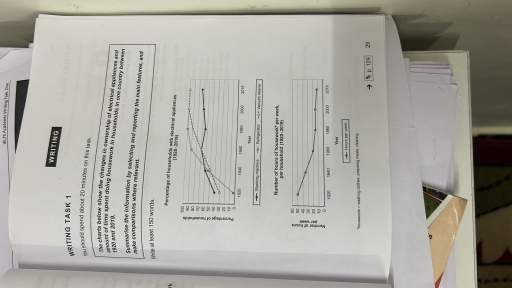
The graph above illustrates the changes in the amount of time spent on housework and the ownership of electrical appliances in households within a single country over a span of one hundred years, from 1920 to 2019.
In summary, there has been a significant increase in the number of household appliances from 1920 to 2019, while the time spent on household tasks has decreased to just 10 hours per week.
The first graph indicates that the ownership of household appliances, such as washing machines, refrigerators, and vacuum cleaners, has risen dramatically from 1920 to 2019. In 1920, only 30% of households owned washing machines and 40% had vacuum cleaners, with no households possessing refrigerators at all.
Regarding housework in 1920, individuals were spending more hours completing their tasks. However, as time progressed, the rise in the availability of electrical appliances led to a notable reduction in time spent on household chores. By 2019, 100% of households owned both refrigerators and vacuum cleaners, and 75% had washing machines. The increase in appliances has contributed to a decrease in the hours required for housework.
Word Count: 182
