Our system will evaluate the answer based on this AI-generated description.
The image contains two sections: "Expenditure on fast foods by income groups" displayed as a bar chart, and "Consumption of fast foods 1970 - 1990" illustrated as line graphs. The bar chart shows expenditure on hamburgers, fish and chips, and pizza by high, average, and low-income groups, with high income spending the most on hamburgers (~44 pence per week) and pizza (~30 pence per week), and average income spending the most on fish and chips (~18 pence per week). The low-income group spends less in all categories, with ~20 pence on hamburgers, ~12 pence on fish and chips, and ~10 pence on pizza. The line graphs depict the consumption trends of hamburgers, fish and chips, and pizza over two decades, with hamburger consumption increasing from ~0 grams in 1970 to ~500 grams by 1990, fish and chips starting at ~300 grams in 1970 and declining to ~200 grams by 1990, and pizza consumption starting at ~0 grams in 1970 and rising to ~300 grams by 1990.
Given the complexity of the image, the above description may not be entirely accurate.
Skyrocket your IELTS band score by 1-2 points in under a month with our premium plan!
Note: Both the topic and the answer were created by one of our users.
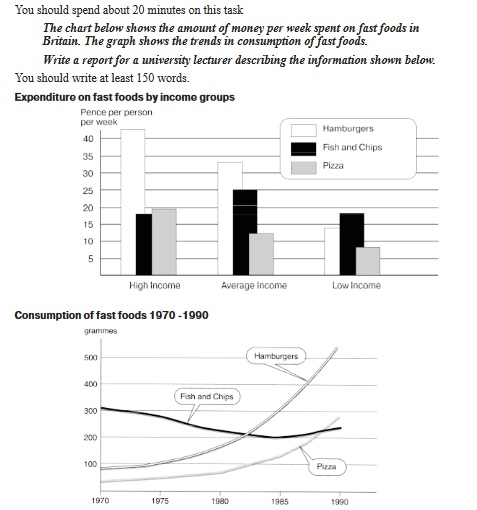
The given graphs depict fast food expenditure in Britain based on income groups and how fast food consumption has changed over time.
In the provided bar chart we can see that fish and chips are the most popular food with low income class but its vice versa for the high earners who prefer to spend more money on hamburgers. Average earners also follow high earners in spending most money on hamburgers but unlike them their least bought fast food is pizza a trait they share with low earning class.
Following the bar chart we are presented with a line chart that displays the consumption of fast food has been on climb between 1970 and 1990 thanks to a steady increase in hamburger and pizza consumption, whereas fish and chips, even though they started as the most popular back in the 70s, they started gradually declining in popularity and only in 1985 they started getting some rhythm back.
Word Count: 157
