🔥 Today Only: Save 30% on Premium — Offer Ends Soon! - Upgrade Now!
Bar Chart

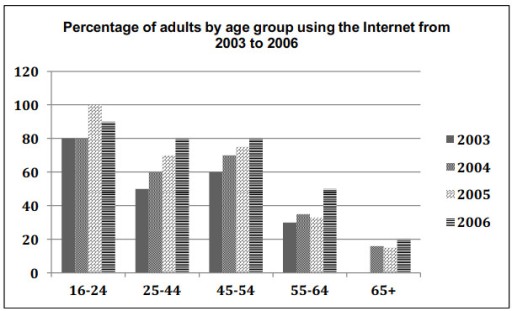
Band 6+: the chart below shows the percentage of adults of different age groups in the uk who used the internet everyday from 2003 to 2006

Image for topic: the chart below shows the percentage of adults of different age groups in the uk who used the internet everyday from 2003 to 2006
Our system will evaluate the answer based on this AI-generated description.
The image depicts a bar graph showing the percentage of adults using the internet from 2003 to 2006, categorized by age group. For 16-24 age group, the percentages are around 110% for 2003, 115% for 2004, 105% for 2005, and 100% for 2006. For 25-44 age group, percentages are 80% for 2003, 85% for 2004, 80% for 2005, and 75% for 2006. For 45-54 age group, percentages are 70% for 2003, 65% for 2004, 60% for 2005, and 50% for 2006. For 55-64 age group, percentages are 40% for 2003, 45% for 2004, 40% for 2005, and 27% for 2006. For the 65+ age group, percentages are 20% for 2003, 25% for 2004, 20% for 2005, and 17% for 2006. The graph highlights a decline in internet usage across all age groups from 2003 to 2006, with the highest percentages observed in the 16-24 age group, followed by the 25-44, 45-54, 55-64, and the lowest in the 65+ age group.
Given the complexity of the image, the above description may not be entirely accurate.
Note: Both the topic and the answer were created by one of our users.

The bar chart illustrates the proportion of British individuals who accessed the Internet daily according to different age groups between 2003 and 2006.

Overall, it is evident that people from 16 to 24 years old had the highest rate of using the internet, while the over 65 years old group accessed the internet least. Moreover, the year 2006 was the period when citizens in the UK used the internet most.

To begin with, the young generation ranging from 16 to 24 years old had the largest percentage of accessing the internet and reached its peak at 100% in 2005, followed by the 25-44 and 45-54 aged groups, which both had the slight equivalent development. They experienced an upward trend in using the internet over a 4-year period from 2003 to 2006 and had the same proportion at 80% in 2006.

The two remaining categories which were the 55-64 and 65 and more aged groups had the lowest percentage shown on the chart. Additionally, the group 55-64 years old fluctuated and reached its peak at 50% in 2006. Finally, the similar tendency shown in the group 65 and over years old, peaked at 20% in 2006, with no data recorded in 2003.

Word Count: 201

Answers On The Same Topic:

the chart below shows the percentage of adults of different age groups in the uk who used the internet everyday from 2003 to 2006

The bar chart illustrates the percentage of adults in the UK who used the Internet daily between 2003 and 2006, divided into six age groups. Overall, it is evident that younger age groups consistently had a higher proportion of daily internet users compared to older ones. The 16-24 age group had the highest usage across […]

the chart below shows the percentage of adults of different age groups in the uk who used the internet everyday from 2003 to 2006

The bar chart illustrates the percentage of internet users across different age groups in the UK in 2003 and 2006. The figures are presented in percentages. Overall, it is evident that the 16-24 age group consistently had the highest proportion of internet users, while those aged 65 and over had the lowest. Most other age […]

the chart below shows the percentage of adults of different age groups in the uk who used the internet everyday from 2003 to 2006

The bar chart illustrates data on the rates of Internet usage from 2003 to 2006 among five age cohorts in the UK. Overall, what stands out from the graph is that all age categories showed an upward trend during the given period, with the highest percentage of users among 16- to 24-year-olds, while the elderly […]

the chart below shows the percentage of adults of different age groups in the uk who used the internet everyday from 2003 to 2006

The bar chart illustrates the proportion of adult daily Internet users across five different age groups in the UK from 2003 to 2006. Overall, Internet usage increased significantly among all the age groups during this period, with the 25-44 age group showing the most substantial growth. While the 65 and older demographic consistently represented the […]

the chart below shows the percentage of adults of different age groups in the uk who used the internet everyday from 2003 to 2006

The bar chart compares the proportions of daily Internet users across five distinct age brackets in the UK between 2003 and 2006. Overall, the Internet became more prevalent across all of these age groups throughout the period surveyed. While the figure for elderly people over 65 established itself as the smallest Internet users group, the […]

See All

Other Topics:

Total number of british cruise passenger by age in year of 1975 and 2003.

The bar graph illustrates information about britain cruise passengers by age between 1975 and 2003. Overall, the percentage for passenger of different age-groups increased considerably throughout the period, although the figure for passenger over 64 experienced a shaper rise. Comapared with 1975, the figure was significantly higher in 2003. The passenger age of 24, which […]

The chart below shows the number of graduate students applying for jobs in different sectors after finishing an undergraduate degree at a UK university in 2015 and 2025 and the predicted figure for 2035

The bar chart presents the quantity of UK students applying for jobs in education, retail, finance, and I.T. sectors after graduation in the years 2015 and 2025 and estimate for 2035. On the whole, between 2015 and 2025, there was a downward trend in undergraduates applying for jobs Education and Retail, and an increase in […]

The bar chart shows expectations for change of European young people in the next 20 years in five different areas.

The provided chart shows expectations for changes among European adults in the next 20 years in five different areas. Overall, there are certain areas that will improve in the future. Health and water quality are moderate. However, air quality will need to improve. We also expect that food quality and people’s communication will improve in […]

The chart below shows the percentages ofdifferent types of householdwaste that were recycled in one city between 1992 and 2002. Summarise the information by selecting and reporting the main featuresand make comparisons where relevant. Write at least 150 words.

The bar chart illustrated proportions of household waste-glass,paper,cans,plastic recycled in a single city from 1992 to 2002. Looking from overall perspective,it’s clear that in glass is most recycled material each year and plastic is least recycled material,while cans are recovered by the end of the period. In 1992,glass the figure was approximately 15 percentage recycled […]

World Production The bar graph shows the total manufacturing production in percentages Asia, Europe, and the rest of the world.

The bar chart elucidates the information from 1840 to 2000 the total number of percentages of manufacturing production in three distinctive continents Asia,Europe and remaining world Considering from an overall perspective,it can be comprehensively observed that the production among rest of the world subtracting Asia and Europe grows rapidly in the following years. However,Asia and […]

The chart below shows the places visited by different places living in Australia.

The chart depicts the destinations visited by various groups of people living in Australia. Overall, it is clear that cinema was mostly visited and preferred among most groups, whereas theatre turned out to be less desirable. Regarding the most popular entertainment options, the Library saw the highest rates of attendance for new migrants born in […]

See All
We have detected unusual activity on your device.
Please verify your identity to continue.
Note: This verification step won't sign you in. If you have a premium account, please log in to access the service as usual.
Google/Gmail Verification
Or verify using Email/Code
We've sent a verification code to:
youremail@gmail.com (Not your email?)
Enter it below to complete the verification process.
Ensure your email address is correct, your inbox is not full, and you check your spam folder. If no email arrives, consider using an alternative email.
You will need a Premium plan to perform your action!
Note: If you already have a premium account, please log in to access our services as usual.

Plans & Pricing

Our mission is to make quality education accessible for everyone.
However, to keep our hardworking team running and this service alive, we genuinely need your support!
By opting for a premium plan, not only do you sustain us in achieving the mission, but you also unlock advanced features to enrich your learning experience.

Free

For learners who aren't pressed for time

What's included on Free
100+ Cambridge IELTS Tests
Instant IELTS Writing Task 1 & 2 Evaluation (2 times/month)
Instant IELTS Speaking Part 1, 2, & 3 Evaluation (2 times/month)
Instant IELTS Writing Task 1 & 2 Essay Generator (2 times/month)
500+ Dictation & Shadowing Exercises
100+ Pronunciation Exercises
Flashcards
Other Advanced Tools

Premium

For those serious about advancing their English proficiency, and for IELTS candidates aspiring to boost their band score by 1-2 points (especially in writing & speaking) in just 30 days or less

What's included on Premium
Save Your IELTS Test Progress & Analyze Mistakes By Question Type
Save Your Own Flashcard Sets & Use Them On Any Device
Unlock All Courses, IELTS Tests, Section & Part Practice
Unlimited AI Conversations
Unlimited AI Writing Enhancement Exercises
Unlimited IELTS Writing Task 1 & 2 Evaluation
Unlimited IELTS Speaking Part 1, 2, & 3 Evaluation
Checked Answers Will Not Be Published
Unlimited IELTS Writing Task 1 & 2 Essay Generator
Unlimited IELTS Speaking Part 1, 2, & 3 Sample Generator
Unlimited Usage Of Advanced Tools & AI Features
Priority Support within 24h (12-month plan only)

Due to the nature of our service and the provided free trials, payments are non-refundable.