Our system will evaluate the answer based on this AI-generated description.
The image is a bar chart displaying the percentage of people who ate five portions of fruit and vegetables per day in the UK from 2001 to 2008, categorized by men, women, and children. In 2001, men were at approximately 22%, women at 25%, and children at 11%. In 2002, men increased to around 23%, women to 26%, and children remained consistent at 11%. 2003 saw a slight decrease for men to about 22.5%, women to 25.5%, and children to 10%. By 2004, men rose to nearly 24%, women to approximately 27%, and children declined to around 9%. In 2005, men reached around 25%, women approximately 29%, and children decreased to 8%. Men had an increase to about 26% in 2006, while women surged to 30% and children to 9%. The year 2007 witnessed men at 27%, women maintaining at 30%, and children at 11%. Lastly, 2008 data indicates men at around 26%, women decreasing to just below 30%, and children increasing to 12%.
Given the complexity of the image, the above description may not be entirely accurate.
Skyrocket your IELTS band score by 1-2 points in under a month with our premium plan!
Note: Both the topic and the answer were created by one of our users.
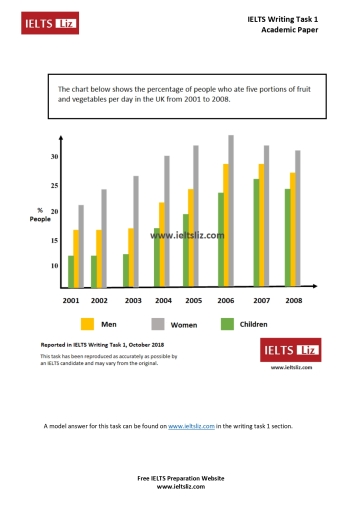
The bar chart illustrates the percentage of men, women, and children in the UK who consumed five portions of fruit and vegetables per day between 2001 and 2008.
Overall, women consistently consumed the highest proportion of fruit and vegetables, whereas children ate the least. All groups showed a general upward trend until 2006, after which their figures declined slightly towards the end of the period.
For women, the highest proportion was recorded in 2006, when over 30% consumed five portions per day. This figure then declined slightly in 2007 and 2008, a trend that was also observed among men and children, though at much lower levels throughout the timeframe.
For both men and children, the proportions stayed under 20% from 2001 to 2003. Their figures then increased steadily until 2006, when men peaked at around 26% and children at just under 20%, before both groups experienced a slight decline in the subsequent two years.
Word Count: 154
